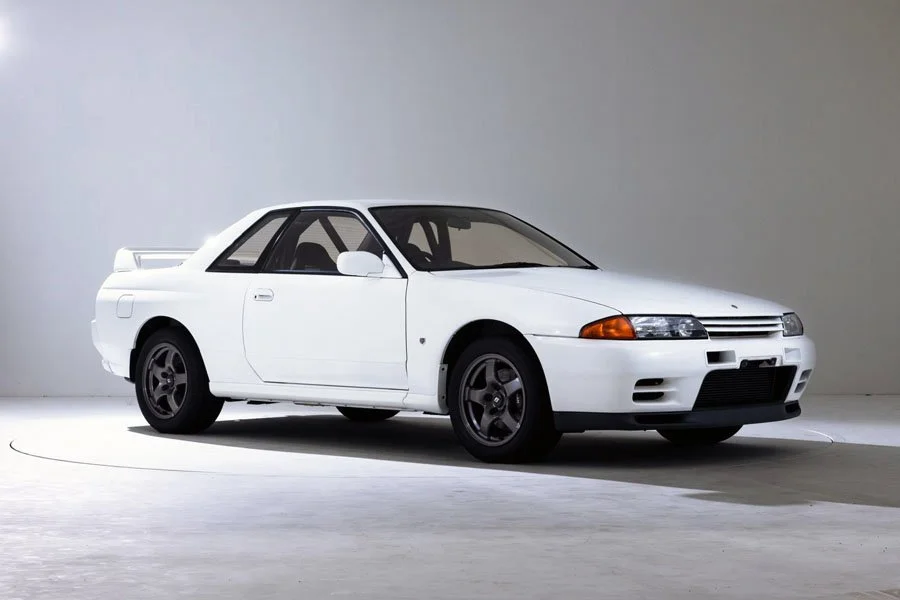
Nissan 300ZX Twin Turbo (Z32)
フェアレディZ ツインターボ (Z32)
Editorial review
- 型式Chassis
- Z32
- 製造者Maker
- Nissan
- 年式Years
- 1989-1996 (US), 1989-2000 (Japan)
- 用途Class
- Grand Tourer
参考動画Reference footage
The Nissan 300ZX Twin Turbo launched in 1989 with a CAD-designed body, a 300-horsepower twin-turbo V6, and a motorsport resume that includes eight straight IMSA GTP wins, seven consecutive Car and Driver Ten Best awards, and a factory racing program that got twin-turbo engines banned outright for being too dominant. It proved a Japanese manufacturer could build a genuine world-class grand tourer, not just a fast coupe.
While its Supra and GT-R contemporaries receive more auction attention today, the Z32's performance credentials and increasingly strong market values argue it deserves equal consideration among Japan's golden-era performance icons.
諸元Specification of record
- 原動機Engine unit
- VG30DETT
- 総排気量Displacement
- 2,960cc
- 最高出力Power
- 300 PS (US), 280 PS (JDM)
- 最大トルクTorque
- 283 lb-ft
- 駆動方式Drivetrain
- Rear-wheel drive
- 変速機Transmission
- 5-speed manual / 4-speed automatic
The 300ZX Twin Turbo arrived at precisely the moment when Nissan's internal "Project 901" — a stated commitment to become the world's best automaker in performance and technology by 1990 — needed a flagship. Nissan approved the Z32's final design in October 1986, unveiled it at the 1989 Chicago Auto Show, and backed it with a Super Bowl commercial directed by Ridley Scott showing the car outrunning a motorcycle, a Le Mans prototype, and an airplane. That ad never aired again after its single broadcast.
What made the Z32 genuinely revolutionary wasn't just its numbers — though 300 horsepower from a turbocharged V6 in 1989 certainly mattered. It was that Nissan's motorsport program proved this wasn't marketing hyperbole. The factory GTP program didn't just compete at the top level; it dominated so thoroughly that IMSA banned twin-turbo engines from the GTS category specifically because the 300ZX's package had made the field uncompetitive.
来歴History & Motorsport Heritage
Nissan approved the Z32's final design in October 1986 and unveiled the finished car at the 1989 Chicago Auto Show. Every major component was new relative to the outgoing Z31 — this wasn't a facelift, it was Nissan's first genuinely revolutionary Z-car redesign. Development was driven by the company's internal "901 Activity" (also referred to as Project 901), an initiative launched in the mid-1980s with the stated goal of making Nissan the world's best automaker in performance and technology by 1990. The Z32 was chosen to spearhead that push, and it shows: the car was among the first production vehicles developed extensively with CAD software, a detail that shows up directly in its unusually clean aerodynamic surfacing.
The launch also arrived against a difficult economic backdrop that shaped the car's entire US sales run. The 1985 Plaza Accord had set off a sustained appreciation of the yen against the dollar, and by the mid-1990s the effect on pricing was severe. The Z32's US sticker price climbed from around $30,000 at launch to nearly $50,000 by its final 1996 model year — a jump that had nothing to do with the car itself and everything to do with currency math. Nissan was reportedly losing $480 million in 1993 alone due to unfavorable exchange rates, and annual US sales of the Z32 fell to under 2,700 units by the end of the run. The rising popularity of SUVs compounded the problem. It's a useful reminder that the Z32's disappearance from American showrooms in 1996 wasn't really about the car losing relevance — it was priced out by forces well outside Nissan's control.
The press reaction on launch was close to unanimous. Road & Track called it "the class of its class." Motor Trend named it 1990 Import Car of the Year. Car and Driver put it on the magazine's Ten Best list for all seven consecutive years it was sold in the US market. Nissan leaned into the moment with a 1990 Super Bowl commercial, directed by Ridley Scott, showing the 300ZX outrunning a motorcycle, a Le Mans prototype, and an airplane. The ad never ran again after that single broadcast.
On track, the Z32-era Z-car's résumé is genuinely elite: The GTP ZX-Turbo prototype (sharing branding and engine lineage with the road car) won eight straight races in the 1988 IMSA GTP season, taking Geoff Brabham to the drivers' championship. In 1989, chassis #8801 became the first Japanese car to win overall at the 12 Hours of Sebring. The GTP ZX-Turbo dethroned a dominant Porsche 962 program, taking the IMSA manufacturers' championship in both 1989 and 1990. It was inducted into the IMSA Hall of Fame in 2024.
From 1990–1995, Clayton Cunningham Racing campaigned twin-turbo 300ZX race cars in IMSA's GTO and later GTS classes, building seven factory-backed cars for endurance racing across that span. Driver Steve Millen took two GTS Drivers' and two GTS Manufacturers' Championships and was ranked Nissan's #1 factory driver for seven straight years. In 1994, Cunningham Racing's No. 75 car — a chromoly tube-frame car with a 2,960cc twin-turbo VG30DETT rated at over 800 horsepower in race trim — won the IMSA GTS class at both the 12 Hours of Sebring and the 24 Hours of Le Mans, finishing 5th overall at Le Mans, plus the season GTS Drivers' and Manufacturers' Championships. A sister Cunningham 300ZX also won the GTS class at the 1994 Daytona 24 Hours.
By 1995, IMSA banned twin-turbo engines from the category specifically because the 300ZX's twin-turbo package had made the field too lopsided. Nissan kept racing the same chassis with a naturally aspirated V8 borrowed from the Infiniti Q45.
That last point is worth sitting with: this wasn't a car that merely competed at the top level, it was banned out of a class for winning too much.
希少性Exclusivity & Production Run
The Z32 nameplate had a long and geographically split production life. It sold in Japan as the Fairlady Z from 1983 (spanning the outgoing Z31 into the Z32 generation) through August 2000, while US 300ZX sales ran only from 1990 to 1996 — with some sources citing a hiatus and Japan-only continuation running as late as 2001, though 2000 is the more consistently documented end date. North American year-by-year export production: 1990: 39,290; 1991: 17,653; 1992: 6,704; 1993: 9,801; 1994: 4,836; 1995: 4,176; 1996: unknown exact figure, but the final 300 US-bound units were marked as a numbered "Commemorative Edition."
Total North American Z32 sales across the run came to roughly 80,000 units. A commonly cited "~140,000 lifetime total" figure appears on lower-quality aggregator sites but isn't consistently supported by primary production data — worth treating cautiously rather than repeating as fact.
Assembly took place at Nissan Shatai's plant in Hiratsuka, Kanagawa, Japan, with a secondary line running at Nissan South Africa's Rosslyn plant from 1992 to 1994. In Japan, the car was sold through a specific dealer channel — Nissan Bluebird Store locations — exclusively, from 1983 through 2000.
Body styles added further exclusivity within the run. The Twin Turbo was T-top only in the US; the JDM Fairlady Z Twin Turbo was available as both a T-top and a fixed-roof "slicktop" coupe, the rarer of the two and, today, the version buyers seek out specifically to avoid the T-top's long-term seal and leak issues. In 1993, Nissan added a factory-authorized convertible — a first for any Z-car — built in partnership with American Sunroof Corporation, but only in naturally aspirated 222-hp form, never with the twin-turbo engine. Convertible production was tiny even by Z32 standards: 501 units in 1993 (421 North America, 80 Japan), 882 in 1994 (837 North America, 45 Japan), 289 in 1995 (253 North America, 36 Japan), and just 29 in 1996, all Japan-market. North American convertible production ended in March 1996; Japan's continued through September 1998.
The rarest factory variant is the SMZ: a Steve Millen Motorsports-built, dealer-sold, factory-warrantied performance package developed in 1995–96, rated at 365 horsepower. Only 104 were built, each carrying a $14,000 premium over a standard Twin Turbo.
意匠Aerodynamics & Design Philosophy
Styling was penned by Toshio Yamashita: wide, low, cab-forward proportions with heavily raked headlamps and minimal overhang — the brief was a shape that looked fast parked. The Z32 was also a design "first" for the Z-car line in engineering terms, introducing Super HICAS four-wheel steering and a central LED brake light to the model (the LED light itself had actually first appeared on the outgoing 1987 300ZX).
Drag coefficient is one area where sources genuinely disagree, and it's worth reporting honestly rather than picking a number to sound authoritative: Most enthusiast and automotive-history sources cite 0.31, a marginal increase over the Z31's claimed 0.30. An independent university fluid-mechanics study measured a 1990 Z32 coupe at 0.32. Z32 owner-forum discussion citing internal data puts it at 0.31 for the Twin Turbo and 0.32 for the heavier 2+2 body style. The likely explanation is that the figure genuinely varies by body configuration (2-seat Twin Turbo vs. 2+2) and by measurement methodology — reporting a range of roughly 0.30–0.32 is more accurate than quoting a single number.
One practical spotting trick for the two body styles: the fuel filler door sits ahead of the rear wheel on the 2-seat coupe and behind it on the 2+2.
Inside, the cockpit was built around a driver-focused layout: instrument and control pods floated around the steering wheel rather than sitting in a flat dash panel, with well-illuminated analog gauges rather than the digital displays some rivals were experimenting with at the time. Twin Turbo models offered power leather seats, and both trims came standard with a leather-wrapped shifter and three-spoke steering wheel. Buyers could option automatic climate control and a Bose sound system — genuinely upscale equipment for a Japanese sports coupe in 1989, and part of why period reviewers positioned the Z32 as a grand tourer rather than a stripped-out track special.
機関VG30DETT · Powerplant
The Twin Turbo's heart was the VG30DETT: a 2,960cc, 60-degree DOHC V6 with 24 valves, twin Garrett turbochargers, and an 8.5:1 compression ratio. Output figures vary slightly by market and measurement standard: US-spec: 300 horsepower at 6,400 rpm, 283 lb-ft of torque at 3,600 rpm; JDM-spec: officially rated at 280 PS under Japan's "gentlemen's agreement" horsepower cap, with some sources citing 300 PS as the underlying real figure.
The naturally aspirated VG30DE, standard on lower trims, made 222 hp and was notably lighter, cheaper, and simpler to maintain — the practical choice for buyers who didn't need the Twin Turbo's straight-line numbers. Power reached the wheels through a 5-speed manual or 4-speed automatic transmission. With the twin-turbo engine, period road tests recorded 0–60 mph in the 5.0–5.6 second range depending on transmission and test conditions, with an electronically limited top speed of 155 mph.
The VG30DETT's overbuilt bottom end became its own kind of legend in tuning circles: stock internals — crank, rods, pistons — are commonly cited as capable of handling output well beyond 500 PS with nothing more than a turbo upgrade, before forging becomes necessary. That reputation for a genuinely stout factory bottom end is a large part of why the Z32 chassis remains a popular engine-swap platform decades later.
The engine's one unforgiving trait: it's an interference design, meaning a snapped timing belt bends valves and can destroy the engine outright. Nissan's specified service interval is every 60,000 miles or 48 months, whichever comes first, and the job also calls for replacing the water pump, tensioners, and idlers at the same time since the labor to access them is largely shared. Buyers evaluating a used Z32 should treat proof of a completed belt service as close to non-negotiable — it's the single biggest mechanical risk on an otherwise robust engine.
車台Chassis, Suspension & Handling Dynamics
The Z32 ran independent multi-link suspension at all four corners, paired with Super HICAS rear-wheel steering on Twin Turbo models — a system that turned the rear wheels in phase with the fronts at speed for stability, and out of phase at low speed to sharpen turn-in. Four-wheel ventilated disc brakes and a genuinely low center of gravity for the era rounded out a chassis that period journalists consistently praised for composure that outclassed most of its contemporaries, twin-turbo or not.
That same chassis, in much more aggressive tune, is what let the GTP and GTS-class race cars run competitively against purpose-built prototypes and eventually get banned for being too effective — the road car's underlying architecture was never the limiting factor.
One practical quirk worth flagging for anyone modifying a Z32 today: the factory suspension geometry is sensitive to wheel diameter. Moving beyond the factory 16-inch wheels induces meaningful camber change — enthusiasts commonly cite roughly a third of a degree of negative camber per inch of wheel size increase — which catches owners off guard when handling degrades and tires wear unevenly after a wheel upgrade they didn't expect to affect alignment.
名義Nomenclature & Lore
The Fairlady name predates the 300ZX by over a decade and has a genuinely well-documented origin. In 1958, Nissan Motors chairman Katsuji Kawamata attended a Broadway performance of the musical My Fair Lady while visiting the United States. Taken with the show, he named Nissan's upcoming sports car line after it when the company launched its first sports car in 1960 — the SP211/213 series, badged "Fairlady."
The name stuck for the Japanese market through every subsequent Z generation, including the Z32: in Japan, this car was sold as the Fairlady Z Twin Turbo, not the 300ZX. That split exists because of one man's judgment call. Yutaka Katayama — "Mr. K," head of Nissan's US operations and the executive most responsible for the Z-car's American success — believed the name "Fairlady" would not land with American buyers. When the first-generation Z car (the 240Z) launched in the US in 1969, Katayama pushed to market it purely by model number, dropping the Fairlady badge for export entirely. That decision carried through the entire Z-car lineage: Fairlady Z in Japan, a numeric badge (300ZX, then later 350Z, 370Z) everywhere else.
相場Auction Records & Modern Market Value
The Z32 market has moved meaningfully in the past two years, though it remains far below Supra- or GT-R-tier money: Highest recorded sale: $233,000 for a 1990 300ZX, March 2025; A separate high-water mark: $230,000 for a 1991 Twin Turbo, August 2025; Lowest recorded recent sale: $3,600 for a 1990 project car, October 2025; Average sale price across tracked auction data: approximately $23,800.
That spread — low-mileage, documented examples pulling six figures while project cars still trade for a few thousand dollars — reflects a market still sorting out which Z32s are genuinely special versus simply old. A numbered 30th Anniversary edition (300 units) sold for $90,100 on eBay in 2017 with 528 original miles, suggesting the ceiling for exceptional, low-mile factory-special examples continues to climb. More broadly, well-kept Twin Turbos currently trade around $30,000, with pristine low-mileage cars reaching into the low-$40,000s outside of standout auction results.
That price naturally raises the ownership question, and it's worth answering directly: the Z32 is not a fragile car, but it is a complex one, and its reliability depends heavily on documented maintenance history. A well-maintained example can comfortably cover 200,000–300,000 miles. A neglected one can be financially ruinous within months. Beyond the interference-engine timing belt risk already covered, the most commonly reported issues are aging engine bay wiring (causing hard starts, misfires, and rough idle), early-style fuel injector failure, and a genuinely hot-running engine bay that punishes cooling-system neglect — buyers should specifically confirm the radiator retains its factory fan shroud and clutch-driven cooling fan rather than an aftermarket electric replacement, which owners widely report as inadequate. Automatic-equipped cars have one further quirk: a factory failsafe prevents the transmission from engaging overdrive until the engine reaches operating temperature, which is normal behavior rather than a fault, but catches unfamiliar owners off guard.
継承Keeping the Legend Alive (Restomod & Specialist Culture)
Nissan put the Z-car nameplate on hiatus after the Z32 ended US production in 1996 (Japan continued through 2000), before reviving it with the 350Z in 2002 and continuing through the 370Z and the current-generation Z. Nissan has been explicit that the modern Z borrows deliberately from the Z32: the current car returns to a twin-turbocharged 3.0-liter V6 displacement, echoing the VG30DETT directly, and Nissan's own marketing describes the current Z's forged wheel design as directly inspired by the Z32 generation specifically.
The Z32 also remains the most aftermarket-supported Z generation for restoration and modification, ahead of even the more numerically popular Z31. Specialist parts suppliers continue to stock everything from body panels to full digital repair manuals, and active enthusiast communities — TwinTurbo.net and the Z32 Wiki among the longest-running technical resources — keep detailed service knowledge circulating decades after production ended. A newer trend among restorers is digital dashboard conversion kits, which retrofit modern gauge displays into the factory cluster location without cutting the original dash.
The chassis has also become a favored engine-swap platform — Toyota 2JZ-GTE swaps into Z32 shells are common enough in tuning circles to have their own nickname ("Zupra" builds) — a testament less to any weakness in the factory VG30DETT and more to the chassis's reputation as a fundamentally excellent platform worth building on.
問答Questions of record
問01How many Nissan 300ZX Z32 Twin Turbos were sold in North America?
Roughly 80,000 units were sold in North America between 1990 and 1996, with production declining sharply from 39,290 units in 1990 to under 5,000 annually by the mid-1990s due to unfavorable yen-to-dollar exchange rates.
問02What is the Nissan 300ZX Z32 called in Japan?
In Japan, the Z32 was sold as the Nissan Fairlady Z Twin Turbo. The "Fairlady" name was inspired by the 1958 Broadway musical My Fair Lady, which impressed Nissan chairman Katsuji Kawamata.
問03What engine powers the 300ZX Twin Turbo?
The VG30DETT: a 2,960cc twin-turbocharged DOHC V6 producing 300 PS in the US market and 280 PS in Japan, with 283 lb-ft of torque. The engine is known for its overbuilt bottom end, capable of handling over 500 PS with turbo upgrades alone.
問04Why was the twin-turbo engine banned from IMSA racing?
By 1995, IMSA banned twin-turbo engines from the GTS category specifically because the 300ZX's twin-turbo package had made the field too lopsided. The Cunningham Racing 300ZX dominated so thoroughly it became uncompetitive for other manufacturers.
問05What is the rarest factory Z32 variant?
The SMZ (Steve Millen Motorsports edition), developed in 1995–96 and rated at 365 horsepower, with only 104 units built. Each carried a $14,000 premium over a standard Twin Turbo.
問06What is the biggest mechanical risk when buying a used Z32?
The VG30DETT is an interference engine, meaning a snapped timing belt destroys valves and can ruin the engine. Nissan's service interval is 60,000 miles or 48 months, whichever comes first. Proof of completed timing belt service is essential before purchase.
結 · IN CLOSING
The Nissan 300ZX Z32 Twin Turbo arrived in 1989 as a technical statement: CAD-designed bodywork, Super HICAS rear steering, and a twin-turbo V6 producing 300 horsepower, backed by seven straight Car and Driver Ten Best awards and a factory-backed racing program so dominant IMSA banned twin-turbo engines specifically because of it. North American production ran to roughly 80,000 units across 1990–1996, split across coupe, 2+2, and a rare factory convertible, with the ultra-limited 104-unit Steve Millen Motorsports SMZ sitting at the top of the desirability ladder. Its "Fairlady" name in Japan traces directly back to a 1958 Broadway performance that impressed Nissan's chairman, while Mr. K's decision to drop that name for American buyers created the Fairlady Z/300ZX split that persists in Nissan's naming to this day.
At auction, the Z32 remains a genuine value play relative to its Supra and GT-R contemporaries — a $233,000 record sale sits well above the roughly $24,000 average, meaning documented, well-kept examples still have real room to appreciate, provided a buyer respects the interference engine's timing belt interval and the car's genuine mechanical complexity. With a factory bottom end tuners trust well past 500 horsepower and an aftermarket that still fully supports the platform, the Z32 continues to earn its reputation among enthusiasts as one of the most underrated cars of Japan's golden performance era.
この項目についてAbout this entry
Specification figures are cross-checked against factory data and period source material. Editorial is researched and reviewed before publication; drafting and formatting may be assisted by tooling, but accuracy checks rest with the editorial desk. This entry was last reviewed in August 2026. Spotted an error? Send a correction →