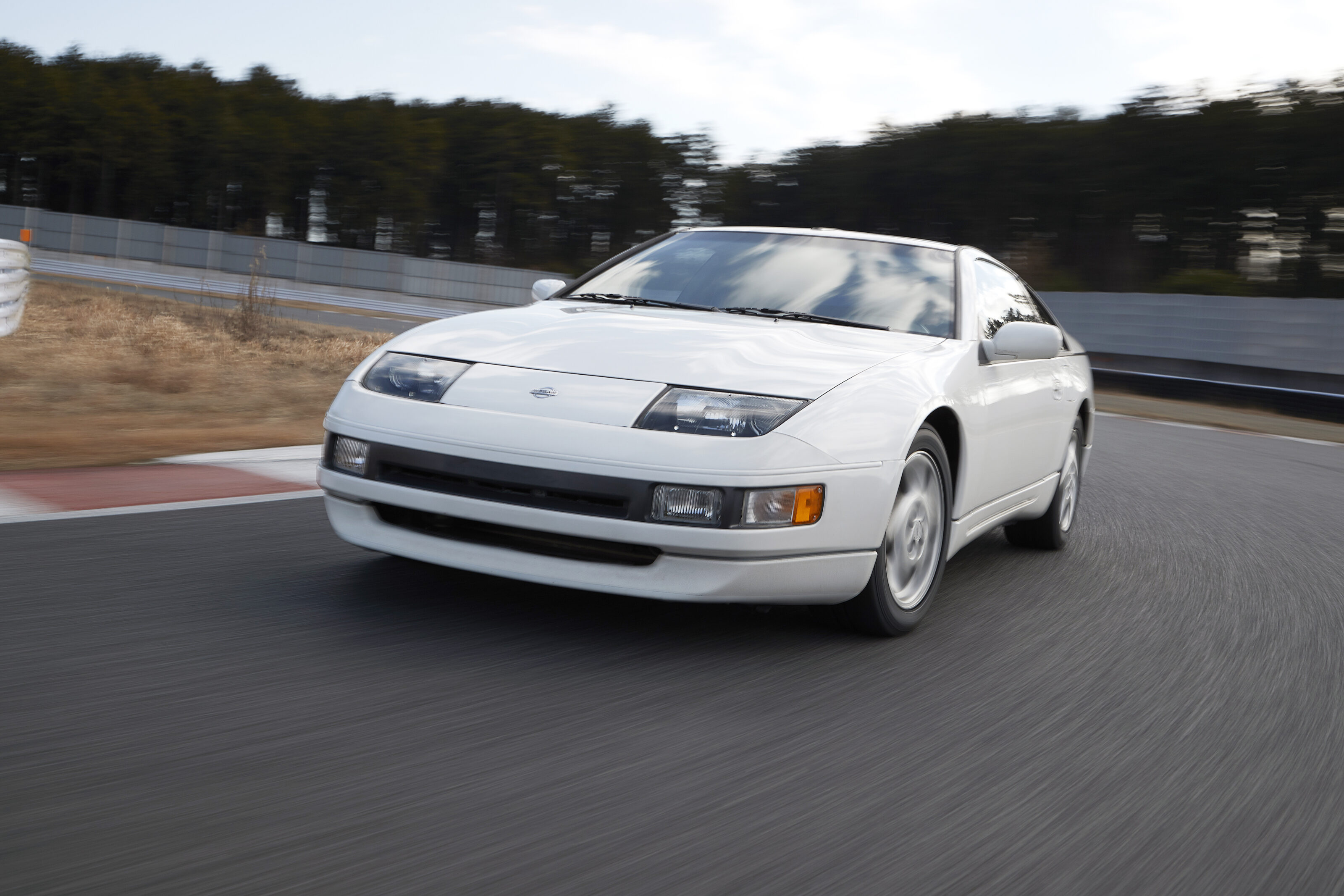
Nissan Skyline GT-R (R32)
スカイラインGT-R (R32)
Editorial review
- 型式Chassis
- R32
- 製造者Maker
- Nissan
- 年式Years
- 1989-1994
- 用途Class
- Sports
参考動画Reference footage
The Nissan Skyline GT-R (R32) is a 1989–1994 twin-turbo, all-wheel-drive coupe that won all 29 Group A races it entered during Japan's touring car championship. Built around the RB26DETT straight-six and the ATTESA E-TS four-wheel-drive system, it was engineered by a Nissan team under Chief Engineer Naganori Ito with a single goal: end Ford's dominance of Group A racing. It succeeded almost immediately, taking championships in Japan, Australia, and Europe within its first two seasons on track. Today it remains the most numerous GT-R generation ever built, with roughly 43,900 examples produced across standard, V-Spec, Nismo, and N1 homologation variants.
諸元Specification of record
- 原動機Engine unit
- RB26DETT twin-turbo inline-six
- 総排気量Displacement
- 2,568 cc
- 最高出力Power
- 276 hp at 6,800 rpm (official/gentlemen's agreement figure); independently dynoed closer to 313 hp, with some period estimates near 320 hp
- 最大トルクTorque
- 260 lb-ft (361 Nm) at 4,400 rpm (official figure; independent dyno data closer to 300 lb-ft at 4,200 rpm)
- 駆動方式Drivetrain
- All-wheel drive via ATTESA E-TS
Few road cars have ever backed up a marketing brief as completely as the R32 GT-R backed up Nissan's: build something that ends Ford's grip on Group A touring car racing. The result didn't just compete — it went 29 races without a loss in Japan, swept Australia's touring car title, and won Bathurst outright twice, all inside a five-year production run.
That run of dominance is why the R32 still carries the 'Godzilla' nickname decades later, and why it sits at the root of one of performance car culture's most enduring lineages. Underneath the nickname is a fairly simple engineering story: a 2.6-liter twin-turbo six rated well below its true output, paired with a four-wheel-drive system built to exploit whatever grip was available, wrapped in a homologation-driven shape that Nissan tuned for stability rather than a flattering drag number.
来歴History & Motorsport Heritage
Nissan's previous attempt at turbocharged Skyline racing had not gone well. The GTS-R, powered by the RB20DET, made around 210 horsepower in road trim and just over 400 hp in race form — respectable numbers that were nonetheless overwhelmed by the Ford Cosworth engines dominating Group A touring car racing at the time. That defeat shaped the brief for what came next. Under Chief Engineer Naganori Ito and Chief Experiment Engineer Kozo Watanabe, a dedicated project team was assembled with one objective: build a car and engine capable of dominating the Japan Touring Car Championship.
The result entered Group A competition on March 18, 1990, at the opening 300 km race at West Japan Circuit. An estimated 41,000 spectators turned out to see what the new Skyline could do. Two factory-backed cars — the Calsonic-liveried entry driven by Kazuyoshi Hoshino and Toshio Suzuki, and the Reebok car driven by Masahiro Hasemi and Anders Olofsson — ran first and second. Calsonic won and broke the course record; the Reebok car finished second despite drivetrain trouble.
That opening result set the tone for the next four seasons. Across the full run of the All Japan Touring Car Championship's Group A era, the R32 GT-R entered 29 races and won all 29, a run corroborated both by independent motorsport archives and by Nissan's own heritage documentation. Team-by-team, the championship went as follows:
- 1990 — Team Impul, driving an R32 Skyline GT-R
- 1991 — Hasemi Motorsport, R32 Skyline GT-R
- 1992 — Team Hasemi (repeat winner), R32 Skyline GT-R
- 1993 — Team Impul (repeat winner), R32 Skyline GT-R
The car's success wasn't confined to Japan. In Australia, the R32 GT-R was introduced to the Australian Touring Car Championship in 1990 and immediately ended the run of the previously dominant Ford Sierra Cosworth, taking the title from 1990 through 1992 — Jim Richards won in 1991, and Mark Skaife took the 1992 crown, before a regulation change excluded the GT-R from the series in 1993. At the Bathurst 1000 endurance classic, Richards and Skaife shared the wheel to win outright in both 1991 and 1992. The 1992 win came amid open hostility from a crowd frustrated by the GT-R's dominance; Richards' furious post-race podium comments became one of the most replayed moments in Australian motorsport history, and the rules that excluded the car followed within the year.
In Europe, the R32 took outright victory at the Spa 24 Hours in 1991. It also proved dominant in endurance-style production racing: in Japan's Group N-based Super Taikyu series, the R32 and its R33 successor combined for 50 wins between 1991 and 1997.
The car's technical basis for all of this was straightforward homologation math. Group A rules applied a turbo-equivalency formula that rated Nissan's 2.6-liter RB26DETT as if it displaced 4.3 liters for classification purposes — a displacement Nissan chose deliberately to land in the sweet spot of the rule book while retaining four-wheel drive. Combined with ATTESA E-TS distributing power to whichever end of the car had grip, and Super HICAS rear steering sharpening turn-in, the race-prepared cars produced over 550 hp and were close to unbeatable in period touring car racing. In 2025, Nissan fans voted the R32 the top Nismo race car of all time in the company's #NISMOtop20 poll, citing a car that, in just five production years, took championships on three continents.
希少性Exclusivity & Production Run
The R32 GT-R carries the chassis code BNR32. Most sources place production between 1989 and 1994, though at least one Nissan parts release states manufacturing continued from August 1989 through January 1995 — a discrepancy that shows up periodically in reference material but doesn't change the broad five-year production window.
Total GT-R production figures vary slightly depending on the source, generally falling between roughly 43,800 and 43,940 units:
- 43,937 — the figure most commonly cited by classic car outlets
- 43,934 — the figure cited on GT-R specialist forums, with a documented model breakdown (below)
- 43,810 standard GT-Rs, including 100 Australian-market cars, according to Supercar Nostalgia — a figure that excludes two special homologation variants entirely
The most detailed model-by-model breakdown, totaling 43,934 units, splits out as follows:
- Standard GT-R: 40,390
- Nismo (Group A Evolution): 560
- V-Spec: 1,453
- V-Spec II: 1,303
- N1 race version: 228
Year-by-year production (standard registrations) reads:
- 1989: 4,555
- 1990: 8,426
- 1991: 7,081
- 1992: 7,961
- 1993: 6,204
- 1994: 7,465
Those registration totals add up to 41,692 cars, leaving roughly 2,242 unaccounted for against the 43,934 production figure — likely pre-production units, media cars, direct exports, or race-only builds that never received standard road registration. VIN records show the first production car as BNR32-000051 and the last as BNR32-314649, dated November 7, 1994.
It's worth separating GT-R-specific numbers from the wider R32 Skyline line: the full R32 generation, including two-door coupes, four-door sedans, and non-GT-R trims like the GXi, GTE, GTS, GTS-t, and GTS-4, totaled 313,491 units built from May 1989 onward. The GT-R was a small fraction of that total, and it was offered exclusively as a two-door coupe — no sedan or convertible GT-R was ever produced.
Relative to its successors, the R32 is by far the most accessible GT-R generation. The R33 GT-R that followed totaled 16,520 units, and the R34 GT-R after that totaled just 12,175 — meaning the R32 accounts for more units than the next two GT-R generations combined.
The GT-R nameplate itself was never built outside Japan. The only markets to receive factory exports were Hong Kong, Australia, and New Zealand starting in 1991, followed by the UK in 1997. Australia holds a unique distinction: because Nissan wanted to campaign the GT-R against the Ford Sierra Cosworth in the Australian Touring Car Championship, it became the only country outside Japan where the GT-R was sold new as a road car.
The rarest homologation variant is the V-Spec II N1, of which only 63 examples were built to qualify the model for Japan's domestic N1 racing series. Based on the GT-R Nismo Edition, these cars featured revised front bumper aerodynamics, deletion of the rear wiper and ABS system, and uprated Garrett T04B turbochargers in place of the standard units.
意匠Aerodynamics & Design Philosophy
Design leadership on the R32 fell to Mr. S. Ito, who led the project team, with Kozo Watanabe — who would go on to lead the R33 program — also contributing to body design work on the R32.
Nissan's aerodynamic brief for the car centered on what the engineering team called the "Zero Lift" concept: rather than chasing a low drag figure, the priority was keeping the car planted at high speed and stable through fast corners. That's the reasoning behind the large rear spoiler mounted across the trunk lid, a piece that stayed on the car through its Group A racing career, suggesting it delivered a net benefit even if its aerodynamic contribution has been debated by enthusiasts in the decades since.
What the "Zero Lift" priority did not deliver was a slippery shape. Independent figures agree the R32 GT-R posted a drag coefficient of 0.40 — a number that was unremarkable even by 1989 standards. For comparison, the R33 GT-R that replaced it dropped Cd to 0.35 with better-balanced front-to-rear downforce, though the R32 retained a smaller frontal area than its successor.
Body dimensions were compact by modern standards:
- Length: 4,545 mm (178.9 in)
- Width: 1,755 mm (69.1 in)
- Height: 1,340 mm (52.8 in)
- Wheelbase: 2,615 mm (102.9 in)
Standard cars rode on five-spoke 16-inch alloy wheels wearing 225/50 R16 Bridgestone Potenza tires. In 1993, Nissan introduced the V-Spec ("V" for Victory) to mark the car's racing success on track. The V-Spec brought Brembo brakes with larger calipers and rotors, 17-inch BBS aluminum wheels wrapped in wider 245/45R17 Bridgestone Potenza RE010 rubber, a retuned ATTESA setup, and a lighter clutch pedal. A second variant, the V-Spec II, followed in 1994 with the same basic mechanical package but even wider tires as its main change.
機関RB26DETT twin-turbo inline-six · Powerplant
The RB26DETT is a 2,568 cc inline-six with a bore and stroke of 86.0 mm × 73.7 mm and an 8.5:1 compression ratio. Forced induction came from twin ceramic turbochargers — sources differ on the exact model, with some citing Garrett T25 units and others Garrett T28s, though both agree on the ceramic turbine wheel construction, chosen for its heat resistance advantage over standard steel rotors of the era. Boost pressure ran around 10 psi (0.7 bar) in stock trim, with the engine spinning to an 8,000 rpm redline and an 8,500 rpm fuel cut.
Officially, Nissan claimed 276 horsepower at 6,800 rpm and 260 lb-ft of torque at 4,400 rpm (361 Nm). That number needs context: Japanese manufacturers in this era observed an informal "gentlemen's agreement" to cap advertised output at 276 hp regardless of a car's actual power, and the RB26DETT was known to exceed that figure substantially. Independent dyno data has put true output closer to 313 hp at 6,800 rpm and 300 lb-ft at 4,200 rpm, and some period estimates place the as-built production engine closer to 320 hp. Some documentation instead lists a factory figure of 280 PS rather than 276 hp — another discrepancy that turns up repeatedly across reference sources without a definitive resolution.
Whatever the exact stock number, the RB26DETT was built with considerable headroom. Rated at 276 hp against its actual output, it was under-stressed by design and became one of the most heavily modified engines in tuning history — figures as high as 1,000 hp have been documented from built examples. More conservatively, the stock bottom end is known to reliably hold over 500 hp without internal upgrades, and current builds commonly target around 600 hp on pump gas using HKS or Tomei turbo upgrades paired with a Haltech ECU.
Performance figures vary by source and test method, reflecting both era-typical variance in road-test procedure and the car's electronically limited top speed:
- 0–62 mph: 5.6 seconds (period claim); other tests report 4.7–5.1 seconds
- Quarter mile: 13.4–13.9 seconds
- Top speed: electronically limited to 155 mph (250 km/h) per the Japanese manufacturers' gentlemen's agreement on top speed; unrestricted examples have reportedly reached in excess of 180 mph, though this figure comes from enthusiast reporting rather than official testing
At launch, this level of performance outstripped period rivals including the BMW E30 M3 and the Porsche 930 Turbo — cars that, unlike the GT-R, relied on rear-wheel drive alone to put their power down.
車台Chassis, Suspension & Handling Dynamics
The GT-R's four-wheel-drive system, ATTESA E-TS (Advanced Total Traction Engineering System for All-Terrain, with Electronic Torque Split), was reportedly inspired by the Porsche 959's all-wheel-drive architecture. Rather than running a fixed torque split, it used an electronically controlled multi-plate clutch to vary distribution between 0 and 50 percent to the front axle, with the remainder always biased to the rear.
In everyday driving, the system kept the car in a rear-wheel-drive default, sending power to the front wheels only once the rears began to lose traction — up to a 50/50 split under those conditions. That default rear bias was a deliberate choice, giving the GT-R the driving feel of a rear-drive sports coupe until the moment additional grip was actually needed.
Steering feel was sharpened further by Super HICAS (High Capacity Actively Controlled Steering), a four-wheel steering system that turned the rear wheels up to one degree to improve stability and reduce the car's effective wheelbase feel in corners. The system activated only above roughly 50 mph, steering the rears in phase with the front wheels to sharpen turn-in at speed rather than intervening at low-speed parking maneuvers.
Underneath, the E-BNR32's steel unitary chassis used independent suspension at all four corners: double wishbones at the front, with a third link at the outer end of the upper wishbone, and a multi-link arrangement at the rear. Spring and damper rates were firmer than typical Skyline models of the period, with anti-roll bars fitted front and rear to control body roll under the added weight of the four-wheel-drive hardware.
名義Nomenclature & Lore
The R32 GT-R picked up the "Godzilla" nickname during its competition career, and the name has stuck in enthusiast and automotive media ever since — it shows up routinely in modern coverage of the car, decades after its Group A and Bathurst dominance made it a target for rule changes rather than simply a competitor. The nickname has since been applied loosely to later GT-R generations as well, but it originates with this car: the one that won every Group A race it entered in Japan and forced a regulation change in Australia after beating the field too convincingly at Bathurst.
相場Auction Records & Modern Market Value
Because the GT-R nameplate was never built outside Japan, the R32's collector market has always been shaped by its export scarcity as much as its production numbers. Factory exports went only to Hong Kong, Australia, and New Zealand from 1991, and to the UK starting in 1997 — meaning cars in most other right-hand-drive and left-hand-drive markets arrived through private grey-market import rather than factory distribution channels.
Within the R32 GT-R lineup, value and collector interest track fairly closely with rarity. The standard car, with roughly 40,000 units built, is the most common and accessible entry point into GT-R ownership. Above that sit the homologation specials: the 560-unit Nismo Group A Evolution model, the 228 to 245-unit N1 race version (depending on which production tally is used), and above all the 63-unit V-Spec II N1 — a car built on the Nismo Edition platform with unique aero, deleted ABS and rear wiper, and uprated Garrett T04B turbochargers. These low-volume homologation cars command the strongest collector interest precisely because so few were built, and because their specification ties directly to Nissan's Group A and N1 racing programs rather than to road-going comfort or convenience.
Even among standard cars, the V-Spec and V-Spec II trims — with their Brembo brakes, BBS wheels, and retuned ATTESA systems — are more sought after than base GT-Rs, with total production of 1,453 and 1,303 units respectively representing a small slice of the roughly 43,900 total GT-Rs built. Given that the R32 also comfortably outnumbers both the R33 (16,520 units) and R34 (12,175 units) that followed it, it remains the generation most likely to be found in usable, driver-quality condition rather than as a garage-kept investment piece.
継承Keeping the Legend Alive (Restomod & Specialist Culture)
The R32 sits at the start of a GT-R lineage that narrowed in numbers with each subsequent generation — the R33 at 16,520 units and the R34 at 12,175 units, both far scarcer than the R32's roughly 43,900. That relative abundance is a large part of why the R32 remains the platform most commonly seen in tuning shops and restoration projects today: there are simply more of them to work with, and parts and specialist knowledge built up around the RB26DETT over three decades of tuning history.
The restoration and modification scene around the R32 tends to split into two camps. One favors mechanical preservation — keeping the ATTESA E-TS, Super HICAS, and RB26DETT in as close to factory specification as condition allows, particularly on Nismo, N1, and V-Spec II N1 cars where originality carries real value. The other treats the RB26DETT as a tuning platform, leaning on the engine's documented headroom: a stock bottom end that reliably handles over 500 hp, and modern builds using HKS or Tomei turbochargers with Haltech engine management routinely reaching around 600 hp on pump fuel — figures that echo the car's competition-bred design intent, since Nissan built the RB26DETT from the outset as an engine for a car that needed to win Group A races outright, at over 550 hp in race trim, not just meet a showroom-friendly output figure.
問答Questions of record
問01How many Nissan Skyline GT-R (R32) models were made?
Total production figures vary by source, generally ranging between roughly 43,800 and 43,940 units, with 43,934 being a commonly cited detailed breakdown across standard, Nismo, V-Spec, V-Spec II, and N1 variants.
問02Why is the R32 GT-R called 'Godzilla'?
The nickname was picked up during its competition career because of its on-track dominance — it won all 29 Group A races it entered in Japan, swept the Australian Touring Car Championship from 1990–1992, and won Bathurst outright in 1991 and 1992, prompting a rule change that excluded it from Australian racing.
問03What engine is in the Nissan Skyline GT-R R32?
The R32 GT-R uses the RB26DETT, a 2,568 cc twin-turbocharged inline-six officially rated at 276 hp, though independent dyno testing puts true output closer to 313 hp.
問04What is the rarest R32 GT-R variant?
The V-Spec II N1 is the rarest variant, with only 63 examples built to qualify the model for Japan's domestic N1 racing series, featuring unique aero, deleted ABS and rear wiper, and uprated Garrett T04B turbochargers.
問05Was the Nissan Skyline GT-R R32 sold outside Japan?
The GT-R nameplate was never built outside Japan, but factory exports were sent to Hong Kong, Australia, and New Zealand starting in 1991, and to the UK starting in 1997; Australia was the only market where it was sold new as a road car outside Japan.
問06How much horsepower can the RB26DETT handle?
The stock bottom end is known to reliably hold over 500 hp without internal upgrades, with modern builds using HKS or Tomei turbochargers and Haltech ECUs commonly reaching around 600 hp on pump gas, and built examples documented at up to 1,000 hp.
結 · IN CLOSING
The Nissan Skyline GT-R (R32) was built from 1989 to roughly 1994 specifically to end Ford's grip on Group A touring car racing, and it did so decisively — winning all 29 Group A races it entered in Japan's championship between 1990 and 1993, taking the Australian Touring Car Championship from 1990–1992, and winning Bathurst outright in both 1991 and 1992. Power came from the 2.6-liter twin-turbo RB26DETT, officially rated at 276 hp but independently dynoed closer to 313 hp, paired with the ATTESA E-TS four-wheel-drive system and Super HICAS rear steering. Nissan built roughly 43,900 GT-Rs across standard, V-Spec, Nismo, and N1 variants — making the R32 the most numerous GT-R generation, well ahead of the R33's 16,520 and the R34's 12,175. Never sold new outside Japan except in Hong Kong, Australia, New Zealand, and later the UK, the car earned the "Godzilla" nickname through its on-track dominance. Today it remains the most accessible entry point into GT-R ownership, with a tuning scene built around an engine known to handle 500-600 hp on largely stock internals, and homologation specials like the 63-unit V-Spec II N1 standing among the rarest and most collectible variants of the entire generation.
この項目についてAbout this entry
Specification figures are cross-checked against factory data and period source material. Editorial is researched and reviewed before publication; drafting and formatting may be assisted by tooling, but accuracy checks rest with the editorial desk. This entry was last reviewed in August 2026. Spotted an error? Send a correction →