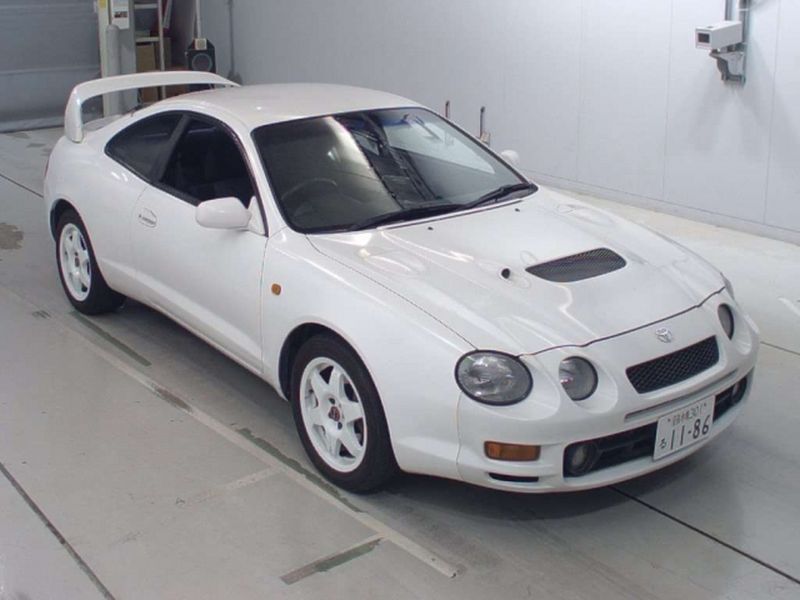
Supra RZ BBB
スープラ
Editorial review
- 型式Chassis
- A80
- 製造者Maker
- Toyota
- 年式Years
- 1993-2002
- 用途Class
- Sport
参考動画Reference footage
Famous for its bulletproof 2JZ engine, the Mk4 Supra became a tuning legend. The sequential twin-turbo system provided smooth power delivery, while the Getrag 6-speed gearbox could handle massive torque. Its cockpit-style interior focused entirely on the driver.
諸元Specification of record
- 原動機Engine unit
- 2JZ-GTE
- 総排気量Displacement
- 3.0L Twin-Turbo
- 最高出力Power
- 276 hp
- 最大トルクTorque
- 318 lb-ft
- 駆動方式Drivetrain
- FR
- 変速機Transmission
- 6-speed Manual
- 車両重量Kerb weight
- 1,510 kg
The fourth-generation Toyota Supra, internally designated as the A80, represents a watershed moment in the history of high-performance automotive engineering. Unleashed upon the world at the 1993 Chicago Motor Show, the vehicle was the product of over four years of exhaustive development that began during the height of the Japanese "bubble economy". This era of unprecedented research and development capital allowed Toyota's engineers to pursue technical excellence over strict cost-benefit ratios, giving birth to a sports car that would transcend its mechanical origins.Overseen by Chief Engineer Isao Tsuzuki, a veteran whose pedigree included the first-generation Celica and both iterations of the MR2, the development team was armed with a simple but daunting directive: build a supercar-slayer. Blending supercar performance, polished refinement, and uncompromised Toyota reliability, the A80 Supra encapsulates what is widely considered the golden age of Japanese automotive history. Although originally developed to challenge the likes of Porsche and Ferrari, the MkIV Supra would eventually surpass its competitors in popular culture, ascending to the status of a blue-chip collector's asset and becoming the charismatic leader of the global "import tuner" movement.
来歴History & Motorsport Heritage
To fully understand the A80 Supra, one must look back to its origins in 1978, when Toyota revealed the Supra nameplate as a longer, wider, and more powerful spin-off of the second-generation Celica coupe. Designed to compete in the grand tourer market against Datsun's Z-cars, the first-generation A40 Celica Supra replaced the four-cylinder engines with a silky-smooth inline-six. The A60 generation arrived in 1981 with a sharper suit, pop-up headlights, and independent rear suspension with chassis tuning by Lotus.The Supra finally became an independent model in 1986 with the A70 generation, completely diverging from the front-wheel-drive Celica to refine its role as a rear-wheel-drive grand tourer. The A70 introduced double wishbone suspension, turbocharging via the 7M-GTE engine, and homologated the Supra for Group A racing. It achieved significant racing pedigree, with early iterations campaigned in the British Saloon Car Championship by drivers like Win Percy and Barry Sheene, and it even enjoyed a brief stint in the World Rally Championship (WRC).However, it was the A80 Supra that cemented Toyota’s motorsport dominance on the world stage. The MkIV Supra was by far the most successful generation in racing; it won its class in the Swiss Mountain Races, charged up Pikes Peak, competed in American SCCA racing, and famously raced at the iconic Le Mans 24 Hours for two consecutive years. Above all, the A80 became an unstoppable force in the All-Japan GT Championships (JGTC), where heavily modified Castrol TOM'S and DENSO SARD Supras absolutely dominated the series from 1995 through to 2003.
希少性Exclusivity & Production Run
Over its eleven-year production lifespan from May 1993 to July 2002, the global output of the A80 Supra remained highly exclusive, with a total of exactly 45,230 units built worldwide. Production peaked during its introductory year in 1993 with 15,901 units manufactured, before steadily declining as the 1990s progressed due to an appreciating Japanese yen and a global shift in consumer preference toward SUVs.Of the 45,230 vehicles produced, the majority remained in Japan, which received 31,575 units. The United States was the second-largest market with 11,446 units, while Europe imported 1,671, and Canada just 227. The Japanese Domestic Market (JDM) boasted the most diverse range of trim levels. Buyers could choose from the naturally aspirated SZ and sport-oriented SZ-R, or step up to the turbocharged models: the RZ-S, the flagship RZ, and the luxury-focused GZ.Due to tightening emission regulations and declining sports car sales, Toyota withdrew the Supra from the UK market by late 1996 (after selling just 600 units) and from North America by 1998. Production for the Japanese domestic market pushed on with lowered volume until July 2002, marking the end of a legendary era. Today, certain configurations are exceptionally rare; for example, globally, only 10,753 Supras were ever fitted with the highly coveted 6-speed manual transmission across both naturally aspirated and twin-turbo variants
意匠Aerodynamics & Design Philosophy
Operating under the philosophy that "less is more," Chief Engineer Isao Tsuzuki’s team initiated a rigorous weight-reduction program requiring 950 engineering meetings dedicated to meticulously shedding bulk. The A80 Supra utilized aluminum for the hood, targa roof, front crossmember, and transmission fluid pans. To shave grams, engineers used hollow-fiber carpeting, a lightweight magnesium-alloy steering wheel, and hollow-head bolts. As a result, the A80 shed approximately 100 kg (220 lbs) compared to its bulky A70 predecessor, and its center of gravity fell by an entire inch.Aesthetically, the exterior design was a radical departure from the chiseled, boxy lines of the 1980s, shifting instead toward a rounded, organic silhouette that paid homage to the classic proportions of the 1960s Toyota 2000GT. The design also subtly borrowed styling cues from the Ferrari F40, notably in its trapezoidal headlamp lenses, deep grille, functional rear brake scoops, and its colossal signature crescent-shaped rear wing.These flowing lines were not just for show; the A80 was optimized using early CAD software to achieve remarkable aerodynamic efficiency, resulting in a drag coefficient of 0.31 for the wingless base model and 0.33 for models equipped with the towering rear wing. This aero profile allowed the car to maintain immense stability at speeds exceeding 150 mph. The interior layout was famously extroverted, featuring an angled, wraparound center console that enveloped the driver to create an immersive, "fighter pilot-ish" cockpit experience.
機関2JZ-GTE · Powerplant
At the core of the Supra’s enduring legacy is the 2JZ-GTE—a 3.0-liter, twin-turbocharged inline-six engine widely regarded as one of the most robust and over-engineered production powerplants ever manufactured. Rejecting the industry trend of transitioning to aluminum blocks, Toyota opted for a heavy-duty cast-iron block featuring a "closed-deck" construction. This provided maximum support to the cylinder walls, preventing distortion under extreme cylinder pressures. The block housed a fully forged steel crankshaft supported by seven massive main bearing caps, and was topped with an aluminum DOHC 24-valve cylinder head developed with Yamaha.To eliminate turbo lag, the 2JZ-GTE utilized a highly sophisticated sequential twin-turbocharger system. Unlike a parallel setup, the two turbos operated in stages. At low engine speeds, all exhaust gases were routed to the first turbine, providing nearly 300 lb-ft of torque as early as 1,800 RPM. As the engine approached 3,500 RPM, a bypass valve initiated a "pre-boost" phase to begin spooling the second turbine. By 4,000 RPM, the second turbo fully engaged, allowing both units to deliver maximum boost seamlessly through the higher rev range.Crucially, the 2JZ-GTE was tailored differently depending on its market. Due to a "Gentlemen's Agreement" among Japanese automakers, the JDM engine was officially capped at 276 hp (280 PS) and 318 lb-ft of torque. It utilized ceramic-wheeled CT20 turbochargers for ultra-fast spooling, 440cc high-impedance fuel injectors, and a MAP sensor. Conversely, the USDM and European export models were unleashed to produce 320 hp and 325 lb-ft of torque. The export engines were upgraded with durable steel-wheeled CT12B turbochargers, larger 550cc low-impedance injectors, slightly more aggressive camshaft profiles, and a MAF sensor system designed for high-speed highway cruising. In 1997, the engine was further refined with Toyota's VVT-i (Variable Valve Timing with intelligence), boosting peak torque to 332 lb-ft.The factory bottom end is so over-engineered that it can reliably handle 600 to 700 horsepower with merely bolt-on modifications and tuning. For builders targeting the 1,000+ horsepower mark, fully forged internals and billet main bearing caps allow the factory cast-iron block to withstand drag racing applications exceeding 2,000 horsepower
車台Chassis, Suspension & Handling Dynamics
The Supra was equipped with a suspension and braking system that allowed it to out-handle contemporary supercars. The chassis featured an independent double-wishbone suspension system at all four corners, utilizing forged aluminum upper control arms to reduce unsprung mass. It achieved an impressive near-perfect weight distribution of 53:47 in turbo models (and 51:49 in NA models). On the skidpad, the A80 recorded a phenomenal 0.95 lateral g-force rating.Handling dynamics took a major leap forward in 1997 with the introduction of the X-REAS (Cross-Relative Absorber System) on Japanese RZ and SZ-R models. This mechanical-hydraulic system replaced traditional shocks with specialized monotube shock absorbers that were interconnected diagonally across the chassis (front-left to rear-right, and front-right to rear-left) via a central control absorber. When the Supra rolled into a corner, oil from the compressing shock flowed into the central control valve, creating a flow resistance that acted as a supplemental damping force for the extending opposite shock. This effectively eliminated body roll, pitch, and sway during aggressive maneuvering, without requiring the uncomfortably stiff springs common in traditional sports cars.Braking was equally revolutionary. Turbo models were equipped with a Formula 1-derived Anti-lock Braking System (ABS) that utilized a lateral G-sensor. The system could actively measure the car's speed, angle, and pitch during hard cornering to apply independent pressure to each individual caliper. The "large brake" package featured 4-piston aluminum monoblock calipers clamping onto 12.7-inch (323mm) front rotors, and 2-piston calipers on 12.8-inch (324mm) rear rotors. In testing conducted by Car and Driver, the Supra Turbo recorded a 70-0 mph braking distance of just 149 feet—a production car record that stood unbeaten from 1997 until the Porsche Carrera GT finally bested it by 4 feet in 2004.Power was transferred to the rear wheels via a Torsen limited-slip differential. While a 4-speed A340E automatic transmission was available, the quintessential setup was the legendary Getrag V160 (and later V161) 6-speed manual transmission. Built to be nearly indestructible, the V160 can famously manage well over 700 horsepower in its completely stock configuration, offering gear selection that was slick, speedy, and precise.
名義Nomenclature & Lore
While its engineering bona fides were undeniable, the MKIV Supra's transition into global mythology was cemented by pop culture. Its reputation exploded in 2001 with the release of the hit film The Fast and the Furious. Driven by Paul Walker's character, Brian O'Conner, the bright orange 1994 Supra—originally sourced from the film’s technical advisor, Craig Lieberman—became the undisputed hero vehicle of the franchise.The film popularized the phrase the "10-second car" and highlighted the 2JZ-GTE's immense tuning potential to a mainstream global audience. Simultaneously, the vehicle dominated the digital realm in the Gran Turismo video game series. Millions of gamers virtually experienced the Supra’s performance and modified its engine to extreme limits, keeping the car incredibly relevant long after production had ceased. This digital and cinematic footprint birthed the "Supra Effect"—a massive resurgence in global demand that indoctrinated a new generation of auto enthusiasts into the JDM tuning culture.
相場Auction Records & Modern Market Value
As of the mid-2020s, the MKIV Supra has formally transitioned from a depreciating tuner car into a blue-chip, investment-grade collector's asset. The days of securing a pristine twin-turbo model for under $25,000 are long gone; today, the average sale price for a 4th-generation Supra hovers around $75,000, with prices still trending sharply upward. Over the last decade, high-end classic vehicles have shown an 82% performance growth, and the Supra is heavily riding this wave.Low-mileage, unmodified, manual-transmission turbo models—often considered the "Holy Grail" of the Supra market—routinely cross the auction block for staggering sums. In 2022, a pristine 1994 Supra Turbo with just 13,000 miles sold on Bring a Trailer for an incredible 232,000∗∗.Shortlyafter,inearly2026,a1998SupraTurbowithonly9,000milesachievedahammerpriceof∗∗220,000 at the Mecum Kissimmee auction, proving the market's continued appetite for untouched examples. Even heavily modified Supras fetch six figures; recently, a 777-horsepower tuned model sold for a highly respectable 135,000.However,theabsolutepeakofthemarketremainstheactualscreen−usedorangemoviecardrivenbyPaulWalker,whichwasauctionedforastaggering∗∗550,000**.
継承Keeping the Legend Alive (Restomod & Specialist Culture)
The surging market value of the A80 has birthed an entire industry dedicated to its preservation and optimization. Recognizing the fervent demand, Toyota launched the GR Heritage Parts initiative, reviving the production of genuine OEM components for classic Supras. For builders pushing the physical limits of the 2JZ-GTE, aftermarket companies like Titan Motorsports and Bullet Race Engineering manufacture solid billet aluminum blocks capable of sustaining 2,000+ horsepower drag builds.After a 17-year hiatus, the Supra legend was reborn with the introduction of the fifth-generation GR Supra (A90). Prompted by Toyota CEO Akio Toyoda's deep personal passion for the Supra and his experiences testing the A80 alongside master driver Hiromu Naruse at the Nürburgring, Toyota partnered with BMW to develop the new chassis. The A90 draws explicit visual inspiration from the FT-1 concept car—with its "double-bubble" roof and aggressive curves bridging the gap to the 2000GT and the A80.Powered by modern turbocharged 3.0-liter inline-six (B58) and 2.0-liter inline-four (B48) engines mated to an 8-speed automatic transmission, the new GR Supra provides blistering modern performance wrapped in nostalgic lineage. While purists continually debate the shift from analog 90s technology to a modern, BMW-collaborated platform, the A90 successfully carries the torch. By marrying high-tech capabilities with a deeply rooted motorsport history, the Supra nameplate continues to thrill a whole new generation, ensuring that the ultimate JDM legend lives on.
結 · IN CLOSING
The Toyota Supra A80 (1993-2002) is a masterpiece of over-engineered Japanese performance. To achieve a supercar-slaying power-to-weight ratio, Toyota implemented extreme weight-saving measures, utilizing hollow-carpet fibers and aluminum components to shed over 200 pounds compared to its predecessor. Handling was further revolutionized by a Formula 1-derived ABS system and the innovative X-REAS suspension, which actively minimized body roll by diagonally cross-linking shock absorbers.The beating heart of the Supra is the 3.0-liter 2JZ-GTE engine. The export models boasted 320 horsepower via steel-wheeled sequential twin-turbos, while Japanese domestic models were capped at 276 horsepower due to a gentleman's agreement. Because of its robust closed-deck cast-iron block and forged internals, the 2JZ-GTE can reliably handle well over 600 to 1,000 horsepower with aftermarket tuning.Beyond the track, the Supra’s legacy was cemented by its starring role as the "10-second car" in the 2001 film The Fast and the Furious, driving an explosion in global import tuner culture. Today, the A80 Supra has transcended its tuner origins to become a premium collector’s car, with pristine, low-mileage manual models frequently selling at auction for well over $200,000.
この項目についてAbout this entry
Specification figures are cross-checked against factory data and period source material. Editorial is researched and reviewed before publication; drafting and formatting may be assisted by tooling, but accuracy checks rest with the editorial desk. This entry was last reviewed in August 2026. Spotted an error? Send a correction →