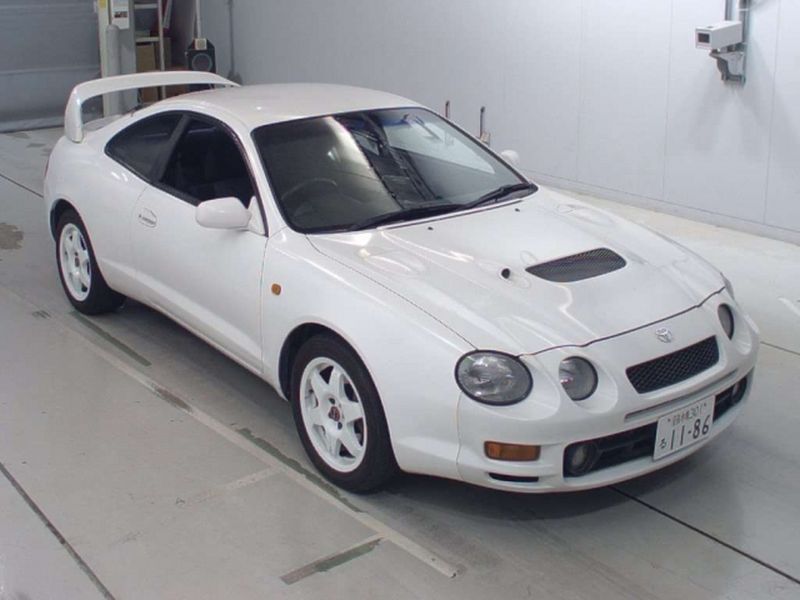
Celica SS-II
セリカ SS-II
Editorial review
- 型式Chassis
- ZZT231
- 製造者Maker
- Toyota
- 年式Years
- 1999-2006
- 用途Class
- Sports
参考動画Reference footage
From 1999 to 2006, the seventh-generation Toyota Celica (the T230/T231 series) redefined the landscape of Japanese domestic market sports coupes. Born from Toyota's "Project Genesis" initiative to recapture a younger demographic, this final iteration abandoned the heavy, all-wheel-drive, turbocharged architecture of the 1990s. Instead, it embraced a philosophy of extreme weight reduction, razor-sharp front-wheel-drive handling, and high-revving, naturally aspirated power.With its striking, cab-forward wedge shape that projected "visible aggressiveness," the seventh-generation Celica offered an impressive 0.32 drag coefficient. However, the true soul of this corner-carver lay under its hood. While base models utilized the dependable, economy-focused 1ZZ-FE engine, the ultimate performance variants were powered by the engineering marvel known as the 2ZZ-GE. Co-developed with Yamaha, this 1.8-liter powerplant utilized VVTL-i technology to deliver a sudden, shrieking surge of power past 6,000 RPM, screaming all the way to a blistering 8,200 RPM redline.Today, as the modern collector market increasingly covets the raw, analog engagement of early-2000s sports cars, the lightweight ZZT231 stands out. It remains an accessible yet fiercely capable machine, cementing its legacy as a "heavenly," high-revving icon in Toyota’s rich automotive heritage
諸元Specification of record
- 原動機Engine unit
- 2ZZ-GE
- 総排気量Displacement
- 1.8L Naturally Aspirated
- 最高出力Power
- 187 hp
- 最大トルクTorque
- 133 lb-ft
- 駆動方式Drivetrain
- FWD
- 変速機Transmission
- 6-speed Manual
- 車両重量Kerb weight
- 1,120 kg
Introduced in late 1999, the seventh-generation Toyota Celica marked a radical shift from the heavy, turbocharged all-wheel-drive grand tourers of the 1990s to a lightweight, naturally aspirated front-wheel-drive sports coupe. Conceived under Toyota's "Project Genesis" to appeal to younger drivers, the T230 series featured an aggressive, cab-forward wedge shape that minimized aerodynamic drag to an impressive 0.32 Cd. The Japanese domestic market also enjoyed exclusive variants like the TRD Sports M, a limited-production model featuring a seam-welded unibody, suspension upgrades, and a power increase to roughly 200 horsepower.The heart of this generation's performance lies in its 1.8-liter, all-aluminum four-cylinder engines. The base ZZT230 utilizes the 1ZZ-FE engine, designed with VVT-i for low-end torque and fuel efficiency, producing around 140 to 145 horsepower. In contrast, the high-performance ZZT231 features the 2ZZ-GE engine, famously co-developed with Yamaha. Utilizing VVTL-i (Variable Valve Timing and Lift with intelligence), the 2ZZ-GE behaves like a standard commuter car until it reaches approximately 6,000 to 6,200 RPM. At this threshold, it engages a high-lift cam profile—an event enthusiasts affectionately call "hitting lift"—delivering a violent surge of power up to a screaming 8,200 RPM redline and producing up to 192 horsepower depending on the market.To harness this high-revving power, Toyota built the Celica on a dedicated lightweight platform weighing as little as 1,120 kg (2,470 lbs). While most global markets received a standard MacPherson strut front suspension, the Japanese SS-II trim offered the highly coveted Super Strut suspension. This complex multi-link setup reduced the kingpin angle and spindle offset, virtually eliminating torque steer and providing immense front-end grip, which paired perfectly with the Celica's standard rear double-wishbone suspension.Despite Toyota's renowned reliability, the seventh-generation Celica requires specific preventative maintenance. Early 1ZZ-FE engines are notorious for excessive oil consumption due to piston ring design flaws. For the 2ZZ-GE, owners must address the "lift bolts"; the original blunt-tipped bolts are prone to snapping and disabling the VVTL-i system, so upgrading to Toyota's revised, tapered design (Part No. 90105-06293) is highly recommended. Furthermore, track enthusiasts must be wary of oil starvation during high-G cornering, which can destroy the engine. Upgrading to an aftermarket baffled oil pan, such as one manufactured by Moroso, is a vital modification for keeping the 2ZZ-GE safely lubricated during aggressive driving
来歴History & Motorsport Heritage
The legacy of the Toyota Celica began in December 1970, when it debuted at the Tokyo Motor Show alongside the Carina sedan. Designed originally as a response to the 1964½ Ford Mustang and the burgeoning American "pony car" market, the Celica was conceived to attach a sleek, stylized 2+2 coupe body to the proven, high-volume chassis of the Carina. Over its 36-year lifespan, the Celica transformed radically across seven generations, shifting from its classic rear-wheel-drive (RWD) roots to front-wheel-drive (FWD) and all-wheel-drive (AWD) layouts.While the seventh generation (the T230/T231 series) returned exclusively to a FWD layout, the Celica nameplate carries one of the most formidable motorsport pedigrees in automotive history. Its prowess on the world stage was cemented in the grueling arenas of the World Rally Championship (WRC). In the perilous Group B era, the Celica Twincam Turbo (TA64) achieved legendary status, winning all six WRC events it entered in Africa between 1983 and 1986. As Group A regulations took over, the AWD Celica GT-Four (chassis codes ST165, ST185, and ST205) dominated the sport from 1988 to 1997, securing two manufacturer's titles and four driver's championships. Legendary drivers like Carlos Sainz, Juha Kankkunen, and Didier Auriol drove the Celica to the absolute pinnacle of rally racing. The Celica's dominance even extended to the clouds; Rod Millen famously piloted a heavily modified, silhouette Celica race car to three overall victories at the Pikes Peak International Hill Climb between 1994 and 1997, setting a record that stood for over a decade.The seventh generation, despite lacking an AWD turbo variant, did not abandon the racetrack. In Japan, Team Racing Project Bandoh competed in the GT300 class of the Japanese Grand Touring Championship (and later Super GT) with a special RWD-converted variant of the seventh-generation Celica powered by a 3S-GTE engine, campaigning it successfully until 2008
希少性Exclusivity & Production Run
In late 1999, Toyota officially began production of the seventh-generation Celica, introducing it as part of an internal initiative known as "Project Genesis". This project was a targeted effort designed to lure younger buyers back to the Toyota marque in the United States, as the company feared the previous sixth-generation model had become overly mature, heavy, and cumbersome. Developed with the key phrase, "The Reinstatement of the Sports Specialty", Toyota aimed to build a car that possessed modern technology while reflecting the lightweight sports cars of yesteryear. The vehicles were assembled in Japan by Kanto Auto Works at the Higashi-Fuji plant in Susono, Shizuoka Prefecture.The seventh generation enjoyed strong initial success, with U.S. sales peaking at 52,406 units in 2000. However, the global sports coupe market began to rapidly shrink as consumer preferences shifted heavily toward SUVs, compounded by the aftermath of the Asian financial crisis and a strong Japanese yen. By 2003, U.S. sales plummeted to 14,856, and by 2005, only 3,113 units were sold. Consequently, exports to North America and Australia ceased in July 2005, and the final Celica rolled off the Japanese production lines on April 21, 2006, concluding a monumental 36-year production run.Despite its mass-market origins, the seventh-generation Celica birthed highly exclusive iterations. The most coveted is the TRD Sports M, a limited-production model restricted to just 1,200 units exclusively for the Japanese Domestic Market (JDM). Based on the top-tier SS-II trim, the Sports M featured a reinforced unibody with extra spot welds, TRD-tuned suspension, a lightweight flywheel, and a power bump to 200-203 PS (147-149 kW). Today, the Sports M is highly sought after by collectors seeking the ultimate factory iteration of the ZZT231
意匠Aerodynamics & Design Philosophy
The exterior design of the seventh-generation Celica, penned at Toyota's CALTY Design Research studio in California, represented a stark departure from the smooth, soap-bar "bio-design" of the 1990s. Embracing an ethos of "visible aggressiveness," the ZZT230/ZZT231 utilized sharp, intersecting triangular lines, a cab-forward profile, and a plunging wedge shape that mimicked much more expensive exotic sports cars. The "one-motion" silhouette featured vertically-elongated headlamps, a sculpted hood, and a remarkably low stance, achieving an impressive drag coefficient of 0.32 Cd.Aerodynamics were a critical focus. Toyota and its in-house tuning division, Toyota Racing Development (TRD), offered an aggressively styled aerodynamic enhancement set—known as the "Action Package" in North America or the "Mechanical Sports Version" in Japan. This factory body kit comprehensively managed airflow around the vehicle. The revised front bumper and air dam reduced aerodynamic drag by redirecting turbulent air away from the front wheels, while the extended side skirts prevented high-pressure air from becoming trapped beneath the chassis, mitigating high-speed lift. The prominent high-mount rear wing was meticulously designed to balance the pressure distribution, pressing the rear tires into the tarmac to generate vital downforce and high-speed stability.For the 2003 model year, the Celica received a mid-cycle facelift. The exterior updates included a restyled front bumper with a slimmer central air intake—moving the Toyota emblem from the grille up to the hood line—and revised rear taillights featuring a new circular inner design. Inside, the cabin transitioned from light grey plastics to a more premium dark charcoal finish, and the resin moonroof, which was prone to yellowing, was replaced with traditional glass
機関2ZZ-GE · Powerplant
The engineering marvel of the seventh-generation Celica lies beneath its sculpted hood. To achieve its aggressive weight-reduction goals, Toyota abandoned the heavy, cast-iron engines of the past and introduced two distinct 1.8-liter, all-aluminum four-cylinder engines: the economy-minded 1ZZ-FE and the high-strung, race-bred 2ZZ-GE.The base ZZT230 model (known as the GT in North America, and SS-I in Japan) utilized the 1ZZ-FE, producing 140 hp (104 kW) at 6,400 RPM and 125 lb-ft of torque at 4,200 RPM. Designed with a long-stroke configuration (79 mm bore x 91.5 mm stroke) and VVT-i (Variable Valve Timing with intelligence), the 1ZZ-FE was optimized for low-end torque, fuel efficiency, and daily drivability.However, the true beating heart of the ultimate Celica (ZZT231, GT-S, SS-II, or T-Sport depending on the market) was the 2ZZ-GE. Co-developed with Yamaha Motor Corporation, the 2ZZ-GE was engineered specifically to deliver blistering high-RPM performance without relying on forced induction. Displacing 1,796 cc, the 2ZZ-GE utilized a "square" design (82 mm bore x 85 mm stroke) that permitted the high piston speeds required to achieve its stratospheric 8,200 RPM redline. The die-cast aluminum block featured Metal Matrix Composite (MMC) cylinder liners—a blend of ceramic and fibers that offered superior heat dissipation and saved weight over traditional iron liners. With an aggressive compression ratio of 11.5:1, the engine demanded premium high-octane fuel to prevent pre-ignition.The secret to the 2ZZ-GE's bipolar personality was VVTL-i (Variable Valve Timing and Lift with intelligence). While standard VVT-i adjusted the camshaft phasing to optimize volumetric efficiency, the "L" added a dual-profile variable valve lift mechanism. Below 6,000 RPM, the engine operated on a low-duration cam profile (228° intake/exhaust duration, 7.6 mm lift), providing smooth idle and acceptable urban torque. But once the tachometer crossed the threshold—typically between 6,000 and 6,200 RPM, provided the engine coolant had reached at least 60°C (140°F)—an oil control valve engaged a locking pin in the rocker arm. This physically locked the valvetrain onto a massive high-lift, long-duration cam profile (292° intake duration, 11.2 mm lift), flooding the cylinders with air and fuel.The phenomenon, affectionately dubbed "hitting lift" by enthusiasts, resulted in a violent surge of acceleration and a shrieking acoustic change akin to a race car. Depending on the market, the 2ZZ-GE produced 180 hp to 192 hp, peaking at a screaming 7,600 to 7,800 RPM. To keep the engine in this narrow powerband, Toyota paired it with a close-ratio C60 6-speed manual transmission. The gearing was specifically spaced so that shifting near the 8,200 RPM redline would drop the engine RPM exactly to 6,200 RPM in the next gear, ensuring the engine never "fell out of lift" during maximum acceleration. By contrast, the optional U240E 4-speed automatic transmission suffered from wide gear spacing, forcing the engine out of the high-cam profile between shifts and severely blunting the car's performance
車台Chassis, Suspension & Handling Dynamics
Shedding the heavy all-wheel-drive hardware of its predecessors, the seventh-generation Celica was built on a dedicated, lightweight FWD platform. The curb weight hovered around a remarkable 1,120 kg to 1,140 kg (2,470 to 2,513 lbs), giving the car an exceptional power-to-weight ratio.At the rear, all ZZT231 models benefited from an advanced double-wishbone suspension setup, which provided superior toe and camber control under high cornering loads compared to the cheaper twist-beam axles found in many contemporary compacts. This sophisticated rear geometry kept the Celica firmly planted, contributing to its reputation as one of the sharpest and most precise front-wheel-drive handling cars of its era.The front suspension offered two distinct variations. Most global markets received a traditional MacPherson strut setup, which offered excellent tuning simplicity and low weight. However, in the Japanese domestic market, Toyota offered the SS-II with the highly coveted Super Strut Suspension. Born from Toyota's motorsport engineering, the Super Strut was a complex, multi-link MacPherson modification. By utilizing a two-part lower control arm featuring a "banana arm" and a "figure-of-eight" link, Toyota created a virtual kingpin axis inside the tire.This engineering sorcery reduced the kingpin angle from a standard 14 degrees down to just 6 degrees, and slashed the spindle offset from 66 mm to 18 mm. The result was the near-total elimination of torque steer and wheel hop, alongside the ability to maintain a constant, negative tire camber throughout the suspension's stroke. Drivers of Super Strut-equipped Celicas reported immense front-end grip, allowing them to apply full throttle mid-corner without losing traction or suffering from understeer—a feat nearly impossible on standard FWD platforms. While the Super Strut system was heavier and notoriously expensive to rebuild due to its numerous spherical bearings and specialized linkages, it provided unmatched tarmac performance and stability
名義Nomenclature & Lore
The name "Celica" is derived from the Latin word coelica, which translates to "heavenly" or "celestial". It is a fitting moniker for a car that, from 1970 to 2006, offered drivers an elevated, high-revving driving experience. Even as the automotive landscape shifted and the Celica evolved from a RWD pony car competitor to a high-tech FWD corner-carver, the celestial name remained synonymous with youthful energy, striking design, and accessible performance.
相場Auction Records & Modern Market Value
oday, the seventh-generation Celica sits in an interesting position within the modern collector market. Because it lacks the turbocharged, all-wheel-drive layout of the WRC-dominating GT-Four models from the 1990s, the ZZT230/ZZT231 generation has remained largely affordable. Modern market valuations place standard 2005 GT models around $2,800, with the higher-performance GT-S variants commanding around $4,725 in fair condition, according to Kelley Blue Book.However, pristine, unmodified examples of the 6-speed manual 2ZZ-GE models are becoming increasingly difficult to find, as many were subjected to poor modifications or neglected maintenance. The incredibly rare JDM TRD Sports M version commands a significant premium when it appears at auction, owing to its strict 1,200-unit production run, factory seam-welding, and tuned 200+ horsepower engine. As nostalgia for the high-revving, naturally aspirated sports cars of the early 2000s grows, clean ZZT231s are steadily appreciating as sought-after modern classics
継承Keeping the Legend Alive (Restomod & Specialist Culture)
Maintaining a high-performance ZZT231 today requires specialized knowledge, as the 2ZZ-GE engine possesses a few critical Achilles' heels. Restorers and owners must vigilantly address the infamous "lift bolt" failure. On 2000–2002 models, the blunt-tipped bolts securing the rocker shafts were prone to wearing down and snapping. When a bolt broke, the rocker shaft rotated, misaligning the oil passages and completely disabling the VVTL-i high-cam engagement. Toyota issued a Technical Service Bulletin (EG010-03) and released a revised, tapered bolt (Part No. 90105-06293), which enthusiasts routinely install as a crucial preventative maintenance measure.Additionally, track-day enthusiasts must combat oil starvation. Sustained high-G cornering on sticky tires can push the engine oil away from the pickup tube in the unbaffled stock oil pan, leading to instantaneous bearing destruction. Restorers solve this by installing aftermarket baffled oil pans, such as those made by Moroso, which trap the oil around the pickup tube regardless of lateral forces. Meanwhile, 1ZZ-FE owners must contend with excessive oil consumption issues caused by inherently flawed piston ring designs in early models, often necessitating engine rebuilds or swaps to late-model engines.Because the 2ZZ-GE engine is notoriously difficult to tune for massive power naturally aspirated, the aftermarket has embraced forced induction. Bolt-on supercharger kits—such as those utilizing the Eaton M62 compressor—are highly popular, delivering a linear power band that flawlessly complements the VVTL-i system, often pushing the car reliably past 220 horsepower. The 2ZZ-GE’s brilliant design was even validated by Lotus Cars, who sourced the Toyota engine for the legendary mid-engined Elise and Exige, utilizing superchargers to push the powerplant up to 260 PS in the Exige Cup 260.When the Celica was discontinued in 2006, Toyota attempted to fill the void in the North American market with the Scion tC, acting as a spiritual successor aimed at the youth demographic. However, it is the modern Toyota GR86 (and its predecessor, the GT86) that truly inherited the seventh-generation Celica's ethos: a lightweight, naturally aspirated, high-revving sports coupe focused intensely on handling dynamics and driver engagement.Yet, the "heavenly" nameplate refuses to fade into obscurity. In late 2024, Toyota executives confirmed rumors that a new Celica sports car is currently in active development, with an anticipated market introduction in 2026 or 2027. Whether it returns with electric power, hybrid assistance, or a combustion engine, the upcoming revival promises to carry the torch of an automotive legend—ensuring that the celestial legacy of the Toyota Celica will continue for a new generation of enthusiasts.
結 · IN CLOSING
The seventh-generation Toyota Celica (1999–2006) represents a radical shift towards a lightweight, front-wheel-drive sports coupe design. It was offered with two distinct 1.8-liter engines: the economy-focused 1ZZ-FE (producing around 140 hp) and the high-performance, Yamaha-co-developed 2ZZ-GE (producing up to 192 hp). The 2ZZ-GE engine is celebrated for its VVTL-i technology, which engages a high-lift cam profile above 6,000 RPM, delivering a massive surge in power up to an 8,200 RPM redline. To maximize this peaky powerband, the 2ZZ-GE is paired with a close-ratio 6-speed manual transmission.While highly regarded for its razor-sharp handling—especially Japanese models equipped with the complex, torque-steer-reducing Super Strut suspension—the Celica requires specific preventative maintenance. Early 1ZZ-FE engines (2000–2002) are notorious for excessive oil consumption, an issue largely resolved in post-2003 facelift models. Meanwhile, the 2ZZ-GE engine is susceptible to snapping its "lift bolts," which disables the high-lift cam and requires an upgraded tapered bolt (Part No. 90105-06293) to fix. Track enthusiasts must also install aftermarket baffled oil pans to prevent fatal engine oil starvation during high-G cornering. A mid-cycle facelift in 2003 further refined the car, introducing an updated front bumper, darker interior plastics, and revised taillights
この項目についてAbout this entry
Specification figures are cross-checked against factory data and period source material. Editorial is researched and reviewed before publication; drafting and formatting may be assisted by tooling, but accuracy checks rest with the editorial desk. This entry was last reviewed in August 2026. Spotted an error? Send a correction →