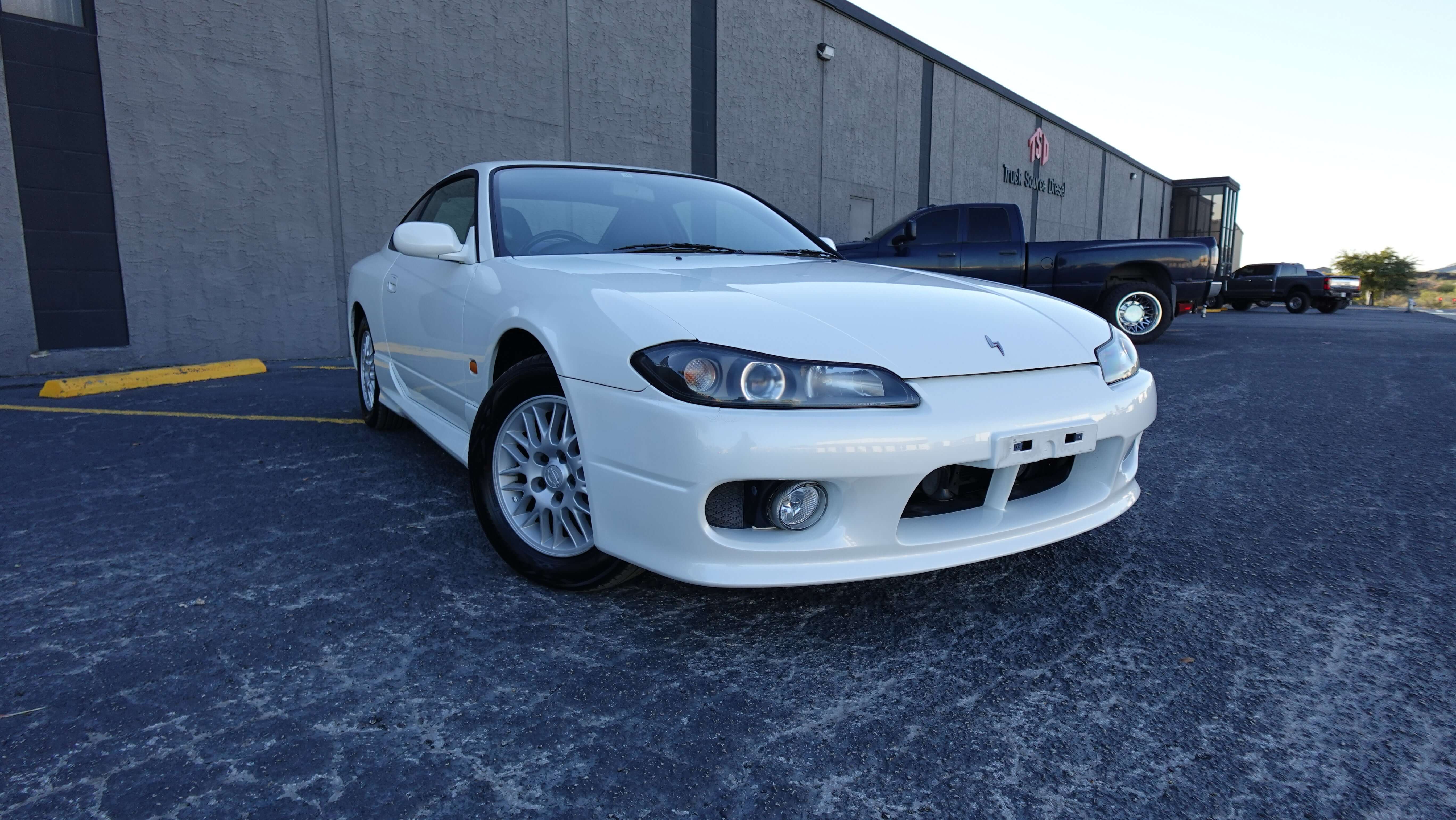
Skyline GT-R V-Spec II
スカイライン GT-R
Editorial review
- 型式Chassis
- BNR34
- 製造者Maker
- Nissan
- 年式Years
- 1999-2002
- 用途Class
- Sport
参考動画Reference footage
The definitive icon of the PlayStation generation. The R34 GT-R refined the formula established by the R32, adding advanced aerodynamics, a stiffer chassis, and the legendary Multi-Function Display. Its RB26DETT engine is famous for its immense tuning potential, often exceeding 1000hp in modified examples.
諸元Specification of record
- 原動機Engine unit
- RB26DETT
- 総排気量Displacement
- 2.6L Twin-Turbo
- 最高出力Power
- 276 hp
- 最大トルクTorque
- 289 lb-ft
- 駆動方式Drivetrain
- ATTESA E-TS Pro AWD
- 変速機Transmission
- 6-speed Manual
- 車両重量Kerb weight
- 1,560 kg
The Nissan Skyline GT-R is arguably the most revered and iconic vehicle to ever emerge from the Japanese Domestic Market (JDM). From its humble origins as a luxury sedan to its evolution into a world-beating, technology-laden supercar killer, the Skyline GT-R possesses a history that spans more than half a century. For decades, the Skyline GT-R was a "unicorn" to enthusiasts outside of Japan and Australia, as Nissan never officially exported the vehicle to markets like the United States. Instead, an entire generation of global car enthusiasts first experienced the GT-R digitally, piloting the legendary machine in video games like Gran Turismo and Need for Speed, or watching it dominate the silver screen in the Fast and Furious film franchise. Beyond its pop-culture iconography, the Skyline GT-R represents a philosophy of continuous improvement, where relentless motorsport success directly dictated the mechanical and aerodynamic evolution of the production vehicle.
来歴History & Motorsport Heritage
The lineage of the Skyline GT-R actually begins outside of the Nissan brand, originating with the Prince Motor Company in April 1957. Initially conceived as a modest 1.5-liter luxury sedan and station wagon, the Skyline's transition toward high-performance racing began in 1964 with the Prince Skyline GT (S54B). Powered by a 2.0-liter inline-six engine with triple carburetors, the S54B famously secured second place against a purpose-built Porsche 904 GTS at the 1964 Japanese Grand Prix. This near-victory galvanized Shinichiro Sakurai, an engineer who resolved to create a Japanese vehicle capable of outright defeating the European racing elite.Following Prince's merger with Nissan in 1966, this ambition materialized into the very first Nissan Skyline GT-R in 1969, initially released as a four-door sedan (PGC10) and later as a two-door coupe (KPGC10). Affectionately known as the "Hakosuka" (combining the Japanese word for box with the abbreviation of Skyline), this 160-horsepower machine secured an astonishing 52 victories in its first three years of competition. The Hakosuka was succeeded in 1973 by the KPGC110 generation, dubbed the "Kenmeri" due to a popular advertising campaign. Unfortunately, the 1970s oil crisis and tightening global emissions standards abruptly halted the GT-R program; Nissan sold only 197 units of the Kenmeri GT-R, and the legendary badge went dormant.After a 16-year hiatus, Nissan resurrected the GT-R moniker in 1989 with a singular goal: absolute dominance in Group A touring car racing. The resulting R32 generation was a technological marvel that systematically dismantled its competition. In the Japanese Touring Car Championship (JTCC), the R32 GT-R won all 29 races it entered from 1990 to 1993, taking the series title every single year. Its motorsport supremacy was not limited to Japan; the GT-R took the overall win at the 1991 Spa 24 Hours in Europe, and it utterly dominated the Australian Touring Car Championship. Nissan later evolved the platform into the R33 generation, which famously became the first production vehicle to break the sub-8-minute mark at the grueling Nürburgring Nordschleife circuit, recording a lap time of 7:59.887. Nissan even entered heavily modified R33 GT-R LM prototypes into the 24 Hours of Le Mans in 1995 and 1996, proving the chassis could compete on the world's most prestigious endurance stage.
希少性Exclusivity & Production Run
The production numbers of the Skyline GT-R highlight its transition from a mass-produced sports coupe to an incredibly exclusive collector's item. The R32 generation, fueled by massive critical acclaim and homologation requirements for Group A racing, saw a robust total production run of 43,937 units between 1989 and 1994. This included highly specialized, limited-production variants like the lightweight N1 (245 units), the aerodynamic Nismo edition (560 units), and the performance-enhanced V-Spec II (1,303 to 1,306 units).The subsequent R33 generation, produced between 1995 and 1998, was more exclusive, with total production reaching 16,668 units. This era introduced ultra-rare variants like the Nismo 400R, of which only 44 units were ever manufactured, and the Autech Version 40th Anniversary four-door sedan, limited to just 416 examples.However, it is the fifth-generation R34 model (1999–2002) that represents the absolute pinnacle of GT-R exclusivity and desirability. Nissan produced a total of just 11,578 R34 GT-Rs across all trim levels. Among these, the V-Spec II was limited to 1,855 units, offering significant mechanical upgrades over the base model.The most coveted factory models are the final "Nür" editions, released in February 2002 to commemorate the car's development at the Nürburgring. Nissan built a total of 1,003 Nür models, split between 718 track-focused V-Spec II Nürs and 285 luxury-oriented M-Spec Nürs. Finding one of these in the iconic Millennium Jade paint color is exceptionally difficult, as only 156 cars worldwide were finished in this shimmering olive-gold hue.Beyond the factory production run, the legendary Nismo Z-Tune represents the rarest GT-R of all. Created to celebrate Nismo's 20th anniversary long after R34 production had ended, Nismo purchased 18 pristine, low-mileage used R34 GT-Rs, stripped them to their bare shells, and hand-built them into 500-horsepower hypercars. Including the original prototype, only 19 Z-Tunes exist in the world today.
意匠Aerodynamics & Design Philosophy
The design philosophy of the Skyline GT-R has always been dictated by function over form, utilizing advanced materials and aerodynamic optimization to achieve maximum track performance. While the R33 generation was sometimes criticized for its bulkier dimensions, Nissan responded by making the R34 physically shorter, reducing the front overhang, and creating a highly rigid steel bodyshell that was 56% stiffer than its predecessor.From the outside, the GT-R separated itself from standard Skylines with heavily flared custom fenders, deep side skirts, and a massive adjustable rear wing designed to generate immense high-speed downforce. To reduce the vehicle's curb weight, the standard R34 GT-R utilized an aluminum hood and aluminum front panels. The track-focused V-Spec II model, however, took this material science further by introducing a revolutionary carbon fiber engine hood. Crafted using advanced pre-preg (dry) carbon fiber technology—which offered a vastly superior strength-to-weight ratio compared to traditional wet layup carbon—this hood featured a prominent NACA duct. Originally developed by the predecessor of NASA, the NACA duct efficiently drew cool air directly into the engine bay with minimal aerodynamic drag, effectively managing the extreme thermal loads generated during sustained high-speed racing.The V-Spec and V-Spec II models also featured significant underbody aerodynamic enhancements, utilizing a carbon fiber rear air diffuser to smooth underbody airflow and create a low-pressure zone that sucked the car to the tarmac.Inside the cabin, the GT-R embraced a spartan, driver-focused atmosphere. The centerpiece of the R34's interior was an advanced 5.8-inch LCD Multi-Function Display (MFD) mounted atop the center console. Years ahead of its time, this telemetry screen provided the driver with live readings of seven different vehicle statistics, including turbocharger boost pressure, oil temperature, and water temperature. The V-Spec variants added intake and exhaust gas temperatures to the display, while an optional Nismo MFD upgrade introduced a lap timer and a G-force meter, cementing the car's video-game-like, hyper-technological identity
機関RB26DETT · Powerplant
The absolute core of the Skyline GT-R's legendary status is its beating heart: the RB26DETT engine. When developing the R32 generation, Nissan engineers originally tested a 2.4-liter engine, but realized that Group A racing regulations required a 1.7 displacement multiplier for turbocharged vehicles. To fit perfectly into the 4,500 cc racing class and allow for massive 11-inch-wide tires, Nissan specifically engineered the inline-six, twin-turbocharged, dual-overhead-camshaft RB26DETT to displace exactly 2.6 liters (2,568 cc).Officially, the engine was rated at 276 horsepower (280 PS) and 289 lb-ft of torque. However, this figure was famously understated to comply with a "Gentleman's Agreement" among Japanese automakers to avoid a horsepower war; in reality, the factory RB26DETT frequently produced in excess of 330 horsepower. The engine block was notoriously over-engineered, providing a blank canvas for the aftermarket tuning community, who quickly realized the motor could reliably handle 800 to 1,000 horsepower with modifications.For motorsport homologation, Nissan developed the highly specialized N1 specification of the RB26 engine, engineered by Nissan's REINIK division specifically for grueling endurance racing. The N1 block (identifiable by a "24U" stamp) featured thicker cylinder walls and enhanced water cooling channels to prevent overheating. It utilized an upgraded water pump, a higher-flowing oil pump, and balanced connecting rods. Most importantly, the N1 engines abandoned the standard ceramic turbocharger turbine blades in favor of steel blades. While the lighter ceramic blades spooled up faster, they were prone to shattering under extreme heat and high boost pressures during sustained track use. The steel blades offered vastly superior durability, allowing tuners to safely increase boost pressure and achieve staggering outputs.The final evolution of this powerplant was placed in the R34 V-Spec II Nür and M-Spec Nür editions. These Nür engines were based directly on the N1 racing block, featuring the upgraded steel turbos and altered camshaft timing, and were visually distinguished by exclusive gold-painted valve covers instead of the standard cherry red. Power was delivered to the wheels through a robust, close-ratio Getrag V160 six-speed manual transmission
車台Chassis, Suspension & Handling Dynamics
If the RB26DETT provided the brute force, the Skyline GT-R's incredibly sophisticated chassis and drivetrain provided the surgical precision. The secret weapon of the GT-R was the ATTESA E-TS (Advanced Total Traction Engineering System for All-Terrain) all-wheel-drive system. Utilizing two accelerometers mounted under the center console, this electronically controlled torque-split system proactively monitored longitudinal and lateral inputs. Under normal driving conditions, the GT-R operated primarily as a rear-wheel-drive vehicle, but the computer could instantly transfer up to 50% of the torque to the front wheels the moment slip was detected, allowing the car to launch out of corners with devastating efficiency.The vehicle also utilized the Super-HICAS (High Capacity Actively Controlled Steering) four-wheel steering system, which turned the rear wheels slightly in the same direction as the front wheels at speeds above 80 km/h (50 mph) to improve high-speed cornering stability and turn-in.For drivers seeking the ultimate track weapon, Nissan offered the "Victory Specification" or V-Spec package. First introduced on the R32 to celebrate JTCC dominance, the V-Spec models featured stiffer, retuned sport suspension that lowered the car's ground clearance. Stopping power was provided by massive Brembo aluminum opposed-piston calipers biting down on large ventilated rotors, hidden behind 17-inch (and later 18-inch) forged alloy wheels.The R33 and R34 V-Spec models received a significant drivetrain upgrade in the form of the ATTESA E-TS Pro system. Unlike the standard mechanical differential, the Pro system integrated an electronically controlled active rear limited-slip differential (LSD). By analyzing throttle position, steering angle, and G-forces, the active LSD could preemptively lock and aggressively vector torque between the left and right rear wheels, providing the GT-R with supernatural agility and the ability to grip the road like few other vehicles of its era.For buyers wanting comfort alongside speed, Nissan released the M-Spec in 2001 (named after chief engineer Kazutoshi Mizuno). The M-Spec retained the advanced ATTESA Pro system but replaced the harsh track suspension with specialized "Ripple control" dampers, a stiffer rear sway bar, and a luxurious leather interior with heated seats, creating the ultimate high-speed grand tourer
名義Nomenclature & Lore
The Skyline GT-R's fearsome nickname, "Godzilla," was not born in Japan, but rather forged in the crucible of Australian motorsport. In 1990, the R32 GT-R arrived in the Australian Touring Car Championship (ATCC) and immediately disrupted the established hierarchy. Competing in the local Group A class against formidable domestic V8 muscle cars and the potent Ford Sierra Cosworth, the technologically advanced GT-R was entirely unrivaled.With drivers like Jim Richards and Mark Skaife at the helm, the R32 GT-R won the prestigious Bathurst 1000 endurance race in both 1991 and 1992, utterly dominating the competition despite being saddled with 140 kg weight penalties and turbo pressure restrictions imposed by race officials attempting to level the playing field. Witnessing this unstoppable, seemingly indestructible Japanese monster terrorizing local racetracks, the Australian motoring publication Wheels formally dubbed the R32 GT-R "Godzilla" in its July 1989 edition.The moniker stuck permanently. When the R34 generation debuted a decade later, Wheels magazine famously declared "Godzilla Returns," describing it as the best-handling car they had ever driven. Today, the name Godzilla is universally recognized as synonymous with the skyline GT-R brand, perfectly encapsulating its giant-slaying performance capabilities
相場Auction Records & Modern Market Value
In recent years, the Nissan Skyline GT-R has transitioned from an underground tuner legend into a blue-chip financial asset, with market values skyrocketing to unprecedented heights. This immense surge in modern market value is primarily driven by the United States National Highway Traffic Safety Administration's (NHTSA) "25-year rule," which dictates that non-compliant foreign vehicles cannot be legally imported for road use until they are 25 years old.As the earliest R32 and R33 models passed this threshold, demand surged; an R32 that cost $12,000 just a few years ago now commands well over $25,000 for a decent example. However, it is the R34 market that has truly exploded. 1999 models of the R34 became federally legal in 2024, causing a frenzy among deep-pocketed collectors.Today, a well-maintained R34 V-Spec II commands an average market value exceeding $183,000, with record auction sales reaching a staggering $577,500. The highly exclusive 2002 Nür editions are even more valuable, regularly trading hands in the $400,000 to $700,000 range. Recently, a virtually untouched 2002 V-Spec II Nür finished in Millennium Jade, showing a jaw-dropping 225 miles (362 km) on the odometer, was listed for sale in Japan at an asking price of $485,000. Because of its 2002 build date, this specific time capsule will not even be legal for street driving in the US until 2027.Certain ultra-rare variants can bypass the 25-year wait via the US government's "Show or Display" exception, which permits the importation of technologically or historically significant vehicles, strictly limiting them to 2,500 driven miles per year. The 2002 M-Spec Nür is one of only two R34 variants granted this special status. At the absolute zenith of the collector market sits the Nismo Z-Tune; if one of the 19 existing examples were to go to auction today, its value is estimated to comfortably exceed $2,000,000
継承Keeping the Legend Alive (Restomod & Specialist Culture)
With prices reaching supercar territory, maintaining and restoring the Skyline GT-R has become a highly specialized industry. Restorers like New York's Skyline Source emphasize finding "pure," well-sorted examples that have avoided heavy aftermarket modifications. When inspecting classic GT-Rs, experts warn buyers to meticulously check for rust in the strut towers, trunk floor, window surrounds, and jack points.Recognizing the cultural and financial importance of preserving these vehicles, Nissan itself stepped in to keep the legend alive. In 2019, Nissan's Nismo division launched the Heritage Program, officially resuming the manufacturing of discontinued spare parts for the R32, R33, and R34 generations. This incredible initiative produces everything from original exterior body panels to brand-new, factory-fresh RB26 engine blocks, ensuring that existing Skylines can be kept on the road indefinitely.When Nissan finally ceased production of the R34 in August 2002, the automotive world waited with bated breath for Godzilla's return. In 2007, Nissan unveiled the modern successor, officially severing the vehicle from the "Skyline" family tree and naming it simply the Nissan GT-R (R35).Built on an advanced Premium Midship (PM) platform, the R35 abandoned the legendary inline-six engine for an entirely new 3.8-liter, twin-turbocharged VR38DETT V6. Launching with 480 horsepower—and eventually evolving to produce 600 horsepower in modern Nismo trims—the R35 GT-R utilized a lightning-fast dual-clutch transmission and an updated ATTESA all-wheel-drive system to absolutely decimate European supercars. Though it lacks the Skyline badge, the R35 retains the iconic quad round taillights, the muscular styling, and the sheer, brutal performance that defined its predecessors. Through dedicated restorers, passionate JDM communities, and a modern successor that refuses to compromise, the legacy of the ultimate Skyline GT-R remains as powerful today as the day the first Hakosuka rolled onto the track
結 · IN CLOSING
The Nissan Skyline GT-R is a legendary Japanese sports car whose lineage traces back to the Prince Motor Company's original 1957 sedan. The first performance-focused GT-R debuted in 1969, establishing a dominant racing pedigree with 52 victories in its first three years. Following a 16-year hiatus due to the 1970s oil crisis, Nissan resurrected the GT-R badge in 1989 with the R32 generation. This model earned the famous nickname "Godzilla" after completely dominating Group A and Australian touring car racing.Successive generations, specifically the R33 and R34, continually refined the GT-R's advanced technology. These vehicles utilized the formidable RB26DETT twin-turbo inline-six engine and the highly sophisticated ATTESA E-TS all-wheel-drive system to deliver unparalleled handling and grip. Nissan produced highly coveted variants for purists, like the track-focused V-Spec II, which featured stiffer suspension and innovative carbon fiber aero components, alongside the ultra-rare Nür editions equipped with upgraded N1 racing engines.Beyond motorsport, the Skyline GT-R became a global pop-culture phenomenon through prominent appearances in video games like Gran Turismo and the Fast and Furious films. Today, it is revered as a blue-chip financial asset; pristine models like the R34 V-Spec II Nür regularly command staggering prices near $500,000 as they become fully legal for US importation
この項目についてAbout this entry
Specification figures are cross-checked against factory data and period source material. Editorial is researched and reviewed before publication; drafting and formatting may be assisted by tooling, but accuracy checks rest with the editorial desk. This entry was last reviewed in August 2026. Spotted an error? Send a correction →