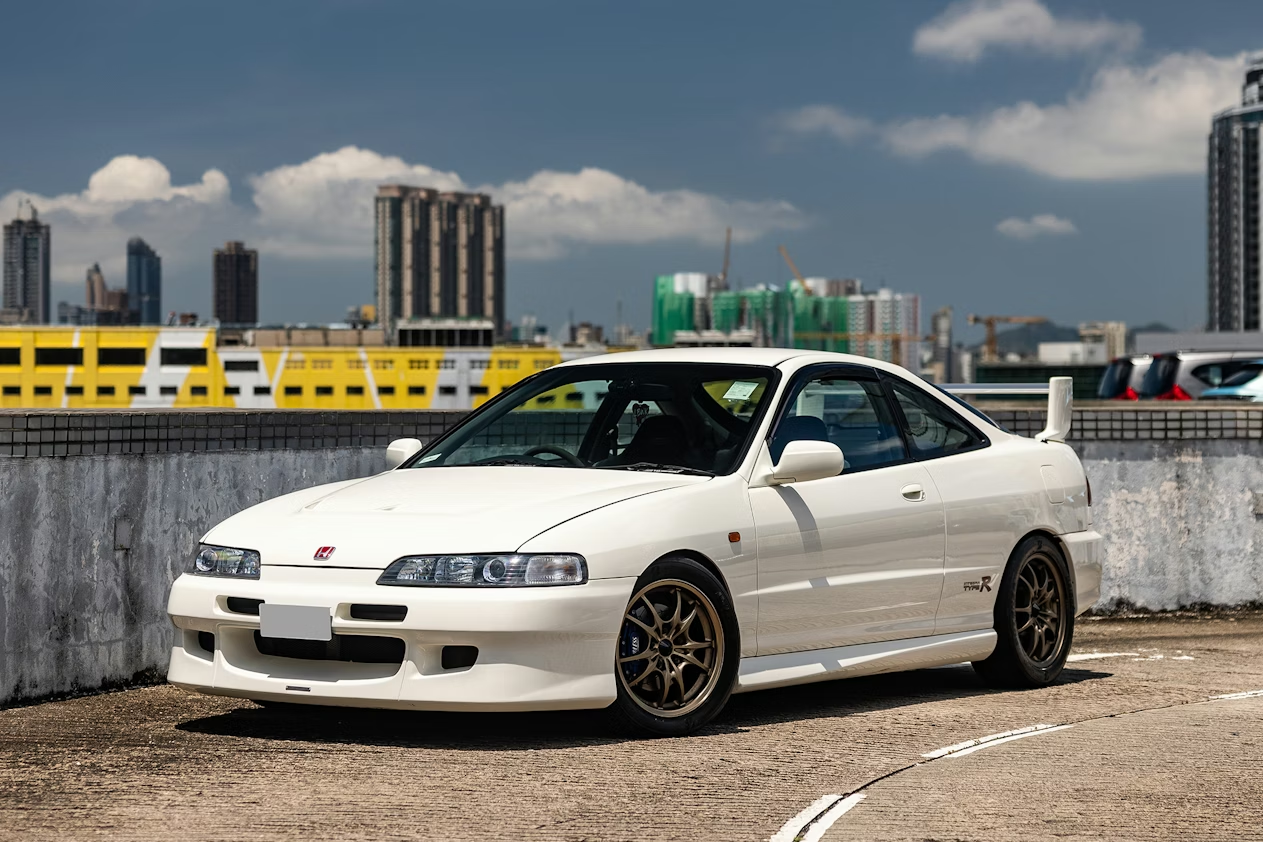
NSX-R
ホンダ NSX
Editorial review
- 型式Chassis
- NA1
- 製造者Maker
- Honda
- 年式Years
- 1992-1995
- 用途Class
- Supercar
参考動画Reference footage
Developed with input from Ayrton Senna, the NSX was the first production car to feature an all-aluminum semi-monocoque body. The Type R variant stripped away sound deadening, air conditioning, and traction control to create the purest possible driving experience.
諸元Specification of record
- 原動機Engine unit
- C30A
- 総排気量Displacement
- 3.0L V6 VTEC
- 最高出力Power
- 276 hp
- 最大トルクTorque
- 217 lb-ft
- 駆動方式Drivetrain
- MR
- 変速機Transmission
- 5-speed Manual
- 車両重量Kerb weight
- 1,230 kg
The automotive landscape of the late 1980s and early 1990s was characterized by a distinct polarization: you either drove a highly reliable but uninspiring commuter car, or you piloted a high-performance European exotic that was temperamental, ergonomically flawed, and mechanically fragile. European giants like Ferrari and Porsche dominated the performance road, operating under the assumption that a true supercar inherently required heavy clutches, cramped cabins, massive blind spots, and frequent, wallet-draining "engine-out" maintenance.Into this complacent establishment arrived a mid-engined disruptor from Japan that changed the rules of supercar manufacturing forever. The Honda NSX (sold as the Acura NSX in North America and Hong Kong) emerged from the height of the Japanese "bubble economy" not merely to compete with the European elite, but to fundamentally redefine the parameters of high performance. Blending cutting-edge aerospace technology with Honda's legendary everyday reliability, the NSX proved that a mid-engine exotic could be both a track-dominating weapon and an entirely sensible daily driver. It was a violent wake-up call that shook the supercar industry to its core, forcing legacy manufacturers to elevate their engineering or be left in the rearview mirror.
来歴History & Motorsport Heritage
Honda's ambition to build a world-beating sports car was born from its overwhelming success as an engine supplier in Formula 1 during the 1980s. The brand desired a road-going machine that reflected its unassailable racing credibility. Naturally, the development of the NSX heavily leveraged Honda's motorsports division and its deep ties to legendary racing drivers. Notably, highly skilled Japanese Formula 1 driver Satoru Nakajima performed extensive endurance testing and chassis tuning at the Suzuka race circuit, while American automobile dealer and 1986 Indianapolis 500 champion Bobby Rahal also participated in refining the car's suspension.However, the NSX's history is most deeply intertwined with the late, great three-time Formula 1 World Champion Ayrton Senna. In 1989, Senna was at Suzuka testing his Honda-powered McLaren MP4/5 when he was invited to drive the pre-production NSX. Senna delivered a blunt critique: while the car was good, it felt "fragile". Taking the champion's words as gospel, Honda engineers retreated to their development base at the Nürburgring—spearheaded by chief development driver Motoharu Kurosawa—and stiffened the aluminum chassis by a massive 50 percent.Beyond its development, the NSX boasts a staggering competitive motorsport pedigree, proving its mettle at the highest levels of global endurance racing. The NSX made three consecutive appearances at the grueling 24 Hours of Le Mans in 1994, 1995, and 1996. In 1995, factory-backed shells were extensively reworked by TC Prototypes in England with dry carbon fiber tubs, bespoke suspension, and race-tuned engines. Team Kunimitsu entered a naturally aspirated GT2 class NSX—driven by Keiichi Tsuchiya, Akira Iida, and Kunimitsu Takahashi—which finished 8th overall and decisively won the GT2 class.The NSX was also an absolute titan in the Japanese Grand Touring Championship (JGTC) and Super GT. Evolving through multiple "Phase" iterations with chassis development by Dome and engine tuning by Mugen, the NSX-GT scored pole position in every single race of the 1998 season. By 2000, despite significant transmission fragility issues, the Castrol NSX captured the Drivers' and Teams' Championship without scoring a single race win. Armed with a longitudinally mounted engine layout and eventually transitioning between naturally aspirated and turbocharged V6 setups pushing nearly 500 horsepower, the NSX-GT amassed 36 race victories, 45 pole positions, and multiple championships before its retirement in 2009
希少性Exclusivity & Production Run
Despite being produced by a mass-market automaker, the NSX was manufactured with the bespoke craftsmanship expected of an elite exotic. Honda constructed a purpose-built R&D plant in Takanezawa, Tochigi (and later moved to Suzuka) where a hand-picked team of roughly 200 of the company's highest-skilled personnel assembled the vehicles. These technicians required a minimum of ten years of assembly experience, ensuring that every extrusion and weld met exacting tolerances. At its peak, the facility produced just 25 examples per day. Over its 15-year first-generation lifespan (1990–2005), total worldwide sales reached just over 18,000 units, guaranteeing its rarity on the road.The exclusivity of the standard NSX pales in comparison to its limited-run, special-edition variants, which represent the true collector grails:NSX Type R (NA1, 1992-1995): Conceived for no-compromise track performance, Honda built a limited run of just 483 units entirely exclusive to the Japanese Domestic Market (JDM).NSX-T (1995-2005): Introduced with a removable targa top to appeal to open-cockpit driving enthusiasts, though it required approximately 100 pounds of structural reinforcement to compensate for the loss of the roof.NSX Type S and Type S-Zero (1997): JDM-exclusive lightweight variants. The Type S saw 209 units produced, while the extreme, track-day S-Zero (which omitted cruise control, stereo, airbags, and sound deadening) saw a microscopic production run of just 30 units.Alex Zanardi Edition (1999): Built exclusively for the United States to commemorate Alex Zanardi's back-to-back CART IndyCar championships, only 51 examples were produced, all finished in Formula Red.NSX-R (NA2, 2002): The second-generation facelifted Type R saw only around 140 units ever made, becoming a darling of professional drivers and track purists.NSX-R GT (2005): Built solely to satisfy Super GT homologation rules, this extreme widebody variant with roof-mounted snorkel intakes was limited to just 5 units built, with only a single car actually sold to the public, making it the rarest NSX in existence.
意匠Aerodynamics & Design Philosophy
The exterior silhouette of the NSX was heavily dictated by the pursuit of aerodynamic efficiency and optimal driver visibility. Executive Chief Engineer Shigeru Uehara famously studied the 360-degree visibility inside the cockpit of an F-16 fighter jet to conceptualize the car's greenhouse. This "cab-forward" layout pushed the cockpit ahead of the mid-mounted powerplant, heavily enhancing forward visibility while a long tail design promoted supreme high-speed directional stability. The low shoulder line, clearly inspired by the Ferrari 328, allowed for a massive windshield and a pillar-less rear glass canopy that provided a sprawling 312-degree viewing angle—a stark contrast to the claustrophobic blind spots of Italian contemporaries.Aerodynamics were significantly upgraded over the vehicle's lifespan. In December 2001, Honda executed a major facelift (NA2), replacing the beloved 1990s pop-up headlamps with fixed HID xenon units and lowering the rear valence. These extensive wind-tunnel refinements successfully reduced the car's drag coefficient from 0.32 Cd to a highly slippery 0.30 Cd, resulting in a higher top speed and improved straight-line acceleration.For the track-focused NSX-R models, Honda applied the principle of "aerodynamically-induced stability". Engineers achieved a degree of negative lift (downforce) rarely seen on street-legal cars of the era. The NA2 NSX-R achieved this via a completely flattened underbody, a massive carbon fiber hood featuring an air outlet duct to extract radiator air, longitudinal underbody fins to prevent wheel-well turbulence, a rear diffuser, and a prominent carbon fiber rear spoiler.
機関C30A · Powerplant
Initially, Honda experimented with smaller engines, but realizing they needed to outgun Ferrari, they settled on a masterpiece: a naturally aspirated, double-overhead-camshaft V6 engine. The 3.0-liter C30A V6 was an absolute tour de force of metallurgical innovation, standing as the very first production car engine to utilize titanium alloy connecting rods. These titanium rods were significantly lighter and stronger than steel, reducing reciprocating mass and allowing the engine to safely rev to a screaming 8,000 RPM redline (with fuel cut at 8,300 RPM).Furthermore, the NSX showcased Honda's revolutionary VTEC (Variable Valve Timing and Lift Electronic Control) system, which hydraulically switched between two camshaft profiles—one for smooth low-end drivability and a highly aggressive profile for high-RPM breathing. The original C30A engine outputted 270 horsepower (280 PS) and 210 lb-ft of torque.In 1997, Honda introduced a major performance update, giving birth to the 3.2-liter C32B engine (for manual transmission models). By utilizing ultra-thin fiber-reinforced metal (FRM) cylinder liners, engineers increased the bore from 90.0mm to 93.0mm without increasing the block's physical size. Coupled with a new lightweight stainless steel exhaust header, larger intake valves, and a high-flow exhaust manifold, power officially jumped to 290 horsepower and 224 lb-ft of torque.For the hallowed NSX-R variants, Honda's elite technicians effectively "blueprinted" each engine to racing specifications. The entire rotating assembly—crankshaft, pistons, rods, and pulleys—was dynamically balanced to a level of accuracy ten times greater than a standard NSX. The weight tolerance between piston and rod pairs was slashed in half to drastically minimize parasitic inertial loss. While the "gentleman's agreement" among Japanese manufacturers capped advertised output at 276 horsepower, it is widely accepted by automotive press that these blueprinted Type R engines produced much higher true figures.The transmission was equally critical. The 1997 update swapped the 5-speed manual for a closer-ratio 6-speed unit. For the ultimate acceleration edge, the NA1 NSX-R utilized an ultra-short 4.235:1 final drive ratio (up from the standard 4.062:1) paired with custom "JDM short gears" and a higher-locking, pre-loaded limited-slip differential. This precise gearing kept the V6 absolutely singing within its VTEC powerband, sacrificing a minor amount of top speed for blistering, aggressive corner-exit acceleration.
車台Chassis, Suspension & Handling Dynamics
The defining engineering achievement of the NSX was its structure. It was the world's first production car to feature an all-aluminum semi-monocoque chassis. By utilizing extruded aluminum alloy frames and suspension components, Honda saved an astonishing 200 kg (441 lbs) in the body and 20 kg (44 lbs) in the suspension compared to traditional steel construction. This extreme lightweighting allowed a fully equipped NSX to tip the scales around 1,370 kg (3,020 lbs).The forged aluminum double-wishbone suspension at all four corners granted the NSX impeccable wheel control. However, track enthusiasts noted that the standard car's rear-biased spring rates could occasionally induce snap-oversteer at the absolute limit.Enter the NSX-R. To transform the refined grand tourer into an uncompromised track weapon, Honda initiated a ruthless weight reduction program. Engineers stripped out the sound deadening, undercoating, audio system, spare tire, traction control, and air conditioning. Power leather seats were replaced by incredibly light carbon-Kevlar racing buckets manufactured by Recaro, while standard alloys were swapped for forged aluminum wheels by Enkei (and later BBS). Power steering was completely deleted in favor of a highly communicative manual rack-and-pinion setup. Ultimately, the NA1 NSX-R weighed a mere 1,230 kg (2,712 lbs).Handling dynamics on the Type R were radically sharpened. Honda reversed the suspension bias, outfitting the front end with significantly stiffer springs and a much thicker sway bar (e.g., front spring rates jumped from 3.0 kg/mm to 8.0 kg/mm). This shifted the load transfer forward, drastically increasing high-speed cornering stability. Additional aluminum chassis brackets were welded under the battery tray and radiator to eliminate flex. The result was a telepathic, laser-precise instrument; legendary driver Keiichi "Drift King" Tsuchiya praised its mid-engine balance, and in 2003, Motoharu Kurosawa piloted an NA2 NSX-R around the Nürburgring Nordschleife in an astonishing 7:56—matching the lap time of the vastly more powerful Ferrari 360 Challenge Stradale.
名義Nomenclature & Lore
When the concept was first commissioned in 1984 in collaboration with Pininfarina, it was designated the HP-X (Honda Pininfarina eXperimental). As the project evolved entirely in-house into a world-beating production model, the prototype was rechristened NS-X, an acronym standing for "New Sportscar eXperimental". Just prior to the official commencement of production and sales, Honda removed the hyphen, officially solidifying the legend of the NSX.The vehicle debuted in North America under Honda's newly formed luxury marque, Acura, to serve as its ultimate halo vehicle and brand-builder. Known affectionately by enthusiasts as "The Samurai Supercar," the NSX completely shattered the prevailing narrative that a high-strung exotic car had to be an unreliable nightmare, permanently stamping its name in automotive history as the quintessential Japanese Ferrari-beater.
相場Auction Records & Modern Market Value
For its first fifteen years, the NSX was celebrated as the ultimate performance bargain. At launch, it retailed around $60,000, undercutting the Ferrari 348 and Porsche 911 Turbo by tens of thousands of dollars while offering vastly superior usability. However, as the collector market has awakened to the significance of "Golden Era" Japanese sports cars, NSX values have absolutely skyrocketed.Today, it is nearly impossible to find even a high-mileage, standard early-model NSX for under $40,000 to $80,000. Pristine standard examples regularly command well over $160,000, and prices for later NA2 variants easily surpass $200,000.But it is the ultra-rare NSX-R models that have become the "Holy Grail" of the JDM collector world. In August 2023, a flawless Championship White 1995 NSX-R (NA1) set an astonishing auction record, selling for $632,000. The current average market benchmark for an NA1 NSX-R hovers around $390,147, and the even rarer NA2 NSX-R is widely valued upwards of $700,000, securing the NSX's modern status as an ultra-premium, blue-chip automotive investment.
継承Keeping the Legend Alive (Restomod & Specialist Culture)
The original NSX left a permanent blueprint on the global supercar industry. Most famously, elite automotive designer Gordon Murray was so captivated by the NSX's ride quality, suspension compliance, and ergonomic brilliance that he used it as the absolute benchmark when developing the legendary McLaren F1 supercar. Today, the classic lines of the first-generation car are being kept alive by dedicated enthusiasts, specialist parts recreation programs directly from Honda, and boutique restomods—such as the Pininfarina-designed 'Tensei' which modernizes the 1990s icon.Honda itself refused to let the nameplate die. After a decade-long hiatus, the Second Generation NSX (NC1) debuted in 2016. Built in Marysville, Ohio, the modern iteration represents a massive leap in complexity. The NC1 features a 3.5-liter twin-turbocharged V6 longitudinally mounted and mated to a 9-speed dual-clutch transmission. Crucially, it embraces the future with an advanced hybrid system employing three electric motors and Honda's Super Handling All-Wheel Drive (SH-AWD), generating a combined 573 horsepower.The second-generation run formally concluded in 2022 with the ultimate 600-horsepower Type S farewell edition. While the hybrid successor operates in a vastly different technological stratosphere than the analog original, both generations share the core NSX ethos: pushing the bleeding edge of automotive engineering while delivering an unparalleled, driver-centric "New Sports eXperience".
結 · IN CLOSING
The Honda NSX stands as a testament to precision engineering, originally born from the 1984 HP-X concept with the explicit goal of outperforming top European sports cars. Powered by a naturally aspirated 3.0-liter (and later 3.2-liter) V6 engine featuring VTEC and the world's first production titanium connecting rods, it achieved a screaming 8,000 RPM redline and unparalleled responsiveness. Its revolutionary all-aluminum semi-monocoque chassis saved nearly 200 kg over traditional steel designs, granting the NSX remarkable agility and handling balance.Following Ayrton Senna’s critical feedback during Suzuka testing, Honda stiffened the chassis by 50 percent, cementing its track-ready prowess. This racing DNA culminated in the 1992 NSX-R, a lightweight, track-focused variant exclusively for Japan that shed 120 kg by stripping out sound deadening, air conditioning, and the audio system. With precision-blueprinted engines, stiffer suspension, and a shorter 4.235:1 final drive ratio, the NSX-R could comfortably rival much more powerful exotics.The NSX’s historical impact extended far beyond raw speed. By offering exceptional fighter-jet-inspired visibility, a comfortable cabin, and bulletproof reliability, it decisively won comparison tests against heavyweights like the Ferrari 348 and Porsche 911. Today, the first-generation NSX—especially the ultra-rare NSX-R variants—is celebrated as a highly coveted collector's item and the definitive benchmark that modernized the entire supercar industry
この項目についてAbout this entry
Specification figures are cross-checked against factory data and period source material. Editorial is researched and reviewed before publication; drafting and formatting may be assisted by tooling, but accuracy checks rest with the editorial desk. This entry was last reviewed in August 2026. Spotted an error? Send a correction →