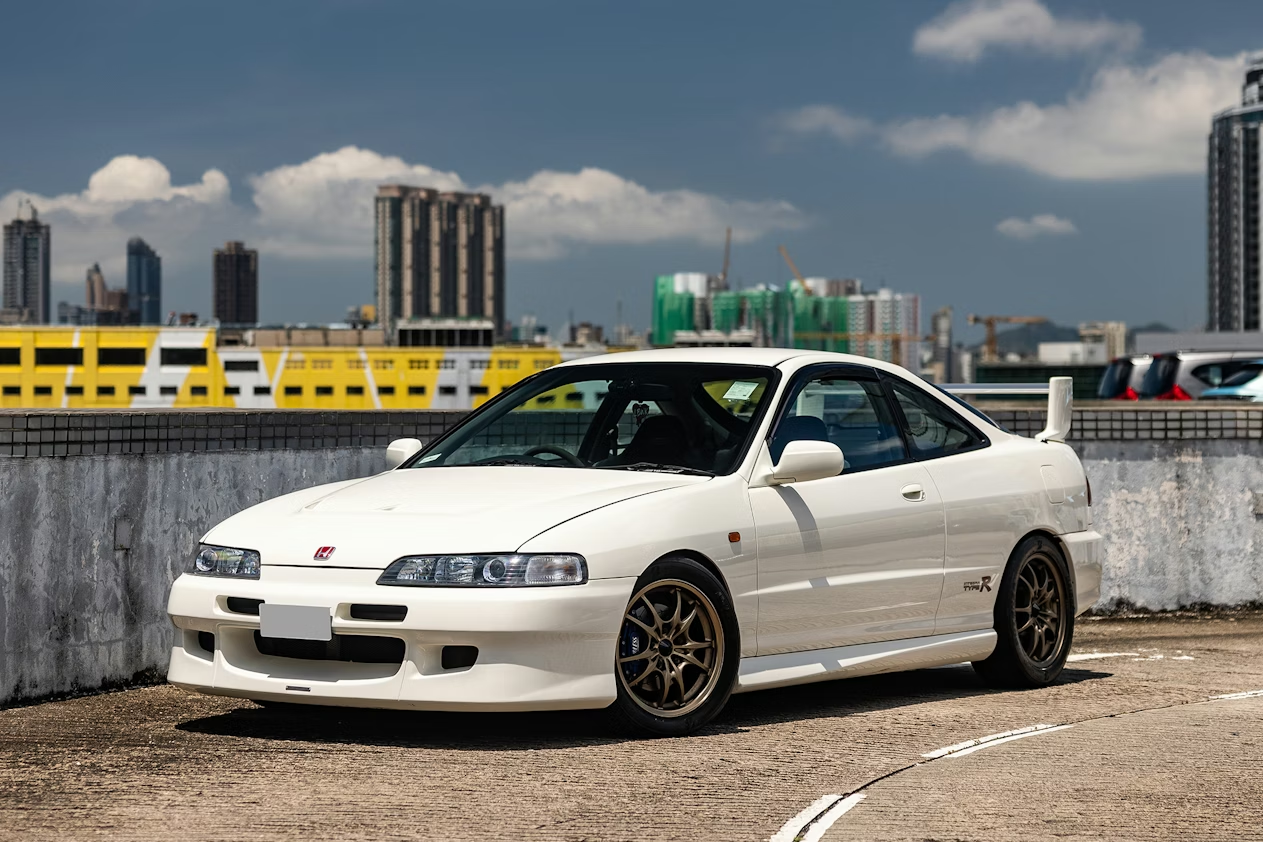
Civic Type R
シビック Type R
Editorial review
- 型式Chassis
- EK9
- 製造者Maker
- Honda
- 年式Years
- 1997-2000
- 用途Class
- Sport
参考動画Reference footage
The first Civic to wear the Type R badge. Its hand-ported B16B engine boasted one of the highest specific outputs of any naturally aspirated production engine (113hp/liter). A seam-welded chassis and helical LSD made it a giant-killer on the track.
諸元Specification of record
- 原動機Engine unit
- B16B
- 総排気量Displacement
- 1.6L VTEC
- 最高出力Power
- 182 hp
- 最大トルクTorque
- 118 lb-ft
- 駆動方式Drivetrain
- FF
- 変速機Transmission
- 5-speed Manual
- 車両重量Kerb weight
- 1,050 kg
In the late 1990s, the Japanese Domestic Market (JDM) was a veritable playground of automotive engineering, producing some of the most iconic and pure driving machines the world had ever seen. However, few vehicles encapsulate the golden era of Japanese front-wheel-drive performance quite like the Honda Civic Type R, designated by the legendary chassis code EK9. Introduced in August 1997 and produced exclusively for the Japanese market, the EK9 was far more than a mere trim level; it was a comprehensive, ground-up re-engineering effort. By prioritizing mechanical purity, structural rigidity, and obsessive weight reduction over luxury and mass appeal, Honda transformed a humble commuter hatchback into a precision instrument of speed. Today, it stands as the definitive naturally aspirated hot hatch and a cornerstone of JDM automotive culture.
来歴History & Motorsport Heritage
The story of the EK9 begins with the philosophical foundation of the "Type R" (Racing) badge. Honda first introduced the prestigious red badge in 1992 with the mid-engined NSX Type R, aiming to create a track-ready everyday vehicle. The philosophy demanded shedding weight, enhancing aerodynamics, and beefing up the powerplant to function seamlessly on both the morning commute and the professional racing circuit. Following the critical success of the NSX Type R and the 1995 Integra Type R (DC2), Honda applied this racing-derived philosophy to its best-selling compact platform: the sixth-generation Civic.The EK9 was developed as a direct evolution of the JDM Civic SiR (EK4), but shared a deep mechanical kinship with the Integra. Assembled at Honda’s Suzuka factory, close to the very racing circuit where Honda developed its vehicles, the EK9 was born from a desire to showcase Honda’s internal combustion prowess. The development was heavily influenced by Honda's extensive motorsport heritage, including its Formula 1 successes in the 1980s and 1990s. To further underline its racing intent, Honda also released a stripped-down Motor Sports Edition (N1). Conceived strictly for competition use, this bare-bones variant deleted the anti-lock braking system (ABS), power steering, air conditioning, electric windows, and audio system to save weight, replacing the alloy wheels with basic steel wheels and the Recaro bucket seats with standard grey fabric seats
希少性Exclusivity & Production Run
Because the EK9 was built solely for the Japanese Domestic Market between 1997 and 2000, it remained a "forbidden fruit" for enthusiasts in Europe and North America. Throughout its three-year lifespan, Honda produced exactly 16,241 units of the EK9 Civic Type R, a figure that includes approximately 200 N1 Motor Sports Editions.The production run is generally categorized into three distinct phases:Phase 1: EK9-100 (1997–1998): The initial release, often referred to as "Zenki" (pre-facelift) models. Honda produced 7,007 units during this run.Phase 2: EK9-110 (1998–1999): Introduced in August 1998, this "Kouki" (facelift) model received redesigned one-piece headlights, a new front bumper with brake cooling ducts, a wider intake grille, and clear instead of amber rear turn signals. Production totaled 4,009 units.Phase 3: EK9-120 and the Type Rx (1999–2000): The final run produced 5,225 units. In December 1999, Honda introduced the Type Rx variant. Responding to market demands for a slightly more civilized daily driver, the Rx model came standard with previously optional features: remote central locking (keyless entry), a Pioneer CD player with upgraded speakers, power retractable door mirrors, automatic air conditioning, drilled aluminum sports pedals, and a glossy carbon-fiber style center console panel.
意匠Aerodynamics & Design Philosophy
The exterior of the EK9 was designed strictly for function rather than pure decoration. The aerodynamic package included a deeper front air dam, body-colored side skirts, and a distinctive roof-mounted rear wing engineered to provide high-speed stability and generate genuine downforce, keeping the rear axle planted during aggressive cornering.Aesthetic identity was heavily tied to the available paint codes. The most iconic color, Championship White (NH-0), served as a direct tribute to Honda’s first Formula 1 winning car, the RA272. Other available colors included Starlight Black Pearl (also known as Flamenco Black Metallic) and Vogue Silver Metallic, with Sunlight Yellow added exclusively for the facelifted models. The exterior was finished with the universal symbols of Honda's racing lineage: the red-backed "H" badges and "Civic Type R" decals on the side flanks and tailgate.Inside, the cockpit was a dramatic, driver-centric departure from the standard commuter Civic. The heavy front seats were discarded in favor of aggressive red Recaro SR3 bucket seats, mounted lower to the floor to improve the car's center of gravity and provide superior lateral support. The driver commanded the vehicle through a leather-wrapped Momo steering wheel and a machined titanium shift knob, interacting with an instrument cluster that featured an amber-illuminated tachometer scaling all the way to 10,000 rpm. To minimize mass, extensive weight reduction was employed; Honda ruthlessly deleted sound-deadening bitumen sheets and insulation materials, reducing the curb weight to a featherlight 1,040 to 1,090 kg (2,293 to 2,403 lbs).
機関B16B · Powerplant
At the very core of the EK9’s legendary status is the B16B engine, a 1.6-liter (1595cc) DOHC VTEC inline-four that is widely regarded as a masterstroke of high-RPM engineering. Adhering strictly to natural aspiration, the engine produced a staggering 185 PS (182 hp) at 8,200 rpm and 160 Nm (118 lb-ft) of torque at 7,500 rpm. This output equated to nearly 116 horsepower per liter—a world record for naturally aspirated production engines at the time, even besting the specific output of the contemporary Ferrari 458.To achieve this, Honda engineers made a brilliant structural choice: they utilized the taller engine block from the 1.8-liter Integra Type R (with a deck height of 212 mm compared to the standard Civic's 203.9 mm). By maintaining the standard B16A's 77.4 mm stroke and 81 mm bore but pairing it with longer connecting rods (142.42 mm), they created an exceptionally high rod-to-stroke ratio of approximately 1.84:1. This reduced side-loading forces on the cylinder walls, allowing the engine to sustain immense rotational speeds with minimal vibration and friction.The B16B was hand-assembled, blueprinted, and completely balanced at the factory. It featured a high 10.8:1 compression ratio utilizing low-friction molybdenum-coated pistons. The cylinder head was hand-ported and polished for optimal airflow, equipped with thinner, lighter intake valves, and paired with high-lift, dual-layered valve springs to eliminate valve float at extreme speeds. The VTEC (Variable Valve Timing and Lift Electronic Control) system operated on two distinct camshaft profiles. At 6,100 rpm, a hydraulic pin locked the rocker arms to a high-lift, wide-angle cam lobe, flooding the engine with air and fundamentally changing its volumetric efficiency. This transition produced the famous "VTEC crossover" sound, propelling the engine forcefully to its stratospheric 8,400 rpm redline.
車台Chassis, Suspension & Handling Dynamics
While a brilliant engine is crucial, the EK9’s reputation as a giant-killer on the track stems equally from its chassis kinematics. To handle the increased power and cornering loads, the EK9 utilized a bespoke, seam-welded monocoque. Adding additional manual welds to the upper pillars, side frames, and rear frame rails drastically increased the chassis's torsional rigidity.The suspension utilized a sophisticated four-wheel independent double-wishbone design, a feature beloved by purists because it maintains a consistent tire contact patch with the road surface throughout the suspension travel—something modern, cost-effective MacPherson struts struggle to replicate. The Type R treatment heavily revised this setup: ride height was significantly lowered, spring rates were substantially stiffened, and specialized high-performance Showa dampers were fitted. Thicker anti-roll bars and harder rubber bushings reduced deflection under heavy cornering loads.Power was delivered to the front wheels via a close-ratio S4C 5-speed manual transmission, designed to keep the engine strictly within its VTEC powerband (above 6,000 rpm) after each upshift. Crucially, Honda equipped the EK9 with a factory helical Limited-Slip Differential (LSD). By distributing torque to the wheel with the most traction, the LSD mitigated the understeer typically inherent in front-wheel-drive cars, allowing the EK9 to pull itself through tight corners with speeds that rivaled rear-wheel-drive sports cars. Braking was handled by upgraded 282mm ventilated front discs and 260mm solid rear discs, complemented by a sport-tuned ABS system.
名義Nomenclature & Lore
The "Type R" badge is more than a marketing exercise; it denotes a vehicle stripped of compromise and honed for the circuit. Culturally, the EK9 transcended its physical hardware. It gained legendary status in pop culture through appearances in video games like Gran Turismo and Need for Speed, allowing a generation of global enthusiasts to experience the "forbidden fruit".The EK9 also holds a mythical place in anime and manga lore, famously featured in Initial D as the signature car of Daiki Ninomiya from the elite Todo School. The series accurately depicted the EK9's real-world strength: its ability to use its flawless balance and lightweight chassis to out-corner much more powerful, turbocharged opponents on technical downhill mountain passes (Touge). In the real-world tuning community, companies like Spoon Sports (led by Tatsuru Ichishima) elevated the EK9 even further. By stroking the B16B to 1.8 liters and balancing it to rev to a screaming 11,000 rpm, Spoon created race cars that produced over 260 naturally aspirated horsepower, proving the absolute ceiling of Honda engineering.
相場Auction Records & Modern Market Value
For decades, the EK9 was locked away in Japan. However, the recent passing of the United States' "25-year import rule" has finally made the earliest 1997 and 1998 EK9 models federally legal to import and register in America. This sudden influx of massive buyer demand has caused a dramatic spike in global market values.When new in 1997, the Civic Type R retailed for 1,698,000 yen (roughly $11,940 to $14,125 USD adjusted for historical exchange rates and inflation). Today, it has shifted from a mere used car to an investment-grade asset. In 2022, a good condition EK9 typically sold between $25,000 and $35,000 USD. However, auction records have since shattered expectations; in 2020, a pristine, unmodified 2000 model with low mileage sold at a Japanese auction for a staggering 7.64 million yen (approximately $52,465 USD). Today, the market is bifurcated: modified "driver" quality cars command high premiums, while bone-stock, Championship White examples are fiercely fought over by deep-pocketed collectors.
継承Keeping the Legend Alive (Restomod & Specialist Culture)
As these vehicles surpass 25 years of age, restorers and enthusiasts face specific maintenance challenges. The most significant threat is structural degradation due to rust; because salt is heavily used on Japanese roads in the winter, many imported EK9s suffer from corrosion in the rear quarter panels, inner frame rails, and the boot well (often caused by leaking tail light gaskets). Mechanically, while the engine is incredibly robust, the high-stress 8,400 rpm redline means worn 3rd-gear synchronizers in the transmission and inevitable oil consumption from frequent VTEC engagement are common issues. Furthermore, the aging rubber components, like the rear trailing arm bushings, frequently require replacement to maintain the car's legendary alignment and handling characteristics.To understand the EK9’s enduring appeal, one must look at its modern successor. The newest iteration, the FL5 Civic Type R (introduced in 2023), represents the pinnacle of modern Honda performance. The FL5 is a 5-door liftback powered by a turbocharged 2.0-liter K20C1 engine, producing an immense 315 to 330 horsepower and holding the current front-wheel-drive production car lap record at the Nürburgring Nordschleife with a time of 7:44.881. However, the FL5 is fundamentally a different machine. It is significantly larger and heavier, tipping the scales at 1,430 kg (3,153 lbs)—nearly 400 kg heavier than the featherweight EK9.While modern Type R models offer adaptive electronic dampers, software-driven drive modes, and forced induction, the EK9 remains the favorite of automotive purists. Its performance was not the product of microchips or turbochargers, but of high-quality metallurgy, meticulous hand-porting, soaring RPMs, and structural seam welding. The EK9 Civic Type R is not just a car; it is the physical embodiment of an uncompromising engineering philosophy that valued the raw, visceral connection between driver, machine, and the road above all else.
結 · IN CLOSING
The Honda Civic Type R EK9, introduced in 1997 exclusively for the Japanese domestic market, is a legendary hot hatchback born from Honda's uncompromising racing philosophy. Designed to deliver a pure, visceral driving experience, the EK9 underwent extensive weight reduction, aerodynamic enhancements, and meticulous chassis seam-welding for maximum structural rigidity.At the heart of the EK9 is the hand-assembled 1.6-liter B16B DOHC VTEC engine. Revving to a soaring 8,400 rpm redline, it produced an astonishing 185 PS, setting a global standard for naturally aspirated specific output. This high-revving powerplant was seamlessly paired with a close-ratio 5-speed manual transmission, a helical limited-slip differential, and a sophisticated four-wheel double-wishbone suspension to ensure unparalleled precision and cornering agility.During its three-year production run, Honda built exactly 16,241 units, which included the bare-bones N1 Motor Sports Edition and the final-year Type Rx model that added a few modern conveniences. Renowned for its iconic Championship White paint and aggressive red Recaro bucket seats, the EK9 cemented its legacy in automotive culture. Today, it commands massive premiums as a highly coveted collector's item, celebrated as the absolute pinnacle of 1990s mechanical purity
この項目についてAbout this entry
Specification figures are cross-checked against factory data and period source material. Editorial is researched and reviewed before publication; drafting and formatting may be assisted by tooling, but accuracy checks rest with the editorial desk. This entry was last reviewed in August 2026. Spotted an error? Send a correction →