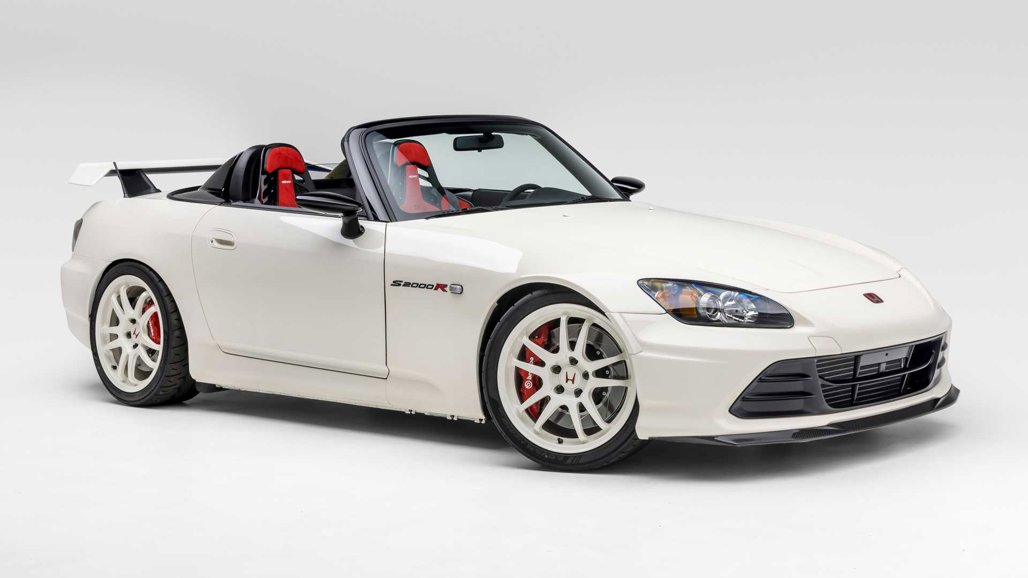
Honda Integra Type R (DC5)
インテグラ タイプR (DC5)
Editorial review
- 型式Chassis
- DC5 (fourth-generation Integra)
- 製造者Maker
- Honda
- 年式Years
- 2001-2006
- 用途Class
- Sports
参考動画Reference footage
The Honda Integra Type R DC5 is a JDM-exclusive coupe built from 2001 to 2006, powered by a naturally aspirated 2.0-liter K20A engine making 220 PS and revving past 8,000 rpm.
Honda designed the fourth-generation Integra from a blank sheet rather than tuning an existing Civic platform, and the Type R version that followed six months later became the car's defining variant. It never reached the United States or the United Kingdom in factory form, yet it built a separate reputation on British racetracks through Team Dynamics' BTCC program. Total Japanese production landed at 12,247 units, a modest run that closed out the Integra Type R line entirely.
諸元Specification of record
- 原動機Engine unit
- K20A naturally aspirated inline-four, DOHC, i-VTEC
- 総排気量Displacement
- 1,998cc (86mm x 86mm bore/stroke)
- 最高出力Power
- 217 bhp (220 PS / 162 kW) at 8,000 rpm
- 最大トルクTorque
- 206 N·m (152 lb-ft) at 7,000 rpm
- 駆動方式Drivetrain
- Front-wheel drive with helical limited-slip differential
- 変速機Transmission
- Six-speed close-ratio manual
- 車両重量Kerb weight
- 1,140 kg
来歴History & Motorsport Heritage
Honda revealed the fourth-generation Integra in Japan on April 13, 2001, following the launch of the seventh-generation Civic EP3 the previous September. The two cars shared a development window, but the Integra arrived with its own identity and, six months after the standard DC5 went on sale, Honda unveiled the Type R at the Tokyo Motor Show in October 2001.
This was not simply a warmed-over Integra. Previous Type-R Integras had been built on a shared Civic/Integra platform and tuned from there; the DC5 Type R was engineered from the ground up as a dedicated performance model, with Honda reportedly drawing on a team of ex-Formula 1 engineers during development. The car was also positioned to replace two nameplates at once — the outgoing Integra Type R and the Prelude Type R — as Honda consolidated its compact performance coupe lineup into a single model with chunkier styling, a larger 2.0-liter engine, and a six-speed gearbox in place of the outgoing five-speed.
The DC5 received one significant update during its production run. Minor cosmetic tweaks arrived for the 2004 model year, including body-color washer nozzles on the hood, but the substantial facelift came in September 2004. That update brought restyled headlights and rear lights, redesigned bumpers and air intakes, an available auto-leveling HID headlight system, and an interior refresh with new white-faced gauges, titanium-colored trim, and an optional HDD satellite navigation unit.
While the DC5 Type R stayed off UK dealer lots, it found its way onto UK circuits regardless. In 2005, Team Dynamics exploited a loophole in British Touring Car Championship regulations that allowed cars to compete whether or not they were officially sold in Britain. The team converted Japanese-market Integras into BTC-Touring specification racers, borrowing internals from the Honda Civic Type R that had already been racing in the BTCC since 2002. The car won its debut outing at Donington Park despite limited pre-season testing.
That first season proved to be one of the most complete in modern BTCC history for a single team. Drivers Matt Neal, Dan Eaves, and later Gareth Howell combined to sweep the Drivers', Teams', Independent Teams', and Independent Drivers' championships in 2005. Neal scored points in every race that year on his way to the Drivers' title — the first championship for a privateer driver in the BTCC's modern era. He repeated the feat in 2006, by which point Team Dynamics had built five race chassis, every one of them a race winner.
Team Halfords, running alongside Team Dynamics, added its own chapter through Dan Eaves. He became the first BTCC driver to win all three races in a single meeting at Thruxton — the fastest circuit on the calendar — and set the fastest lap of the day in the process. Eaves went on to win five more races that season plus five fastest laps, finishing third in the championship behind Neal and Yvan Muller.
The racing story didn't end there. One chassis, designated TD-02, was later repainted in a pink-and-black Motorbase Performance livery for the 2006–2007 seasons, driven by David Pinkney to a BTCC podium finish. Pre-facelift DC5 Integra Type R race cars continued competing in the BTCC through 2011, six years after the model's factory production had already ended in Japan.
The race version itself ran a 2,000cc naturally aspirated inline-four, front-mounted power, front-wheel drive, and a six-speed sequential gearbox — a configuration that stayed faithful to the road car's fundamental layout even as the internals were upgraded for competition.
希少性Exclusivity & Production Run
Honda built the DC5 Integra Type R exclusively at its Suzuka plant in Mie Prefecture, Japan, and the car was never offered in anything other than right-hand drive. Total Japanese-market production reached 12,247 units by the time the line closed, a figure low enough that Honda chose not to develop a direct replacement once the Integra nameplate itself was retired.
Sales were heavily front-loaded. The car's best year was its first full year on sale, and volume dropped steadily as the model aged: 2001 saw 4,875 units sold in Japan, 2002 saw 3,431 units, and the final year (2006) saw just 997 units, for a total JDM production of 12,247 units.
Beyond Japan, the DC5 Type R reached only Australia and New Zealand, where export figures are less precisely documented — estimates put combined Oceania sales somewhere between 2,000 and 3,000 units, though exact numbers aren't confirmed. New Zealand-market cars were detuned to roughly 200 hp rather than the 220 PS quoted for Japanese cars, part of the same Oceania-spec package that used a different intake manifold and lower compression ratio than the JDM engine.
The United Kingdom never received the DC5 Type R at all. Honda UK's stated reasoning was that the DC5 would sit too close to the locally built Civic Type R EP3, a justification that looked questionable given how different the two cars were in body style and outright performance. North America saw a related but distinct product instead: the Acura RSX Type-S, a detuned export version of the platform. There was never an Acura RSX Type R, and the DC5 badge itself stayed JDM-exclusive.
That exclusivity has practical consequences for American enthusiasts today. Under the US 25-year import rule, the earliest DC5 Type R examples from the 2001 model year became eligible for legal import in 2026, with later production years becoming eligible on a rolling basis through 2031. The Integra nameplate itself disappeared after the DC5's discontinuation in 2006, only returning in 2022 on an unrelated, FL5-based turbocharged sedan built for a different market and era entirely.
意匠Aerodynamics & Design Philosophy
The DC5's bodyshell used galvanized steel and was engineered to be noticeably stiffer than the outgoing DC2-generation Integra it replaced. Overall dimensions grew only slightly over the previous car — the new model stretched to 4,400mm in length, 20mm longer than before, while wheelbase (2,570mm), width (1,695mm), and height (1,320mm) all carried over unchanged.
Type R-specific bodywork set the car apart from lesser DC5 trims. Up front, Honda fitted a new bumper with enlarged intakes and a deeper chin spoiler, along with a body-colored duct plinth positioned between HID headlights. Deep, crossover-style side skirts ran the length of the car, while the rear received a trunk-lid-mounted "basket-handle" spoiler, an extended rear apron, and a wiper-less windscreen. Red-backed Honda badges appeared front and rear, joined by a Type R tailgate badge and Integra Type R decals on the rear fenders. Buyers at launch could choose from five exterior colors: Championship White, Milano Red, Nighthawk Black Pearl, Satin Silver Metallic, and Eternal Blue Pearl.
None of this bodywork was purely cosmetic. The rear wing cut lift at the back of the car by roughly 30 percent, and the sculpted lip under the front bumper worked alongside it to keep the nose settled at speed. Reducing lift at both ends kept the tires loaded and the steering responsive under hard cornering rather than adding drag for its own sake.
Weight control ran alongside the added structural work rather than fighting against it. Engineers added extra spot welds through the chassis for rigidity and fitted aluminum strut braces, yet still brought the finished car in at a 1,140kg kerb weight — nearly 40kg lighter than the standard Integra GS-R despite the extra bracing. Stiffer springs and dampers, a thicker rear anti-roll bar, and an aluminum front strut brace rounded out the Type R's mechanical upgrades over other DC5 variants, while aluminum lower control arms and an aluminum front bumper beam trimmed further mass from the front end.
Wheels measured 17 inches across a five-spoke twin design, wrapped originally in Bridgestone Potenza RE040 rubber. The September 2004 facelift brought trim-level distinctions to the range: a "Kick-up type" featuring a low-wing rear spoiler and colored side-sill garnish became standard on the related Type S grade, offered alongside a "High-wing type" more familiar from earlier cars. Type S buyers could choose from eight body colors including Blaze Orange Metallic, while Type R buyers kept a tighter five-color palette headed by Championship White.
One frequently repeated detail — that Honda used continuous seam welding on the DC5 chassis for extra stiffness — is disputed among long-term owners. At least one enthusiast who had a car partially stripped for restoration reported finding closer-spaced, more numerous spot welds rather than true seam welds, suggesting the "seam-welded" description may be more folklore than factory spec.
機関K20A naturally aspirated inline-four, DOHC, i-VTEC · Powerplant
The Type R's 2.0-liter K20A engine is a naturally aspirated, chain-driven DOHC four-cylinder with i-VTEC valve control, producing 217 bhp (220 PS / 162 kW) at 8,000 rpm and 206 N·m (152 lb-ft) of torque at 7,000 rpm on Japanese-market cars. Actual displacement measures 1,998cc, with a square bore and stroke of 86mm each. Power reaches the front wheels through a six-speed manual gearbox.
Redline figures vary depending on the source — some quote 8,400 rpm, others 8,600 rpm — but every account agrees the K20A was built to spin freely and reward high-rpm driving rather than deliver low-end torque. This engine replaced the 1.8-liter B18C used in the previous DC2 generation, and despite the larger displacement it came in lighter than the outgoing unit. It also out-revved and out-torqued the related K20A used in the contemporary EP3 Civic Type R of the same era, thanks in part to a free-flow exhaust that gave the DC5 roughly 5 bhp and 3 lb-ft more than its Civic sibling, along with a rev limiter set 200 rpm higher.
Behind the engine sat a purpose-built six-speed close-ratio manual gearbox, 20mm shorter and 2.5kg lighter than the transmission used in the previous Integra Type R generation, with a newly developed multi-cone synchromesh fitted to every gear. Most sources describe the differential as a helical limited-slip unit, though at least one source describes it as a Torsen design — the specification isn't consistent across every account, but the helical LSD is the more commonly cited configuration.
Braking hardware matched the engine's performance ambitions: 300mm vented discs up front, clamped by four-piston Brembo calipers, paired with 260mm solid rear discs and single-piston calipers, all running high-performance Ferodo pads.
Oceania-market cars ran a detuned variant of the same architecture, badged K20A2, with a lower 11.0:1 compression ratio and the PRB intake manifold rather than the JDM car's PRC unit — the mechanical basis for the roughly 2,000 to 3,000 export units delivering less power than their Japanese counterparts.
Performance figures vary slightly by source and test method. Top Gear recorded a 6.5-second 0-60mph time and a 143mph top speed for the 1,140kg car, while other data puts the 0-60 closer to 7.1 seconds with a 140mph top speed — differences likely tied to test conditions rather than genuine spec discrepancies.
車台Chassis, Suspension & Handling Dynamics
The DC5, developed alongside the EP3 Civic, moved away from Honda's traditional double-wishbone suspension setup that had defined earlier Integras. Up front, both cars adopted MacPherson struts, which freed up cabin space compared to the double-wishbone layout it replaced. Accounts differ on what Honda used at the rear — some describe a trailing-arm setup, while others state the DC5 retained double-wishbone geometry at the back even as the front end changed. Either way, the front-end switch was the headline chassis change for this generation.
Steering ran through a rack-and-pinion setup with variable power assistance as standard equipment, praised by road testers for its precision. The 2004 facelift brought further chassis refinement: harder suspension bushes, stronger mounting points, a larger brake master cylinder, and tougher pedal mountings, alongside a revised steering rack and uprated springs and dampers.
The helical limited-slip differential played a central role in the car's handling character, distributing power between the front wheels under cornering load so the chassis had traction to match the grip generated by its suspension and tires. When the DC5 launched in 2001, it ranked among the fastest front-wheel-drive production cars available at any price.
Crowd-sourced lap time data — treated as informal rather than verified test results — suggests the DC5 Type R runs roughly 5.7 seconds faster on average than the later Civic Type R FN2 across eight shared circuits, a gap that points to how seriously Honda engineered this chassis for outright pace on a track.
One practical concern for owners and buyers today is corrosion. The most common rust point is where the rear quarter panel meets the sill; visible bubbling near the rear emblems is usually a sign of more serious corrosion hidden beneath the paint. UK and European-delivered cars tend to suffer worse than JDM examples, largely because their wheelarch liners trap water and road salt against the bodyshell over time.
名義Nomenclature & Lore
Honda's Integra nameplate traces back to the English word "integrate," reflecting the car's original positioning as a model that combined driving performance with usable cabin space — Honda's own description called it "a new-type car that integrates driving performance and a spacious interior." The name first appeared in 1985 on a redesigned version of the Quint, badged the Quint Integra, before Honda simplified the name to just Integra in 1989. The car had originally been developed as a sportier, more upscale derivative of the Civic.
"Type R" carries its own separate lineage within Honda's range. The "R" stands for Racing, and while every Type R model has been sold as a street-legal production car, each one has been built around racing-derived engineering rather than styling alone. The badge's story began in 1992 with the NSX-R, a hardcore, JDM-only version of the NSX supercar that Honda had developed in collaboration with Ayrton Senna. Every Type R since, including the DC5, has carried forward the tradition of a red Honda badge and an available Championship White paint option — a visual nod back to the colors of Honda's early winning Formula 1 cars.
相場Auction Records & Modern Market Value
Because the DC5 Integra Type R was never federalized for the US market, its value story in America has been shaped almost entirely by import law rather than domestic dealer history. The 25-year import rule means the earliest 2001-model cars only became legally importable to the United States in 2026, with each subsequent model year following on a rolling basis through 2031. That timeline has effectively kept a lid on US demand for years while simultaneously building anticipation among collectors watching the eligibility window open.
Rarity underpins the car's standing regardless of market. With only 12,247 units built for Japan and a further estimated 2,000 to 3,000 for Australia and New Zealand, total worldwide production sits in a tight band that few genuinely comparable Honda performance models can match. The car's JDM-only status, combined with the fact that Honda chose not to build a direct successor, has kept the DC5 firmly positioned as a closed chapter rather than one entry in an ongoing model line.
The car's motorsport pedigree adds a separate layer of collector interest. The Team Dynamics and Team Halfords BTCC race chassis that carried Matt Neal and Dan Eaves to championship wins have surfaced through major auction houses including Bonhams and Goodwood, reflecting sustained interest in the DC5's competition history distinct from the road car market. Chassis TD-02, campaigned in Motorbase Performance's pink-and-black livery during 2006 and 2007, stands as one example of this racing lineage still tracked and documented by collectors today.
継承Keeping the Legend Alive (Restomod & Specialist Culture)
Honda never built a direct replacement for the DC5 Integra Type R. The disappointing overall sales figures — just over 12,000 units against a backdrop of a shrinking market for compact Japanese coupes — led Honda to retire the Integra Type R concept entirely rather than develop a fifth generation. The Integra nameplate itself went dormant after 2006, only returning in 2022 on a completely different car: an FL5-based, turbocharged sedan built for a different market context and unrelated mechanically to the DC5.
That gap has left the DC5 as a closed, self-contained chapter rather than the starting point of a continuing lineage, which has pushed enthusiast attention toward preservation rather than comparison to a modern successor. The car's known rust-prone areas — particularly where the rear quarter panel meets the sill — have become a standard checkpoint for buyers and restorers alike, with UK and European cars generally requiring closer inspection than Japanese-market examples due to wheelarch liner design.
The approaching wave of US import eligibility, running from 2026 through 2031 as successive model years cross the 25-year threshold, is expected to bring a fresh influx of DC5s into the American grey-market and restoration scene, adding new demand for parts, bodywork expertise, and mechanical knowledge built up largely within Japan, the UK, and Oceania over the past two decades.
問答Questions of record
問01How many Honda Integra Type R DC5 were made?
Honda built 12,247 units for the Japanese market between 2001 and 2006, plus an estimated 2,000 to 3,000 additional units exported to Australia and New Zealand.
問02Did the Honda Integra Type R DC5 ever come to the US or UK?
No, the DC5 was never officially sold in the United States or United Kingdom in factory form. North America instead received the related but detuned Acura RSX Type-S, and the UK avoided it to prevent overlap with the locally built Civic Type R EP3.
問03What engine powers the Honda Integra Type R DC5?
It uses the naturally aspirated 2.0-liter K20A inline-four with i-VTEC, producing 217 bhp (220 PS) at 8,000 rpm and 206 N·m of torque at 7,000 rpm, paired with a six-speed manual gearbox.
問04When can the DC5 Integra Type R be legally imported to the US?
Under the US 25-year import rule, the earliest 2001 model-year DC5 Type Rs became eligible in 2026, with later production years becoming eligible on a rolling basis through 2031.
問05Did the Honda Integra Type R DC5 race in the BTCC?
Yes, Team Dynamics converted Japanese-market DC5 Integras into BTC-Touring race cars starting in 2005, winning the Drivers', Teams', Independent Teams', and Independent Drivers' championships that year with driver Matt Neal, who repeated the Drivers' title in 2006.
問06How much does the Honda Integra Type R DC5 weigh?
The DC5 Type R has a kerb weight of 1,140kg, nearly 40kg lighter than the standard Integra GS-R despite added chassis bracing and stiffening.
結 · IN CLOSING
The Honda Integra Type R DC5 was Japan's final Integra Type R, built from 2001 to 2006 exclusively in right-hand drive at Honda's Suzuka plant. Engineered from the ground up rather than adapted from an existing platform, it paired a 220 PS naturally aspirated K20A 2.0-liter engine with a close-ratio six-speed manual gearbox and a helical limited-slip differential, all wrapped in a stiffened, weight-trimmed body that hit 1,140kg. Total production reached just 12,247 units in Japan, plus an estimated 2,000 to 3,000 units for Australia and New Zealand; the UK and US never received it in factory form, though Acura sold a detuned RSX Type-S variant in North America. The DC5 built a second reputation on British racetracks, where Team Dynamics' BTCC-spec cars won drivers' and teams' titles in 2005 and 2006. Its exclusivity, combined with the US 25-year import rule opening between 2026 and 2031, continues to shape demand today, as Honda never built a direct successor once the Integra Type R line ended in 2006.
この項目についてAbout this entry
Specification figures are cross-checked against factory data and period source material. Editorial is researched and reviewed before publication; drafting and formatting may be assisted by tooling, but accuracy checks rest with the editorial desk. This entry was last reviewed in August 2026. Spotted an error? Send a correction →