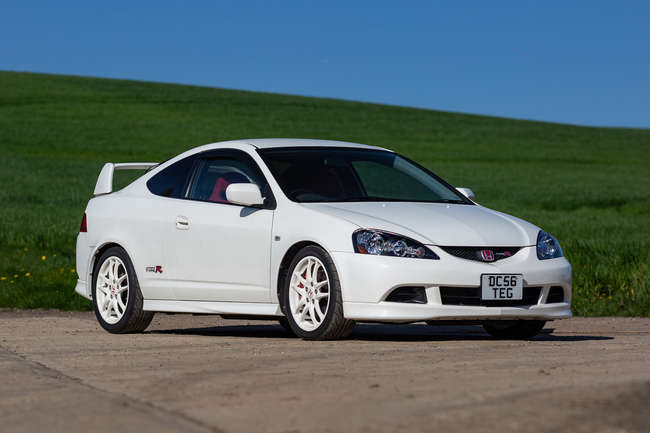
2007 Honda Civic Type R (FD2)
Editorial review
- 型式Chassis
- FD2
- 製造者Maker
- Honda
- 年式Years
- 2007-2010
- 用途Class
- Sports Sedan
This entry's photographic record is still being assembled. The specification and history below are complete.
The Honda Civic Type R (FD2) is the only Civic Type R ever built as a four-door sedan, sold exclusively in Japan with a naturally aspirated 225 PS K20A engine. Announced in October 2006 at the Suzuka F1 Japan Grand Prix, it went on sale on 29 March 2007 and stayed in production until August 2010, with a documented total of 14,062 units built. It paired a K20A four-cylinder revving to an 8,600 rpm redline with a close-ratio six-speed manual, a helical limited-slip differential, and double-wishbone rear suspension carried over from the Integra Type R rather than the cost-cut torsion beam used on its European FN2 hatchback sibling.
諸元Specification of record
- 原動機Engine unit
- K20A
- 総排気量Displacement
- 1,998 cc
- 最高出力Power
- 225 PS at 8,000 rpm
- 最大トルクTorque
- 215 Nm at 6,100 rpm
- 駆動方式Drivetrain
- Front-wheel drive
- 変速機Transmission
- Close-ratio six-speed manual
- 車両重量Kerb weight
- 1,270 kg
The FD2 arrived a decade after the EK9, and its debut at the Suzuka F1 Japan GP in October 2006 signaled Honda's intent to keep the nameplate connected to the track. It was the first four-door Type R since the Integra 4-door Type R, and the longer wheelbase that came with the sedan body actually worked in its favor, adding stability through high-speed corners that the shorter hatchback-based Type Rs couldn't match.
That stability showed up in direct comparison testing. On the UK television program Fifth Gear, the FD2 ran three seconds quicker than an equivalent FN2 around Castle Combe Circuit in wet conditions — a notable margin for cars sharing a generation and a badge.
来歴History & Motorsport Heritage
The Type R badge predates the Civic by several years. Honda first applied it to the Japan-market NSX Type R in 1992, then to the Integra Type R in 1995 — the same Integra Type R that arrived in America in 1997 wearing an Acura badge. The Civic didn't get its own Type R until later that same year, when the JDM-only EK9 became the third model in Honda's lineup to carry the designation. "R" stands for Racing, and the concept was the work of Shigeru Uehara, Honda's Special Projects Development Manager, who had also worked on the NSX before turning his attention to building what he described simply as a car "to provide drivers who love sports driving."
Honda and Mugen built on the FD2's racing credentials with dedicated derivatives:
- Civic Mugen RC — a race version developed by Mugen for the 2008 Honda Exciting Cup Civic One-Make Race–Civic Series.
- Civic Mugen RR Advanced Concept — debuted at the 2009 Tokyo Auto Salon based on the facelifted FD2, with a dry weight of 1,095 kg and 340 mm brake discs, up from the 320 mm discs on the standard Type R/RR.
- FD2 Japan One Make Race prototype — a one-make racing livery later commemorated in diecast form by model makers, reflecting the chassis's ongoing popularity in single-make competition.
The broader Type R racing lineage didn't stop with the FD2. Today's Honda Civic Type R TCR, built on the FL5 chassis, runs a 340 hp turbocharged K20C1 under FIA-sanctioned TCR rules in the World Touring Car Cup. Road-going Type Rs have continued to chase front-wheel-drive lap records too — the FL5 set a Nürburgring Nordschleife FWD record of 7 minutes 44.881 seconds in 2023, a benchmark set well after the FD2's production run ended but part of the same continuous engineering thread.
希少性Exclusivity & Production Run
Honda built 14,062 units of the FD2 Civic Type R before production ceased in August 2010. Multiple sources attribute the end of the line to the car's inability to meet upcoming emissions requirements, which closed out the naturally aspirated K20A sedan without a direct JDM successor until the turbocharged FK2 arrived years later.
There's some disagreement in the record about the exact production window:
- Several sources list 2007–2010 as the production span, matching the August 2010 end date.
- Others, including some infobox data, extend the range to 2011 — likely reflecting leftover dealer stock or late registrations rather than continued manufacturing.
The FD2 was a JDM-exclusive model, part of a broader pattern in Civic Type R history where market availability shifted generation to generation:
- EK9 (1997–2000): Japan only
- EP3 (2001–2005): global, including a JDM variant
- FD2 (2007–2010): Japan only
- FN2 (2007–2011): Europe only
Malaysia was the sole exception to the FD2's Japan-only status, receiving official Honda retail and after-sales support — though dealers there only ever received small batches, and total numbers sold remained modest. A related "Type R Euro" version — essentially the FN2 hatchback with its less powerful engine and different chassis — was also sold in limited numbers within Japan alongside the standard FD2.
Honda also built a genuinely rare special edition through its in-house tuning partner: the Mugen RR. Limited to 300 units, fitted with lightweight body panels that shed 15 kg, running a stronger 240 hp tune, and offered only in Milano Red, it sold out within 10 minutes of going on sale.
Launch pricing is another point of disagreement between sources — one lists ¥2,835,000, another puts the figure at just over ¥3.7 million (roughly $25,000 at the time). The higher figure aligns more closely with contemporary Type R market positioning in Japan, though neither can be verified as definitive.
For US buyers, import timing is a hard constraint: the FD2 isn't eligible under the 25-year rule until 2032 at the earliest. Canada's 15-year rule already permits import of 2007–2011 cars, and Australia and the UK see them through used-import channels. Across the entire Civic Type R lineage — EK9 through FL5, spanning 1997 to 2025 — total production is estimated at 84,899 units, making the FD2's 14,062-unit run one piece of a comparatively small overall family.
意匠Aerodynamics & Design Philosophy
The FD2 holds a specific distinction within the Type R family: it's the only Civic Type R ever built as a sedan rather than a hatchback. Every other generation — EK9, EP3, FN2, FK8, FL5 — used a hatchback body.
Exterior changes over the standard Civic sedan included a large rear wing, unique front bumpers, a bodykit with an integrated rear diffuser, and 18-inch wheels. Inside and out, the car carried a set of Type R-specific parts: exclusive aero pieces, unique hood fenders, red Type R emblems, R-spec seats, a dedicated steering wheel, a short-throw sport shifter, metal pedals, and an engine starter button.
Weight reduction ran deeper than trim pieces. Honda used aluminum extensively throughout the larger FD2 bodyshell, and where possible, panels were bonded rather than welded — a construction method that both cut weight and increased stiffness. The resulting chassis is up to 50% stiffer than the DC5 Integra Type R that preceded it, a figure that underpins the FD2's high-speed composure.
Inside, the red-and-black Type R color scheme carried through the cabin: red seat trim, red carpet accents, the red Honda logo, and the red-ringed start button all appeared as standard Type R visual cues, distinct from the regular Civic sedan's interior.
Later, facelifted and limited-run FD2 variants pushed weight savings further, adding an aluminum hood (saving 4.6 kg), a titanium exhaust system (saving 7.6 kg), additional carbon fiber interior trim, an Intelligent-Tire Condition Monitoring System, and Recaro seating. No verified drag coefficient figure specific to the FD2 exists in available records, so any claimed Cd number for this chassis should be treated with caution until a dedicated source confirms it.
機関K20A · Powerplant
The FD2 is powered by the K20A, a water-cooled inline-four with double overhead cams and a 1,998 cc displacement, using an 86.0 x 86.0 mm bore and stroke and an 11.7:1 compression ratio. Fitted with Honda's PGM-FI fuel injection, the factory spec sheet lists 165 kW (225 PS) at 8,000 rpm and 215 Nm (21.9 kgm) of torque at 6,100 rpm, with a redline at 8,600 rpm.
Published specs for this engine vary depending on the source, and it's worth laying out the discrepancies plainly:
- fd2.org and several JDM specialist sites: 225 hp at 8,000 rpm, torque peak at 6,100 rpm.
- Honda-Tech's engine listing: same power figure, but torque peak listed at 7,000 rpm.
- Low Offset: 222 hp at 8,000 rpm, 158 lb-ft at 6,100 rpm.
- Encycarpedia: 221 hp (224 PS) at 8,000 rpm, 159 lb-ft at 6,100 rpm.
- A Wikipedia-sourced figure circulated on VW Vortex forums: 225 PS (222 hp) at 8,400 rpm.
A handful of aggregator sites also reverse which market got which output, claiming the JDM car made 201 hp and the European FN2 made 225 hp. This contradicts the majority position across Wikipedia, PistonHeads, FujimaxJDM, VW Vortex, and Honda-Tech, all of which agree the JDM FD2 made roughly 222–225 hp (225 PS) while the Euro-market FN2, running the K20Z4, made around 197–198 hp (201 PS). Given the FD2's Japan-only sales status, the reversed figures on those minority sites appear to be simple errors rather than an alternate spec.
FujimaxJDM attributes the power gap between FD2 and FN2 to differences in compression ratio and Honda's tuning priorities for the JDM car — the FD2's engine was built for reduced friction loss and higher-rev output, going as far as removing the vibration-suppressing balancer shaft to get there.
Weight tells a parallel story: the FD2 weighs 1,270 kg against the FN2's 1,320 kg, a 50 kg gap explained by the FD2 dropping comfort items like sound insulation that the FN2 retained.
Performance figures likewise shift depending on the source:
- Low Offset: 0–60 mph in 6.0 seconds, top speed 149 mph.
- Encycarpedia: 0–60 mph in 6.1 seconds, 0–62 mph in 6.3 seconds, top speed 149 mph, power-to-weight of 12.57 lb/hp.
- Lapmeta: 0–62 mph in roughly 6.2 seconds, top speed near 146 mph.
The Mugen RR, announced 13 September 2007, pushed the K20 further with exclusive camshafts, valve springs, and intake/exhaust tuning to reach 240 hp (240 PS at 8,000 rpm, 22.2 kgm at 7,000 rpm). It paired that engine with a six-speed manual using a short-stroke shifter and Brembo brakes fitted with slit rotors and stainless-mesh brake lines.
The standard FD2's six-speed manual uses close-ratio gearing: 3.266 in first, 2.130 in second, 1.517 in third, 1.147 in fourth, 0.921 in fifth, 0.738 in sixth, 3.583 in reverse, and a 5.062 final drive ratio.
On the reliability question that regularly comes up among prospective buyers: the K20A is generally described as an engine that tolerates abuse but punishes neglect, with rod bearing failure and cam-chain tensioner wear cited as the typical failure points when maintenance is skipped. These notes apply to the K20A family broadly rather than being FD2-specific findings, but they're consistent with what owners report across the platform.
車台Chassis, Suspension & Handling Dynamics
Honda built the FD2 around a lightweight, highly rigid body shell, paired with an exclusive suspension tune, a specially calibrated ABS/EBD system, 18-inch Potenza tires, and 17-inch front discs gripped by Brembo four-pot aluminum calipers.
The biggest mechanical difference between the FD2 and its European FN2 counterpart is at the rear axle. The FN2 was criticized on debut for switching to a torsion beam rear setup — a downgrade from the fully independent rear suspension used on the earlier EP3 — because the FN2's platform was based on the contemporary Honda Fit/Jazz. The FD2, built on a different platform, kept a multi-link (double wishbone) rear suspension throughout its run, a difference that shows up directly in the Fifth Gear comparison mentioned earlier.
Standard equipment included a helical limited-slip differential, which distributes torque to the wheels more effectively than an open differential and wears more slowly than clutch-type LSD alternatives. Combined with the FD2's roughly 50 kg weight advantage over the FN2, the fully independent rear suspension gives the chassis meaningfully different at-the-limit behavior than its hatchback sibling.
Wheel and tire specs on the standard FD2 were 225/40R18 front and rear, with McPherson strut front suspension and double wishbone rear suspension, and ventilated discs at the front paired with solid discs at the rear.
Owner and forum feedback consistently describes the FD2 as well balanced, with a neutral handling character achieved through a tuned combination of anti-roll bars, shocks, struts, springs, and the stiffer-than-standard chassis. (Claims of "hydraulic suspension" that occasionally circulate in forum threads have been debunked by other posters as inaccurate.) The trade-off for that track focus is real-world ride quality — aftermarket specialists note that factory rear damping on the FD2 is stiff to the point of being uncomfortable on rough public roads, a deliberate choice given the car's circuit-oriented design brief.
名義Nomenclature & Lore
"FD2" is Honda's internal chassis code, not a marketing name — the badge that matters on this car is "Type R," and its story goes back further than the Civic itself. The designation first appeared on the Japan-market NSX Type R in 1992, then the Integra Type R in 1995, with the Integra crossing to America under the Acura badge in 1997. The Civic didn't receive its own Type R until the EK9 arrived that same year, exclusively in Japan — making the Civic the third Honda-family nameplate, after the NSX and Integra, to wear the badge.
"R" stands for Racing, and the person credited with shaping the concept is Shigeru Uehara, Honda's Special Projects Development Manager, who had previously worked on the NSX. Uehara framed the goal in simple terms: the role of a Type R car is to serve drivers who love sports driving, not to chase outright numbers for their own sake. That philosophy shows up in a visual detail carried across every Type R model, including the FD2: the Honda badge sits on a red background, distinguishing Type R cars from the rest of the lineup at a glance.
Within enthusiast circles, the FD2 is commonly shortened to "FD2R," a shorthand that separates it from the regular FD1/FD3 Civic sedans it was based on. That distinction matters for buyers, because a documented issue in the used market involves sellers passing off a standard FD1 sedan — fitted with a manual gearbox swap and a Type R-style body kit and badges — as a genuine FD2R. Complete JDM Type R front-end and rear conversion kits are sold commercially specifically for this purpose, which means verifying chassis numbers and factory documentation matters more with this car than with many other JDM performance models.
相場Auction Records & Modern Market Value
Pricing data for eighth-generation Civic Type R cars — a category that includes both the JDM FD2 and the Euro-market FN2 — shows a wide spread depending on condition, mileage, and specification:
- Highest recorded sale: $122,500 for a 2007 Honda Civic Type R, April 1, 2025.
- Lowest recorded sale: $8,437 for a 2009 Honda Civic Type R Limited Edition.
- Average sale price: $29,127 across tracked auction results.
- A specific 2008 FD2 sold through Collecting Cars for $30,159.
- A low-mileage, Canada-eligible FD2 listed on Bring a Trailer drew a high bid of just $6,750 with under 24 hours left in the auction — a reminder that condition and documentation swing prices dramatically even within the same model.
- UK retail listings show a 2007 FD2 with 79,600 miles priced at £21,000, against an original import price of £22,995.
- Grey-import listings out of Japan show the low end of the market clearly: a 147,000 km example was listed at $9,460, illustrating how mileage and auction grade affect value far more than they do on lower-production JDM classics.
Launch price in 2007 was roughly $25,000 (about ¥3.7 million by one account). Collector commentary suggests that figure still buys a usable example today, while pristine, low-mileage cars are fetching closer to $50,000.
The 300-unit Mugen RR occupies a separate pricing tier entirely. A UK-market example, serial number 24 of 300, was listed at £89,990 (roughly $127,000) — a price point that puts it well above what an ordinary FD2 commands. Broader Japanese auction and private-sale data suggests a similar range:
- Low-end examples (high mileage, minor damage): ¥8–10 million (~$55,000–$70,000)
- Average, well-maintained originals: ¥12–14 million (~$80,000–$95,000)
- Pristine, low-mileage originals: ¥15 million+ (~$100,000–$130,000)
An Australian listing of Mugen RR number 241 of 300, with 32,500 km on the clock, confirms the special edition's presence in international auction markets beyond Japan and the UK.
Import eligibility is the single biggest factor shaping where prices go from here. Canada's 15-year rule already opened the door to 2007–2011 cars, and demand there has been building since roughly 2019, when the FD2 shifted from an overlooked JDM sedan to a car people began actively stockpiling. The US 25-year clock doesn't start clearing FD2s until 2032. With supply fixed at 14,062 units and demand rising as import windows open market by market, pricing has moved in one direction over the past several years.
継承Keeping the Legend Alive (Restomod & Specialist Culture)
The FD2's naturally aspirated K20A didn't carry forward directly — Honda's next Type R, the FK2, introduced turbocharging to the nameplate in 2015. That was followed by the FK8 (2017–2021) and the current FL5 (2022–present), which builds on the 11th-generation Civic platform with a 2.0-liter turbocharged K20C1 producing 315 horsepower and 310 lb-ft of torque, making it one of the most powerful front-wheel-drive cars currently sold.
Enthusiast coverage frames the FD2 as a distinct point in the lineup's evolution: a car built as "a race car for the road," with ultra-stiff suspension, specially developed tires, and a screaming naturally aspirated engine, before European emissions and noise legislation pushed subsequent generations toward more refined, less aggressive execution. The FL5 illustrates that shift visually — where the FD2 and its immediate successors wore aggressive double spoilers, fins, and wings, the FL5 relies on more subtle bodywork, generating around 100 kg of downforce at 200 km/h through refined aerodynamics rather than overt add-ons.
The FD2 itself supports an active engine-building culture rather than a formalized restomod industry. One documented owner build illustrates the ceiling available within the chassis: a K20 RSP hand-ported cylinder head, K20 RRC intake manifold, stock J35 throttle body, Skunk2 Alpha 3-inch full exhaust, a K24 lower block bored and stroked to 99 mm stroke by 88 mm bore, forged Supertech pistons at 12.8:1 compression, Skunk2 connecting rods, Skunk2 Stage 2 camshafts, and Hondata engine management running on 98-octane fuel — a combination targeting more than 300 whp while remaining usable as a daily driver.
Specialist tuners caution that build order matters more on this chassis than raw parts spending: throwing bolt-on parts at a factory-locked ECU tends to produce gains no larger than a stock Civic Si, and the recommended sequence is to tune first, address airflow second, and address fueling third.
Suspension support for the FD2 remains active in the aftermarket, with BC Racing offering coilover kits for the chassis and Annex Suspension Group producing a ClubSpec Pro coilover purpose-built for the FD2. One customer testimonial for the Annex setup claims a personal-best improvement of more than 2 seconds and a class-record, naturally-aspirated overall record for the chassis at their home track.
Full-rebuild content also exists documenting FD2s brought back from damaged or worn condition to a refreshed state, pointing to a community of FD2-specific restorers distinct from the shops that focus on older Japanese classics like the AE86.
問答Questions of record
問01How many Honda Civic Type R FD2s were built?
Honda built 14,062 units of the FD2 Civic Type R between March 29, 2007 and August 2010, making it an exclusive JDM-only model that represents one piece of an estimated 84,899 total Civic Type R units produced across all generations from 1997 to 2025.
問02What engine does the FD2 have and how much power does it make?
The FD2 uses a K20A naturally aspirated 1,998 cc four-cylinder engine producing 225 PS (222 hp) at 8,000 rpm and 215 Nm of torque at 6,100 rpm, with an 8,600 rpm redline and 11.7:1 compression ratio.
問03Why is the FD2 faster than the European FN2 hatchback?
The FD2 uses a superior double-wishbone rear suspension compared to the FN2's torsion beam setup, weighs 50 kg less, and has a stiffer chassis (up to 50% stiffer than the DC5 Integra Type R). In Fifth Gear testing, the FD2 was three seconds quicker around Castle Combe Circuit in wet conditions.
問04How much does a used FD2 cost today?
Average auction prices range around $29,127, with usable examples at $25,000-$30,000, well-maintained examples at $35,000-$50,000, and pristine low-mileage cars exceeding $50,000. The 300-unit Mugen RR variant commands $100,000-$130,000.
問05When will the FD2 be legal to import to the United States?
The FD2 won't be eligible for US import under the 25-year rule until 2032, as the earliest model year (2007) won't reach 25 years old until then. Canada's 15-year rule already permits imports of 2007–2011 cars.
問06What is the Mugen RR and how is it different from the standard FD2?
The Mugen RR is a limited 300-unit special edition with a 240 hp tune, lightweight body panels reducing weight by 15 kg, Brembo brakes with slit rotors, and exclusive availability in Milano Red only. It sold out within 10 minutes of going on sale in 2007.
結 · IN CLOSING
The 2007 Honda Civic Type R (FD2) stands as a uniquely focused sports sedan — the only four-door Type R ever built, sold exclusively in Japan during its 2007–2010 production run, with 14,062 units made before emissions regulations ended the naturally aspirated era. Its 225 PS K20A engine, paired with a close-ratio six-speed manual and double-wishbone rear suspension, delivered genuine circuit capability that proved measurably faster than its European FN2 hatchback sibling in wet track conditions. The FD2's ultra-rigid, aluminum-intensive chassis tuned for extreme track focus resulted in genuinely uncomfortable real-world ride quality, a deliberate engineering choice that prioritized high-speed stability and neutral handling over everyday comfort.
Today, the FD2 occupies a pivotal moment in the used market. Canada's 15-year import rule has already opened access for early examples, sparking sustained demand buildup since 2019. The US 25-year clock won't clear FD2s until 2032, but with fixed supply and rising international interest, pricing momentum is moving upward — average auction results now cluster around $29,000, with pristine examples breaking $50,000 and the rare 300-unit Mugen RR commanding $100,000+. The genuine 300-unit Mugen RR variant, dropped 15 kg through lightweight panels, tuned to 240 hp, and offered only in Milano Red, sells at a clear premium when examples surface.
The car's legacy rests on its refusal to compromise. It was built as "a race car for the road" before emissions pressure pushed subsequent Type Rs — the turbocharged FK2, FK8, and current FL5 — toward refined execution. That uncompromising DNA, combined with a fixed global production run and opening import markets, positions the FD2 as a defining document of naturally aspirated JDM performance engineering. For buyers, verification of chassis numbers and factory documentation is essential, as the used market continues to see standard FD1 sedans passed off as genuine FD2s using conversion kits. The FD2 remains relevant in aftermarket tuning circles and track-focused driving communities, with engine-building capability extending well past 300 whp and specialized suspension support keeping the platform competitive at club level.
この項目についてAbout this entry
Specification figures are cross-checked against factory data and period source material. Editorial is researched and reviewed before publication; drafting and formatting may be assisted by tooling, but accuracy checks rest with the editorial desk. This entry was last reviewed in October 2026. Spotted an error? Send a correction →