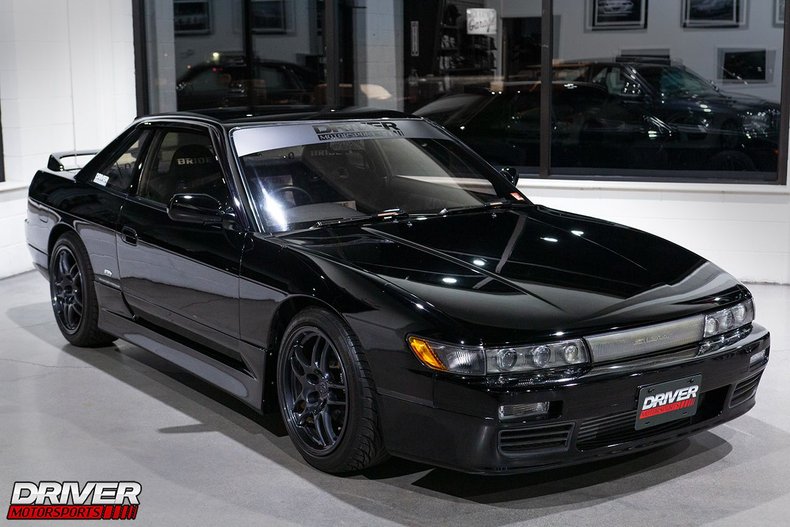
Nissan Skyline GT-R KPGC10 Hakosuka
By Kenneth AuUpdated
The Nissan Skyline GT-R (KPGC10), nicknamed Hakosuka, is the two-door coupe version of the first Skyline GT-R, built from October 1970 to 1972 with a 2.0-liter S20 DOHC straight-six rated at 162 PS (160 hp). Its engine traces to the R380 race car, and the coupe extended a touring car winning streak that sources put between 46 and 58 races. Every car was right-hand drive and sold only in Japan.
日産 スカイライン GT-R(ハコスカ)
Editorial review
- 型式Chassis
- KPGC10
- 製造者Maker
- Nissan
- 年式Years
- 1970-1972
- 用途Class
- Touring Car Homologation Special
参考動画Reference footage
Specifications
| Engine unit | S20 |
|---|---|
| Displacement | 1,990 cc |
| Bore × stroke | 82 × 62.8 mm |
| Redline | 7,500 rpm |
| Power | 162 PS (160 hp) at 7,000 rpm |
| Torque | 177 N·m (130 lb-ft) at 5,600 rpm |
| Drivetrain | Rear-wheel drive |
| Transmission | Five-speed manual |
| Kerb weight | About 1,100 kg |
| Wheelbase | 2,570 mm |
| 0–100 km/h | 9.6 seconds (0–62 mph, estimate) |
| Top speed | 128 mph (estimate) |
| Production | Disputed: 1,115 to 1,197 coupes |
| Price when new | ¥1,500,000 |
The Nissan Skyline GT-R KPGC10 is the two-door coupe built from October 1970 to 1972, nicknamed "Hakosuka," that won more than 50 Japanese touring car races with its 162 PS (160 hp) S20 straight-six. Fewer than 1,200 coupes left the factory, all right-hand-drive and sold only through Nissan's Prince Store network. It remains one of the most expensive Japanese classics at auction today.
History & Motorsport Heritage
The Skyline nameplate predates Nissan's involvement entirely. Prince Motor Company built the original Skyline Sport from 1957 to 1964, and things got serious that year when Prince stretched a Skyline by eight inches, dropped in the Gloria's 2.0-liter inline-six, and entered it in the 1964 Japanese Grand Prix. Nissan absorbed Prince in 1966, inheriting both the Skyline line and the engineers who had gone on to develop the R380 race car.
That merger set up the GT-R project directly. Nissan paired the R380's racing pedigree with the C10-generation Skyline body, aiming to build a homologated touring car for Japanese Grand Prix competition. The first Skyline GT-R, internally coded PGC10, arrived on February 4, 1969, as a four-door sedan sold exclusively through the Prince Store dealer network, following its public debut at the October 1968 Tokyo Motor Show alongside the R380 racer itself.
The two-door coupe, the KPGC10, followed roughly two years later, debuting in October 1970 and going on sale to the public in March 1971. Nissan shortened the wheelbase and trimmed weight for the coupe body, changes aimed at the racetrack rather than the showroom.
On the circuit, the GT-R name became shorthand for domination in Japanese touring car racing. Sources differ on the exact tally:
- RM Sotheby's: 46 straight class wins and more than 50 overall wins over roughly three seasons
- State of Speed: 49 consecutive wins and 50 victories overall
- NISMO Festival recap: over 52 race wins for the two factory Hakosuka cars between 1970 and 1972
- Hagerty: 58 overall wins for all three works GT-Rs (including the earlier PGC10 sedan), 49 of them consecutive, with 32 at Fuji Speedway
Whichever count is used, the underlying campaign is the same. The four-door PGC10 opened the streak, winning 33 races in a year and a half before a Mazda Savanna RX-3 ended its bid for a 50th consecutive victory. The KPGC10 coupe picked up where the sedan left off. Driver Kunimitsu Takahashi, part of the factory trio known as the Oppama Works "Miragurasu" (three crows) alongside Moto Kitano and Motoharu Kurosawa, was personally responsible for seven of the streak's wins, including the 50th victory, taken at the Fuji Grand Champion 300 km race in March 1972.
At the JAF Grand Prix, the new KPGC10 swept the TS-b class podium on debut, with Takahashi taking the win ahead of Masahiro Hasemi and Hiroshi Kubota. After 1972, the GT-R program went quiet. The 1973 successor, the KPGC110 "Kenmeri," is widely believed to have existed mainly to use up remaining stock of the S20 engine, and the GT-R nameplate then disappeared entirely until 1989.
Exclusivity & Production Run
Exact production totals for the KPGC10 are disputed across sources, and none of the commonly cited figures reconcile perfectly. What is consistent is that the car was built in small numbers over a short run and sold only in Japan.
- English-language reference sources: 832 PGC10 sedans and 1,197 KPGC10 coupes, for a combined 2,029 cars
- RM Sotheby's: only 1,115 GT-R coupes built between 1970 and 1972
- BH Auction (Japan): an estimated 1,197 KPGC10 units built over roughly two years
- Whichcar: 1,947 combined cars, with 1,115 coupes and 832 sedans
- Enthusiast outlets (State of Speed, GTR Forum, Project JDM): 1,945 total cars, with the coupe outnumbering the sedan by a factor of about 1.5
None of these totals is official, and Nissan itself has never published a definitive number. What's certain is that every Hakosuka was built in right-hand drive for the domestic market, with no factory export program.
The successor shows how limited the whole GT-R nameplate was in this era: only 197 examples of the 1973 KPGC110 "Kenmeri" were built before the badge went dormant for 16 years.
Factory color data adds a layer of detail collectors use for authentication. Roughly 30 percent of KPGC10s left the factory in white. "Skyline Brown" was offered only during the earliest production window in 1970, making a brown Hakosuka an early-build indicator on its own. Chassis numbers are used the same way: a documented chassis number 58, for instance, confirms a car belongs to the very first production batch.
Aerodynamics & Design Philosophy
Designer Shinichiro Sakurai penned the C10 Skyline using a straightforward three-box layout, with separate volumes for engine, cabin and trunk, and that boxy shape is where the "Hakosuka" nickname comes from. Sakurai gave the car pronounced front fender tops, contoured flanks, and a full-width front end housing twin headlights per side, with a matching satin-black treatment at the rear.
The coupe body wasn't just a styling exercise. Nissan shortened the wheelbase from 2,640 mm to 2,570 mm and cut about 20 kg of weight compared to the sedan, while widening the body and enlarging the wheel housings to fit bigger tires. A lower windshield and, on some cars, an optional rear wing were added for aerodynamic reasons tied directly to racing. The ducktail spoiler and front splitter seen on many surviving cars complete that competition-oriented profile, and a genuine factory rear spoiler, as opposed to an aftermarket replacement, is now a specific point of value on auction listings.
Fender-mounted side mirrors, a detail that gives the Hakosuka much of its recognizable side profile, weren't a styling choice at all. Japanese motor vehicle regulations at the time required mirrors to be placed where they'd remain visible through the defroster-cleared portion of the windshield.
Inside, the GT-R trim distinguished itself from lesser GC10/GT-X Skylines with specific hardware: fixed-back bucket seats with ribbed basket-weave centers, a 10,000 rpm tachometer in place of the standard car's 8,000 rpm unit, a black leatherette-rimmed three-spoke steering wheel instead of wood, and red badging on the wheel and gear lever where other trims used black. The cabin also carried aluminum pedals and a steel chassis structure, kept deliberately minimal to save weight.
That shape has stayed relevant well beyond its original production run. Japanese designer Kei Miura's Pandem/Rocket Bunny line still produces FRP and carbon overfenders, ducktail spoilers, and full aero kits cut specifically for the KPGC10 body, a two-door shape now more than 50 years old.
S20 · Powerplant
Under the hood sits the S20, a 1,990 cc DOHC straight-six with an 82 mm bore and 62.8 mm stroke, four valves per cylinder, a crossflow head, and hemispherical combustion chambers. It was fed by three Mikuni-Solex N40PHH-A24 carburetors and traced its lineage directly to the GR-8, the 2.0-liter unit developed for the R380 race car.
The road engine was rated at 162 PS (119 kW), usually quoted in English as 160 hp, at 7,000 rpm, and 177 N·m (130 lb-ft) of torque at 5,600 rpm, with a 7,500 rpm redline. Some sources list the torque peak as 131 lb-ft at 5,600 rpm and give a slightly lower 158 hp. Dry weight for the engine itself was 199 kg.
Racing-tune variants of the S20 used different fueling entirely. Some accounts describe early PGC10 race engines running triple Weber 40DCOE carburetors, later switched to a Lucas mechanical fuel injection system from October 1969 that pushed output to 230 hp and eventually 250 hp. These figures describe competition-spec engines, not the road-going S20 that buyers drove home.
For context, 160 hp was modest even by Nissan standards: the S30 Fairlady Z's single-cam 2.8-liter L28 six made 170 hp, ten more than the Hakosuka's twin-cam 2.0-liter. What the S20 offered instead was a 7,500 rpm ceiling and race-bred architecture in a road car that weighed roughly 1,100 kg (about 2,425 lb by some estimates) in coupe form, 20 kg lighter than the sedan. One reference source estimates 0–62 mph in 9.6 seconds and a top speed of 128 mph for the coupe.
The original retail price was 1.5 million yen, about $4,200 in 1971 dollars or roughly $27,000 in today's purchasing power.
For scale against the modern car carrying the same badge: the current R35 GT-R weighs just over 3,800 lb and makes over 560 hp from a twin-turbo VR38DETT V6 with active torque-split all-wheel drive. The Hakosuka ran a naturally aspirated inline-six with roughly 400 fewer horsepower, sending drive to the rear wheels only through a simple limited-slip differential.
Chassis, Suspension & Handling Dynamics
The KPGC10 used MacPherson struts up front and a semi-trailing-arm independent rear, a fully independent four-wheel setup that was sophisticated for a compact sedan-derived platform in 1970. Braking combined front discs with rear drums, and both the steering (unassisted recirculating ball) and the brakes were unboosted, so the driver did all the work at low speed and under hard braking.
Drivetrain hardware included a five-speed manual gearbox and a clutch-type limited-slip differential. The rear semi-trailing-arm layout controlled suspension geometry with relatively few moving parts and, combined with the car's light weight, gave it a precise, responsive character when pushed. Period racers and modern owners describe that trait consistently.
The coupe-specific changes mattered more than they might suggest on paper. Beyond the 20 kg weight saving over the sedan, the coupe's wheelbase was 7 cm shorter, sharpening turn-in and weight transfer. Works driver "Gan-San" recalled the two-door version being nearly two seconds faster than the four-door at Fuji Speedway, a substantial gap for what was fundamentally the same running gear.
The sedan's longer wheelbase and period low-grip tires gave it a different personality: strong understeer that drivers managed by braking hard into corners to rotate the car, then holding a drift through the apex. The coupe's shorter wheelbase reduced the need for that technique.
Despite the spartan cabin, with non-adjustable bucket seats and minimal sound deadening, the KPGC10 still carried a 100-liter fuel tank to support long-distance racing while remaining lighter overall than its four-door sibling. It was, in effect, a homologated racer with license plates: four-wheel independent suspension and a competition drivetrain in a road-legal shell.
Nomenclature & Lore
"Hakosuka" was never Nissan's own designation; the factory paperwork reads PGC10 for the sedan and KPGC10 for the coupe. The nickname is a Japanese portmanteau. "Hako" means box, describing Sakurai's three-box styling, and "suka" is a shortened form of "Sukairain," the Japanese pronunciation of Skyline. Put together, it translates roughly to "boxy Skyline."
The name now functions as the car's de facto title among collectors and Japanese fans alike, used more often than either chassis code. It's part of a naming pattern that continued with the next GT-R generation: the 1973 KPGC110 became known as "Kenmeri," after "Ken and Mary," the fictional couple featured in Nissan's advertising campaign for that car. Both nicknames have long since eclipsed their chassis codes in everyday use.
Auction Records & Modern Market Value
The KPGC10 market shifted in August 2014, when a 1972 coupe sold at RM Auctions' Monterey sale for $242,000, at the time the most expensive Hakosuka GT-R ever sold. That record didn't last. At BH Auction in Japan, during Tokyo Auto Salon weekend, a 1971 Silver Metallic KPGC10 (chassis KPGC10-000206) sold for ¥33,880,000, roughly $308,150 at the exchange rate of the time.
The broader Nissan Skyline auction record now belongs to a related car rather than the KPGC10 itself: a 1973 KPGC110 "Kenmeri" sold in Tokyo for $430,483, surpassing the 2014 Hakosuka result. It is a different chassis, so it shouldn't be read as KPGC10 pricing.
Aggregated auction data covering the broader C10-generation Skyline, including GT-R and lesser trims, shows a wide spread:
- Highest recorded sale: $211,000 for a 1971 Skyline 2000 GT-R (October 2023)
- Lowest recorded sale: $40,000 for a 1972 Skyline 2000GT (KGC10) "Hakosuka Tribute," a non-genuine GT-R build rather than an original coupe
- Average sale price across the C10 generation: $107,946
- 1971 KPGC10 comparables: 30 sales ranging from $106,314 to $233,522
Hagerty's valuation guide places a typical 1971 Skyline 2000 GT-R in good condition around $210,000, with strong examples approaching a quarter-million dollars. Earlier sales show how quickly values climbed: a 1971 KPGC10 sold at USS Tokyo in June 2016 for ¥12,670,000, while a comparable car had sold for ¥4.4 million three years earlier.
Authenticity drives these numbers directly. A verified factory S20 engine, unmolested suspension geometry, period-correct interior trim, and even original spot welds can swing a six-figure price significantly. Well-documented, unmodified examples now command prices that put them in the same conversation as European homologation classics like the BMW E9 CSL or Porsche 911 Carrera RS.
Keeping the Legend Alive (Restomod & Specialist Culture)
The GT-R nameplate returned in 1989 with the R32, and the current R35 generation has been in continuous production since the 2008 model year. For the GT-R's 50th anniversary, Italdesign built the GT-R50, based on a production 2018 GT-R NISMO and fitted with an evolved twin-turbo 3.8-liter V6 producing 720 hp at 7,100 rpm and 575 lb-ft of torque. Only 50 were built, priced around $1.1 million each. Its retractable rear wing, when raised, echoes the downward-angled spoiler of the original Hakosuka, and even with the wing lowered the car's boxy rear deck nods to the same source.
Nissan's own parts-support program, NISMO Heritage Parts, launched in December 2017 starting with the R32 GT-R before expanding to the R33 and R34. The catalog has grown from roughly 80 to 300 parts, using techniques like dual-sided dieless forming to stamp small-batch sheet metal, alongside 3D-printed components. The program currently stops short of the Hakosuka and the S30 Fairlady Z, a gap enthusiasts have publicly noted, arguing that OEM-quality rust-replacement panels for those older cars would justify the production cost.
In the absence of factory support, independent shops have filled that role. Rocky Auto, run by "Watanabe-san," has spent more than 20 years performing engine and drivetrain swaps on vintage Skylines and Fairlady Zs, and is regarded as a leading name in re-engineered vintage Japanese cars. Example builds documented from the scene include:
- Carbon-bodied RB26 build: an Autech RB26DE swap with forged 87 mm pistons bringing displacement to 2,627 cc, 11.5:1 compression, Tomei 260-degree camshafts and a Rocky Auto exhaust system
- Toyota 1UZ V8 swap: a fully restored and structurally reinforced KPGC10 chassis producing 250 hp and 260 lb-ft, with what builders describe as strong reliability
- UK RB26 build: a five-speed RB25 gearbox and a Subaru R160 limited-slip differential, whose owner notes the original KPGC10 draws the highest demand and prices among Japanese classic buyers
Tokyo Auto Salon continues to showcase similar builds each year, including an HPI-built Hakosuka running an L-series engine stroked to 3.1 liters producing 320 PS, and the "Rocky Auto 3000GT," a from-scratch body built to mimic the Toyota 2000GT while housing a modern 3.0-liter 2JZ inline-six. Genuine period race cars, meanwhile, are treated as museum pieces: at a NISMO Festival event, two works KPGC10s that had won races in 1971 and 1972 were driven again by their original race-winning drivers, Moto Kitano and Masahiro Hasemi.
FAQs
What engine is in the Hakosuka GT-R?
The KPGC10 uses the S20, a 1,990 cc DOHC straight-six with four valves per cylinder and three Mikuni-Solex carburetors, descended from the R380 race car's GR-8. It was rated at 162 PS (160 hp) at 7,000 rpm and 177 N·m (130 lb-ft) at 5,600 rpm, though some sources list 158 hp and 131 lb-ft.
How many Hakosuka GT-R coupes were made?
Sources disagree, and Nissan has never published an official figure. English-language reference sources and BH Auction give 1,197 KPGC10 coupes, while RM Sotheby's states 1,115. Every car was right-hand drive for the Japanese market.
Why is it called Hakosuka?
Hakosuka is a Japanese nickname, not a factory name. "Hako" means box, for the car's three-box styling, and "suka" is short for "Sukairain," the Japanese pronunciation of Skyline, so it means roughly "boxy Skyline."
How much is a Hakosuka GT-R worth?
Hagerty values a 1971 Skyline 2000 GT-R in good condition around $210,000. A 1972 coupe sold at RM Auctions' Monterey sale in August 2014 for $242,000, and a 1971 KPGC10 later sold at BH Auction in Japan for ¥33,880,000, roughly $308,150.
What is the difference between the KPGC10 and the PGC10?
The PGC10 is the four-door GT-R sedan launched on February 4, 1969, and the KPGC10 is the two-door coupe that debuted in October 1970. The coupe's wheelbase is 2,570 mm instead of 2,640 mm and it weighs about 20 kg less. A works driver recalled the coupe being nearly two seconds faster at Fuji Speedway.
How many races did the Hakosuka GT-R win?
Counts vary by source. RM Sotheby's cites 46 straight class wins and more than 50 overall, while Hagerty's tally for the sedan and coupe together reaches 58 wins, 49 of them consecutive. Kunimitsu Takahashi took the 50th victory at the Fuji Grand Champion 300 km race in March 1972.
結 · IN CLOSING
The Nissan Skyline GT-R KPGC10, known as the Hakosuka, was built from October 1970 through 1972 as the coupe version of Nissan's first GT-R. Powered by the 2.0-liter S20 straight-six inherited from the R380 race car, rated at 162 PS (160 hp), it and its four-door PGC10 sibling combined for a touring car winning streak variously reported between 46 and 58 races. Production topped out somewhere around 1,100 to 1,200 coupes depending on the source, all sold exclusively in right-hand drive through Japan's Prince Store network. Its three-box styling by Shinichiro Sakurai gave rise to the "hako" (box) plus "suka" (Skyline) nickname that's now more common than its factory chassis code. Today, genuine examples routinely sell for $200,000 or more at auction, with the top recorded KPGC10 result at $308,150 and the broader Skyline record, set by the related KPGC110 "Kenmeri," reaching $430,483. Authenticity of the S20 engine and factory suspension geometry drives much of that value. With official parts support still limited to later GT-R generations, the Hakosuka's ongoing life is sustained largely by independent restorers running RB26 and even V8 swaps into cars that started life with a 160 hp straight-six and a 1.5-million-yen price tag.
About this entry
Edited by Kenneth Au. AI tools help gather the research and write a first draft; every entry is then edited by hand before it is published. This entry was last reviewed in November 2026. Spotted an error? Send a correction →