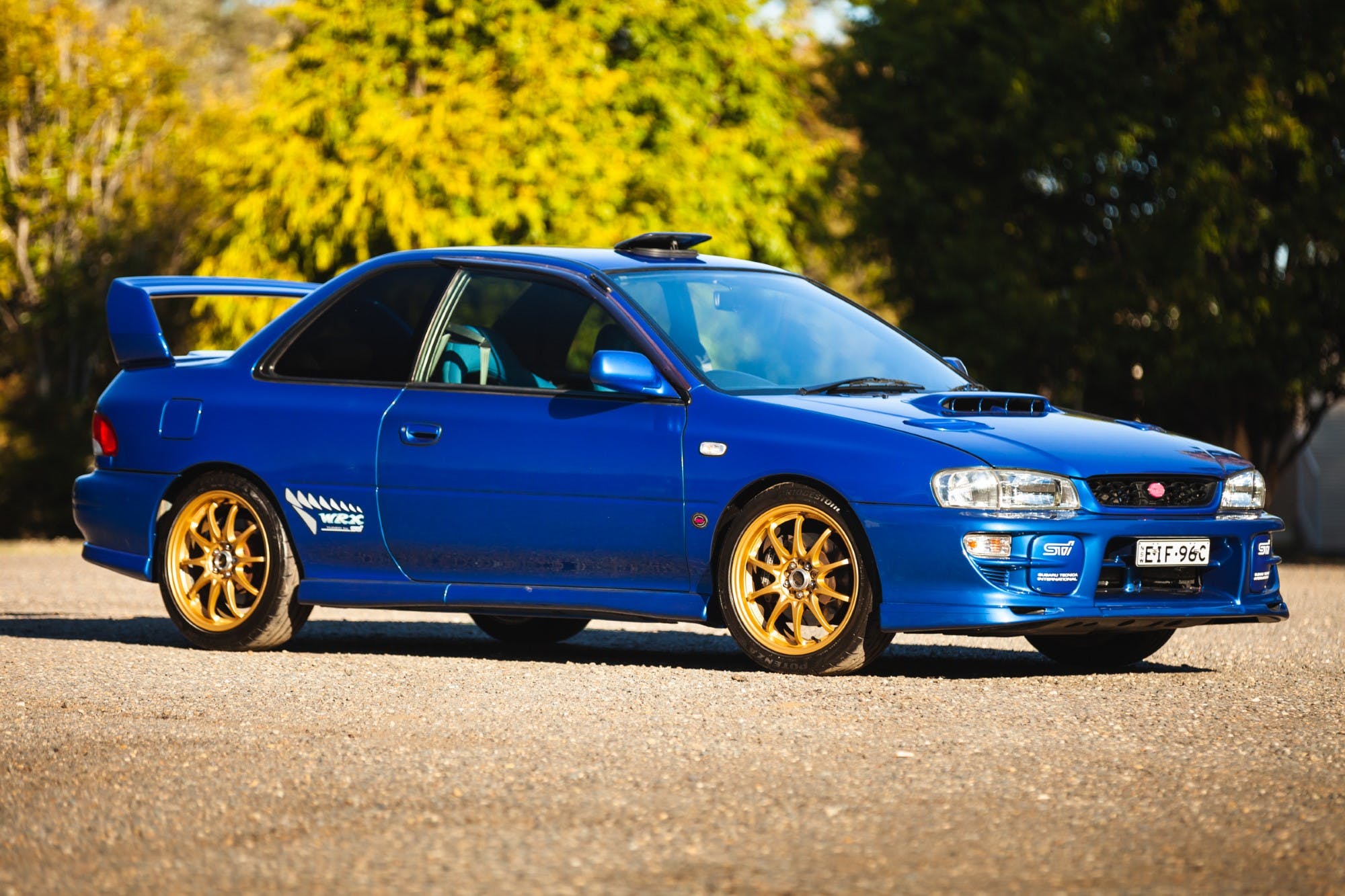
Subaru Legacy RS Turbo (BC5)
レガシィ RS ターボ (E-BC5)
Editorial review
- 型式Chassis
- First-generation Legacy, chassis code BC5 (sedan) / BF5 (wagon)
- 製造者Maker
- Subaru
- 年式Years
- 1989-1994
- 用途Class
- Sedan
参考動画Reference footage
The Subaru Legacy RS Turbo is a Japan-market performance sedan and wagon built on the first-generation Legacy platform, chassis code BC5, sold from 1989 to 1994 with a 220 PS turbocharged EJ20G boxer engine and full-time all-wheel drive. It is sometimes mislabeled with the "GC" chassis prefix, which actually belongs to the later Impreza — the Legacy uses the B-series codes (BC for the sedan, BF for the wagon). Built before Subaru had even launched the Impreza, the RS Turbo was the car that created STI as a company, carried Subaru to its first World Rally Championship victory, and laid the groundwork for everything that followed, including the 22B.
諸元Specification of record
- 原動機Engine unit
- EJ20G turbocharged flat-four (DOHC 16v)
- 総排気量Displacement
- 1,994cc
- 最高出力Power
- 220 PS (162 kW) @ 6,400 rpm (JDM RS/RA spec)
- 最大トルクTorque
- 27.5 kg·m (269.7 Nm) @ 4,000 rpm (JDM RS/RA spec)
- 駆動方式Drivetrain
- Full-time all-wheel drive
- 変速機Transmission
- 5-speed manual
- 車両重量Kerb weight
- 1,280-1,300 kg (road cars); 1,150 kg (Group A works car)
Long before the Impreza WRX STI or the 22B became shorthand for Subaru performance, there was a boxy, unassuming four-door sedan that quietly did all the groundwork. The Legacy RS Turbo set a FIA endurance record in the Arizona desert before it ever reached a rally stage, then went on to win Subaru's first-ever World Rally Championship event and hand a 23-year-old Colin McRae his maiden WRC victory.
It is, in every meaningful sense, patient zero for STI — the car whose success justified the company's existence and whose formula of homologation-special road car plus factory rally effort would define Subaru's performance lineage for the next three decades.
来歴History & Motorsport Heritage
Subaru introduced the first-generation Legacy worldwide in 1989 as a mid-size sedan and wagon built by Fuji Heavy Industries, aimed squarely at establishing Subaru as a more serious competitor to Honda and Toyota. Subaru had experimented with turbocharging since the Leone in the early 1980s, but for a proper 2.0-liter turbocharged Legacy, buyers had to look outside North America — to Japan, Australia, New Zealand, or Europe. The performance model was called the RS in Japan and simply the Turbo in Europe and Oceania. In Australia, Subaru couldn't even use the Legacy name; a conflict with a veterans' charity forced the brand to badge the car "Liberty," so Australian buyers bought a "Liberty RS Turbo" instead.
Before the RS ever reached showrooms in volume, Subaru used it to set a record. STI prepared four Legacy RS models with reinforced drivetrains, stiffened suspension, a deep front air dam, a roll cage, and a quick-fill long-range fuel tank. In January 1989, under FIA supervision, three Japanese-spec turbocharged RS sedans ran for over 18 days at the Arizona Test Center, an oval track outside Phoenix, covering 100,000 kilometers and breaking the FIA World Land Endurance Record with an average speed of 138.78 mph. That endurance run gave STI the technical credibility and marketing story to launch its first commercial product: the Legacy RS Type RA, released in November 1989, visually identical to the standard RS aside from small decals reading "Handcrafted tuning by STi."
Subaru moved quickly from endurance racing into rallying. The Legacy RS was developed through 1989 and homologated under Group A regulations in January 1990. It made its World Rally Championship debut at the 1990 Safari Rally, the third round of that season, with six cars entered and Markku Alen leading the STI team — and the Legacy became the first Group N car to finish the notoriously brutal Safari Rally. A year later, Subaru Rally Team Europe fielded Ari Vatanen and a 23-year-old Colin McRae in the Legacy at the 1991 Lombard RAC Rally; Vatanen finished fifth while McRae crashed out. McRae's season wasn't wasted, though — driving the Legacy RS, he won the 1991 British Rally Championship with four BRC wins that year. The Legacy went on to take three consecutive British Rally Championship titles, with both McRae and Richard Burns behind the wheel.
The Legacy's biggest moment came at the 1993 Rally New Zealand. Colin McRae, driving the #7 Prodrive-run Legacy RS, held off Ford's Francois Delecour and Toyota's Didier Auriol to win — his first WRC victory, Subaru's first-ever WRC win, and the first win by a British driver in a World Rally event since 1976. McRae added a podium in Sweden and three more points finishes that season, finishing fifth in the drivers' championship, while Vatanen took a second-place finish at Rally Australia. Subaru closed out 1993 third in the manufacturers' championship. Vatanen also produced one of the era's more memorable near-misses that year, leading the 1993 Acropolis Rally ahead of Tommi Mäkinen, Carlos Sainz, and McRae himself before crashing out.
By the time of Rally Finland in 1993, Subaru had a new weapon ready. The Legacy was retired from top-level competition and replaced by the Impreza 555, which went on to win three consecutive manufacturers' titles and three drivers' titles across its career. Even so, McRae and Burns both preferred the outgoing Legacy in some respects. It was longer, wider, and more cumbersome than the Impreza that replaced it, but both drivers found it faster and noisier, and McRae in particular loved its balance — the longer wheelbase made the car less nervous and let him set up for corners well before the apex, balancing it on the throttle through the turn. Subaru's motorsport department had relocated its base from Japan to Banbury, England back in 1989, handing international rally operations to David Richards' Prodrive — the same partnership that would run the Impreza's world championship campaigns.
希少性Exclusivity & Production Run
Because the RS was never sold in North America in its full-strength form, production was concentrated on Japan and a handful of export markets, and the numbers involved are small by any modern standard.
- RS Type RA, Series 1 (1989): limited to 100 units, available only in Ceramic White.
- RS Type RA, Series 2 (May 1990): added a close-ratio transmission.
- RS Type RA, Series 3 (1991 facelift): gained a 16-bit ECU, improved mid-range torque, and a color change to Feather White.
- RS Type RA, final series: added a Black Mica color option.
- Total Type RA production: approximately 700 units across all series.
- STI Touring Wagon: launched July 1992, limited to 200 units, fitted with BBS wheels.
- Group A works cars: one registry lists 26 chassis built by Prodrive for the Legacy RS Group A rally program.
There's some ambiguity around the earliest cars — enthusiast forums claim the first run may have originally been badged "RS-R" before the name changed to "RS RA" in 1990, which would mean no genuine 1989-badged RA cars exist, though this claim remains unconfirmed. Surviving numbers for specific variants also appear to be extremely thin; one owner community discussion of a particular RA example put the surviving population at just two rally cars and one road car, though that figure describes survivors rather than total production.
For the North American market, Subaru offered only a detuned Legacy Turbo Sport Sedan, and even that sold in tiny numbers. Subaru of America's own figures for the 1991 model year list 149 automatic-transmission cars and 58 manual-transmission cars. A separate, unofficial breakdown circulated on enthusiast forums claims: 1991: 58 five-speeds, 149 automatics; 1992: 6 five-speeds, 5 automatics; 1993: 25 five-speeds, 45 automatics; 1994: 170 five-speeds, 230 automatics.
Forum members themselves have flagged these year-by-year numbers as suspiciously low and internally inconsistent, and no fully authoritative factory count by year has surfaced. What is clear is the scale of the whole platform against which the RS operated: first-generation Legacy production totaled 824,612 units worldwide — 620,444 built in Japan and 204,168 built at Subaru of Indiana — meaning the turbocharged, all-wheel-drive RS variants were a small slice of a much larger, mostly ordinary family car program.
意匠Aerodynamics & Design Philosophy
The first-generation Legacy was designed by Kiyoshi Sugimoto, with the design finalized in 1987, and offered as either a four-door pillared hardtop sedan or a five-door station wagon. Subaru positioned it directly against the Honda Accord and Toyota Camry, and for the brand, it represented a real jump forward — before the Legacy, Subaru had built a reputation for "quirky" cars while rival Japanese manufacturers moved toward more conventional, upscale styling. The RS was a deliberate part of that image shift, giving Subaru a genuine sports sedan to point to rather than just an oddball all-wheel-drive wagon.
Visually, the RS distinguished itself from lesser Legacy trims through hardware rather than dramatic styling changes. The RS, RS Type R, and GT models rode on 15-inch alloy wheels with 205/60R15 tires, backed by dual-piston front brake calipers and single-piston rear calipers, along with a sport-tuned suspension — a significant step up from the 14-inch steel wheels fitted to standard Legacy trims.
The Type RA pushed the concept further by cutting weight rather than adding equipment. Subaru stripped sound-deadening material, fitted thinner glass, and deleted the sunroof, while reinforcing the drivetrain with forged pistons, hand-ported cylinder heads, stronger connecting rods, and a fully balanced set of reciprocating components. The Series 2 RA, introduced in 1990, went further still, removing power windows, central door locking, the power antenna, the rear wiper, the optional rear spoiler, the under-spoiler, the exhaust tip trim, tire chains, the courtesy light, and auto-folding mirrors, along with the radio, trunk mat, and factory undercoating. Blue-tinted glass, black door mirrors, and simple lever-type climate controls replaced the more comfort-oriented items found on other Legacy models.
No official factory drag coefficient figure for the BC5 RS turned up in period documentation. Enthusiast forum discussion has speculated that the first-generation Legacy's longer body and shallower windshield angle might give it a lower Cd than the early Impreza, and a later Legacy GT sedan is sometimes cited at 0.31 for comparison — but neither claim is backed by a verified factory number for the BC5, so it should be treated as unresolved rather than fact.
On the marketing side, Subaru Japan used Bruce Willis as a brand ambassador during this period, running print and television campaigns built around him — an unusual choice that reflected how seriously Subaru was trying to reposition itself with the Legacy generation.
機関EJ20G turbocharged flat-four (DOHC 16v) · Powerplant
The RS Turbo is built around the EJ20G, a 1,994cc DOHC 16-valve turbocharged and intercooled flat-four. In JDM RS and RS Type RA spec, Subaru's own figures list 220 PS (162 kW) at 6,400 rpm and 27.5 kg·m (269.7 Nm) of torque at 4,000 rpm, running an 8.5:1 compression ratio with a 92mm bore and 75mm stroke, paired exclusively with a 5-speed manual transmission and full-time all-wheel drive.
A commonly repeated alternative figure puts output at 217 hp and 199 lb-ft — a number that shows up across several English-language sources and roughly matches the 220 PS/269.7 Nm Japanese spec once converted, suggesting the discrepancy is a rounding or gross-versus-net measurement difference rather than evidence of two distinct factory tunes.
Export markets received a noticeably softer version of the same engine. Cars sold in Europe and Oceania used the same turbocharged EJ-series unit but were detuned to around 197 hp. North American buyers fared worse still — Subaru of America's Legacy Turbo Sport Sedan used the SOHC EJ22T instead of the DOHC EJ20G, ran without an intercooler, and produced just 165 PS, offered only with a 5-speed manual. It was, by a wide margin, the weakest turbocharged Legacy sold anywhere.
One spec database lists a substantially higher output for a 1993 Legacy RS: 247 bhp (250 PS/184 kW) at 6,500 rpm and 309 Nm (228 lb-ft) at 5,000 rpm, with a 1,330 kg curb weight through a 5-speed manual. That figure is well above the 220 PS commonly cited for the RS, RS Type R, and RS Type RA, and it isn't clear whether it reflects a genuine late-series running change, a different GT-based variant, or a database error — it should be treated as unconfirmed rather than repeated as the definitive late-model spec.
Real-world performance figures for the export-spec RS/Turbo, at 217 hp and 199 lb-ft, are commonly cited at a 0–60 mph time under 6.5 seconds, with Iconic Auctioneers listing a top speed of 155 mph for the car.
The Group A works engine used in the WRC program was a different animal entirely, though even here sources disagree on the exact number. One listing puts the works engine at 300 hp from the 2.0-liter turbo boxer, in a car weighing 1,150 kg; another source states around 290 hp and 392 Nm, sent through a 5-speed X-Trac manual gearbox, with a viscous-coupling center differential and limited-slip units front and rear. A restored ex-works Group A car is likewise described as running a period-correct 290 hp works turbo engine paired with the X-Trac gearbox, which suggests 290 hp is the more commonly cited figure for the rally-spec unit even if it isn't universally agreed upon.
車台Chassis, Suspension & Handling Dynamics
The RS Turbo's chassis is built around a longer wheelbase than the Impreza that eventually replaced it in competition, and that length shaped how the car actually drove. Colin McRae and Richard Burns, who both raced the Legacy before moving to the Impreza, found it faster and noisier than its successor but preferred its balance and stability. The longer wheelbase made the car less nervous through direction changes, and McRae liked to set the car up for a corner well before the apex, then balance it on the throttle through the turn rather than making late, sharp inputs.
On the road, the RS and RS Type R backed up their power with genuine chassis hardware rather than badge-only upgrades: 15-inch alloy wheels wrapped in 205/60R15 tires, dual-piston front brake calipers with single-piston rears, and a sport-tuned suspension setup, all sitting above the 14-inch steel wheels fitted to lesser Legacy trims. Curb weights stayed relatively contained for an all-wheel-drive turbo sedan of this era — the RS Type R from May 1990 weighed 1,280 kg, the RS Type RA from June 1992 came in at 1,290 kg, and a separate RS listing puts full weight at 1,300 kg.
The Group A rally cars stripped that further, down to a 1,150 kg race weight, and ran a viscous-coupling center differential alongside limited-slip differentials front and rear — hardware that let the works Legacy manage power delivery across rough, high-speed stages like the Safari and RAC rallies where it first made its name.
名義Nomenclature & Lore
The Legacy RS Turbo carries several layers of naming confusion. Its chassis code is BC5 (sedan) / BF5 (wagon), yet it is sometimes mislabeled with the "GC" prefix, which actually belongs to the later Impreza. The performance trim itself was badged RS in Japan, simply Turbo in Europe and Oceania, and in Australia the entire Legacy nameplate had to be dropped in favor of "Liberty" due to a conflict with a veterans' charity, resulting in the "Liberty RS Turbo." There's also unresolved ambiguity around the earliest homologation cars, with enthusiast forums claiming the first run may have originally been badged "RS-R" before switching to "RS RA" in 1990 — a claim that remains unconfirmed but, if true, would mean no genuine 1989-badged RA cars exist.
相場Auction Records & Modern Market Value
Hard sale-price data for the JDM RS Turbo is thin in English-language sources, largely because the car was never officially sold in markets where collector-car auction reporting is most developed, such as the United States. What evidence does exist comes mostly from specialist UK collector-car auction listings, such as Iconic Auctioneers, which has catalogued export-spec cars with the commonly cited 217 hp/199 lb-ft output and 155 mph top speed — itself a sign that these cars have entered the established European classic-car auction circuit rather than staying purely in enthusiast-to-enthusiast sales.
Scarcity is the main driver of whatever value these cars command. Total Type RA production sits at roughly 700 units across four running series, with the original Series 1 limited to just 100 cars, all in Ceramic White. The STI Touring Wagon is rarer still at 200 units. Survivor counts for specific variants appear to be even lower than production numbers suggest — one owner community discussion of a particular RA example puts the surviving population at just two rally cars and one road car, though this describes survivors of one specific build rather than the model as a whole. Group A works chassis are rarer yet, with one registry listing only 26 examples built by Prodrive for the factory rally program.
Because so few RS and RS Type RA cars were built, and because none were sold new in North America, most transactions happen either in Japan, in the UK and Australian markets where the car was officially sold, or through specialist importers dealing in JDM performance cars. Given the low survivor counts reported for individual variants, values are likely to remain driven by rarity and documented history — particularly for cars with a traceable link to the STI Type RA program or the Group A rally effort — rather than by any single benchmark sale price currently on public record.
継承Keeping the Legend Alive (Restomod & Specialist Culture)
The Legacy RS's competition career ended when Subaru retired it from top-level rallying after the 1993 season, replacing it with the Impreza 555, which debuted at that year's Rally Finland. The Impreza went on to win six world rally titles across its career, including three consecutive manufacturers' championships and three drivers' championships — a run of success the Legacy had helped make possible by proving Subaru's turbocharged all-wheel-drive formula could win at world championship level in the first place.
That handover also marked a shift in STI's own product line. The Legacy RS Type RA was STI's first-ever commercial product, born directly out of the 1989 Arizona endurance record program, and it established the formula — a homologation-special road car built alongside a factory rally effort — that STI would carry forward through the Impreza WRX STI generations that followed, eventually leading to cars like the 22B.
Restoration interest today centers on a few specific groups of cars. The Type RA's factory-forged pistons, hand-ported heads, and balanced rotating assembly make its EJ20G a more desirable base for rebuilds than the standard RS engine, and its lighter, stripped-out equipment list appeals to owners chasing an original homologation-spec car rather than a comfort-oriented one. On the competition side, surviving Group A works chassis have become restoration projects in their own right — one rebuilt ex-works car has been documented running a period-correct works turbo engine producing around 290 hp, paired with the original X-Trac 5-speed manual gearbox, effectively recreating the specification McRae and Vatanen raced in 1993. With Type RA production sitting at roughly 700 units and works chassis numbering as few as 26, cars in either category are working from an extremely small base to begin with.
問答Questions of record
問01How many Subaru Legacy RS Type RA cars were made?
Approximately 700 Type RA units were built across all four running series, starting with just 100 Series 1 cars in Ceramic White in 1989.
問02What engine is in the Subaru Legacy RS Turbo?
It uses the EJ20G, a 1,994cc DOHC 16-valve turbocharged and intercooled flat-four producing 220 PS (162 kW) at 6,400 rpm and 27.5 kg·m (269.7 Nm) of torque at 4,000 rpm in JDM RS/RA spec, paired with a 5-speed manual and full-time all-wheel drive.
問03Did the Subaru Legacy RS Turbo win any WRC rallies?
Yes — Colin McRae won the 1993 Rally New Zealand in a Prodrive-run Legacy RS, Subaru's first-ever WRC victory and the first win by a British driver in a World Rally event since 1976.
問04Was the Legacy RS Turbo sold in North America?
Not in its full-strength form. North America only received a detuned Legacy Turbo Sport Sedan with the SOHC EJ22T engine, no intercooler, and just 165 PS, sold in very small numbers.
問05Why is the Legacy RS Turbo important to STI's history?
STI's 1989 Arizona endurance record run with the Legacy RS led directly to the RS Type RA, STI's first-ever commercial product, establishing the homologation-special formula that STI carried forward through the Impreza WRX STI line and eventually the 22B.
問06How rare is the STI Touring Wagon version of the Legacy RS?
The STI Touring Wagon, launched in July 1992 with BBS wheels, was limited to just 200 units, making it rarer than the roughly 700-unit Type RA sedan production run.
結 · IN CLOSING
The Subaru Legacy RS Turbo (BC5) is the Japan-market performance sedan that started STI as a company and gave Subaru its first World Rally Championship win. Built on the first-generation Legacy platform from 1989 to 1994, it used a 220 PS turbocharged EJ20G boxer engine and all-wheel drive, sold in Japan as the RS and abroad as the Turbo or, in Australia, the Liberty RS Turbo. STI's own endurance record run in Arizona in January 1989 led directly to the RS Type RA, STI's first commercial car, limited to roughly 700 units total. On the world stage, the Legacy RS won its class at the Safari Rally in 1990, took three British Rally Championship titles, and gave Colin McRae his first WRC victory at the 1993 Rally New Zealand before handing rally duties to the Impreza 555. North American buyers only ever got a detuned, non-intercooled version producing 165 PS. Today, surviving RS and RS Type RA cars — along with the rarer 200-unit STI Touring Wagon and the ex-works Group A chassis — sit at the root of the STI lineage that eventually produced the 22B, making the RS Turbo the direct ancestor of Subaru's entire modern performance program.
この項目についてAbout this entry
Specification figures are cross-checked against factory data and period source material. Editorial is researched and reviewed before publication; drafting and formatting may be assisted by tooling, but accuracy checks rest with the editorial desk. This entry was last reviewed in August 2026. Spotted an error? Send a correction →