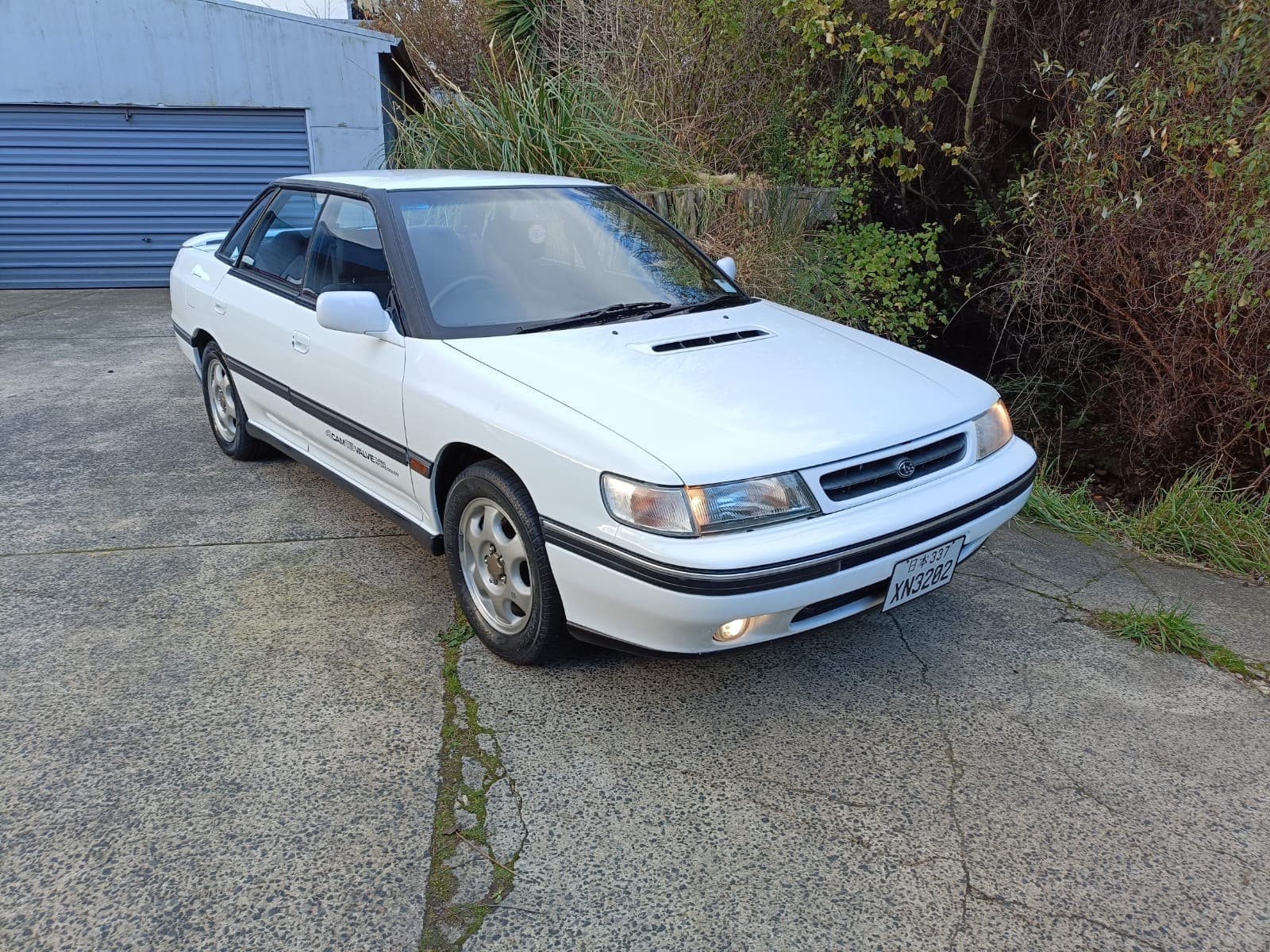
Subaru Impreza WRX STI (GC8)
インプレッサ WRX STI (GC8型)
Editorial review
- 型式Chassis
- GC8
- 製造者Maker
- Subaru
- 年式Years
- 1992-2000
- 用途Class
- Sports
参考動画Reference footage
The Subaru Impreza WRX STI (GC8) is a turbocharged, all-wheel-drive sedan built from November 1992 to August 2000 that won Colin McRae the 1995 WRC drivers' title. Developed alongside Prodrive as Subaru's replacement for the Legacy RS in Group A rallying, the GC8 became the road-going face of a program that took three consecutive manufacturers' championships from 1995 to 1997. Sold new only in right-hand-drive markets and Europe, it never officially reached American showrooms, which has made grey-market and 25-year-rule imports the primary route to ownership in the US today.
諸元Specification of record
- 原動機Engine unit
- EJ207 turbocharged flat-four (also EJ20G, EJ20K, EJ22G variants)
- 総排気量Displacement
- 2.0L (1,994cc); 2.2L (2,212cc) in EJ22G/22B
- 最高出力Power
- 280 PS (EJ207 STI); 280 PS/276bhp at 6,000 rpm (22B EJ22G)
- 最大トルクTorque
- 260 lb-ft (EJ207); 363 N·m/268 lb-ft at 3,200 rpm (22B)
- 駆動方式Drivetrain
- All-wheel drive
- 変速機Transmission
- 5-speed manual
- 車両重量Kerb weight
- 1,235 kg (base WRX) to 1,270 kg (STI/22B)
Few road cars carry motorsport pedigree as directly as the Subaru Impreza WRX STI GC8. Born from Prodrive's collaboration with Subaru's Technical Improvement STI division, it became the platform that carried Colin McRae to the 1995 WRC drivers' title and Subaru to three straight manufacturers' championships from 1995 to 1997.
Never officially sold in the United States, it remains one of the most sought-after grey-market and 25-year-import JDM performance cars on the market today, with the rarest 22B variant only recently becoming legal for American buyers to own.
来歴History & Motorsport Heritage
Subaru's WRC effort didn't start with the Impreza. Through the early 1990s the company campaigned the larger Legacy RS, but Prodrive's engineers concluded that a smaller, lighter platform would make a sharper rally car. Development of a Group A Impreza began in 1992, and the car took over Subaru's WRC program from the Legacy starting in the 1993 season.
Technical Improvement STI (STI) had been founded in 1988 by Fuji Heavy Industries specifically to run Subaru's motorsport program and sharpen its performance image. Working with longstanding partner Prodrive, STI built the Group A Impreza using the Legacy RS's basic engine, chassis, and suspension layout, but fitted a new turbocharger, intercooler, and cylinder heads to meet the class rules. The car also introduced active center differentials to rallying — a first for the sport.
Subaru's blue-and-yellow livery, instantly recognizable from the era, traces back to a sponsorship deal with State Express 555, a British American Tobacco cigarette brand with strong sales across Asia. Carlos Sainz joined the factory team in 1994 to partner Colin McRae for a full championship campaign, and Sainz delivered the Impreza's first outright rally win at that year's Acropolis Rally.
The following season produced the result the GC8 is remembered for. McRae won the 1995 drivers' championship in the Impreza 555, becoming the youngest world rally champion in history at 27 and the first British driver to take the title. Subaru also claimed the manufacturers' championship that year — the first of three straight, following through in 1996 and 1997. Toyota, a rival for the title, was disqualified from the 1995 Rally Catalunya for running illegal turbo restrictors and handed a one-year ban, a footnote that shaped how tightly the championship was fought that season.
Subaru's rally success didn't stop with the GC8-based car. The team went on to win drivers' titles in 2001 with Richard Burns and in 2003 with Petter Solberg, but those wins came in the newer WRC-spec Impreza, not the Group A GC8. The GC8 chapter closed out its motorsport life with Piero Liatti's win at the 1997 Monte Carlo Rally — the first victory ever recorded by a World Rally Car under the new regulations, achieved after a tight fight with Tommi Mäkinen's Mitsubishi and Carlos Sainz's Ford.
One persistent myth is worth correcting: the 22B road car, despite looking like the rally car, was not built to homologate anything. Group A homologation rules didn't require it, and the 22B was, in the words of one contemporary review, simply a marketing exercise to sell a road car that resembled the WRC machine as closely as possible.
Provenance from this era still surfaces at auction. A Group A test car used by McRae himself between 1993 and 1996 was later sold to a private driver and underwent a full restoration in 2020 before changing hands again — a rare piece of hardware with direct ties to the works rally program.
希少性Exclusivity & Production Run
The GC8 designation covers the entire first-generation Impreza WRX STI line sold in Japan between November 1992 and August 2000. It came in three body styles: a four-door sedan (GC chassis code), a five-door wagon (GF), and, from 1998, a two-door coupe.
Subaru revised the car through six internal "versions," each with its own JDM chassis suffix and set of updates:
- Version I (GC8-B, 1992–1994): original homologation-spec WRX STI, built following the Impreza's third-place finish in the 1993 WRC manufacturers' standings.
- Version II (GC8-C, 1994–1996): power increased to 256 hp, larger 410mm ventilated brake rotors front and rear, bigger 16-inch wheels, and the introduction of the now-familiar red intake manifold.
- Version III (GC8-D, 1996–1997): introduced the two-door Type R body that Prodrive adopted for WRC competition; both WRX and STI were quoted at 276bhp, the ceiling set by Japan's "Gentleman's Agreement."
- Version IV (GC8-E, 1997–1998): redesigned interior with new white-faced gauges, forged pistons, and a torque increase from 253 to 260 lb-ft while power held at 280 PS.
- Version V (GC8-F, 1998–1999): facelifted exterior; included a Type RA STi Limited run of 1,000 cars and a Type R STi Limited edition with a four-month order backlog.
- Version VI (GC8-G, 1999–2000): improved turbocharger; included 2,000 WRX STi Limited units, 1,000 Type R Version 6 Limited units, 2,000 STi RA Version 6 Limited units, and 500 STi Version 6 Limited hatchbacks. A standard-run Type R was also planned at roughly 1,000 units for Japan only.
Early on, Subaru built cars at a measured pace — around 100 Impreza units per month from February 1994, with STI production stabilizing at roughly 100 cars monthly starting that March.
The 22B, launched in 1998, remains the most exclusive GC8 variant, though sources disagree on the exact global total. What's consistently reported: Subaru priced it at 5 million yen and the initial allocation sold out within days of going on sale. Most figures put the core Japanese production run at 400 units, with an additional batch built for export:
- 16 examples for the UK, modified by Prodrive with longer gearing and UK-spec lighting
- 5 examples for Australia
- 3 prototype units
That brings total worldwide production to somewhere between 399 and 425 units depending on the source, with most calculations landing around 424. Adding to the confusion, unit number 13 never received its numbered dash plaque — Subaru of America used it as a press car — while three cars carrying the special "000/400" plaque went to McRae, co-driver Nicky Grist, and Prodrive's David Lapworth.
Before the 22B, STI had also built the Type RA — a stripped-out homologation special with no sound deadening, radio, or air conditioning, intended for racing teams that would gut it further anyway.
Britain got its own tribute model in 1995: 200 "Series McRae" Turbo 2000 cars, built by Prodrive in Rally Blue with gold wheels and McRae decals to mark his championship. Because the Japanese numbering skipped 13, 201 cars were actually built.
The GC8 generation closed with the S201 farewell edition in 2000. Just 300 were produced, and its engine tune pushed output to a quoted 296bhp — openly exceeding the 276bhp Gentleman's Agreement that governed Japanese performance cars at the time.
None of this was ever sold new in the United States. Subaru didn't offer the WRX in America until the 2002 "Bugeye" model, a ten-year gap from the GC8's original November 1992 JDM launch. That means every GC8 in the US today arrived as an import. The standard WRX STI became eligible under the federal 25-year import rule in 2017; the 22B followed later, becoming eligible in 2023.
意匠Aerodynamics & Design Philosophy
Most of the GC8's design changes tracked function rather than fashion. The Version II cars introduced the red intake manifold that became a visual signature of the era. Version III moved the intercooler to sit flat under the hood scoop rather than at an angle, improving airflow into the unit. Version IV brought a reworked cabin with new white-faced gauges, and the two-door Type R body, introduced with that update, was 10kg lighter and stiffer than the sedan — engineered specifically with rallying in mind.
The 22B is where GC8 styling departed furthest from the standard car. Its widebody borrowed directly from the Peter Stevens–designed WRC97 rally car, widening the body by 80mm to a total width of 1,770mm — matching the width Subaru's works rally cars ran from 1997 onward. The 22B received its own hood, front and rear fenders, a WRC-style front bumper, and an adjustable rear wing. Wheels grew from the standard Type R STI's 16x7-inch to 17x8.5-inch BBS Elektra units wrapped in 235/40 ZR17 Pirelli tires.
Peter Stevens, known for his work on the McLaren F1, also styled the UK-market P1 — a coupe-only variant built with Prodrive that stood apart mechanically too. It was the only GC-chassis coupe to use ABS instead of the driver-controlled center differential, and it produced 276hp with suspension tuned for British roads, four-piston front brakes, optional Recaro seats, and 18-inch wheels.
The GC8's factory aero language — hood scoop, boxy rear wing, flared fenders on Type R and 22B cars — remains a reference point in the aftermarket today. Companies still produce reproduction hood scoops, rear wings, and full 22B-style widebody kits for GC8 owners looking to replicate the factory rally look decades after production ended.
機関EJ207 turbocharged flat-four (also EJ20G, EJ20K, EJ22G variants) · Powerplant
The GC8's engine lineup evolved substantially across its eight-year run. Early WRX models used the EJ20G, a turbocharged 2.0-liter flat-four making 237hp at launch, paired with all-wheel drive, a viscous coupling center differential, a viscous rear limited-slip differential, and a five-speed manual gearbox. The UK-spec Impreza Turbo 2000 was detuned further, to 208bhp, reflecting the market segmentation Subaru applied outside Japan.
STI variants pushed harder from the start. An early STI version of the Type RA reached 271hp and introduced the Driver Controlled Center Differential (DCCD) for the first time, while a lighter hatchback model in the same range made 217hp. By Version III in 1996, both WRX and STI trims were quoted at 276bhp — the maximum permitted under Japan's informal "Gentleman's Agreement" among manufacturers, though most in the industry believed real output ran higher.
In 1998, Subaru introduced its Phase II turbo engines: the EJ205 for the standard WRX and Forester, and the EJ207 for the WRX STI. The EJ207 used modified pistons bringing compression down to 8.0:1, EJ205-spec camshafts, a new ECU, and an IHI VF28 turbocharger running up to 1.1 bar of boost. Its semi-closed deck block gave it noticeably more cylinder wall strength than the open-deck EJ205, letting it tolerate higher boost pressure without the block flexing.
That durability advantage carried into the tuning scene. In stock form the EJ207 typically produces 280–300 wheel horsepower, and independent dyno testing of unmodified 1999–2000 EJ207 crate engines on 100-octane fuel recorded around 340 horsepower with no changes made — well above the factory's quoted figures. With supporting modifications, the EJ207 can reliably handle 350–400+ wheel horsepower.
The 22B received its own bespoke engine, the EJ22G, bored out from 2.0 liters (1,994cc) to 2.2 liters (2,212cc) with a 96.9mm bore. Officially rated at 280 PS (276bhp) at 6,000 rpm and 363 N·m (268 lb-ft) of torque at 3,200 rpm, it used EFI and an IHI RHF5HB turbocharger. As with other performance cars bound by Japan's 280 PS pact — the Skyline GT-R, Supra, and Lancer Evolution among them — independent testing suggested the 22B's real output sat well north of 300bhp. One source claims a considerably higher 350 PS figure for the 22B, but that number is a significant outlier against the 280 PS/276bhp figure repeated across most contemporary documentation and should be treated with skepticism.
Owners of high-mileage GC8s face one well-known mechanical weak point: the early closed-deck EJ20 blocks are sensitive to detonation, and the factory single-layer head gasket at the block-to-head seam tends to fail eventually rather than never. Budgeting three to five thousand dollars for a head gasket job on any car past 100,000 miles is standard advice among specialists, and most surviving examples have either already been rebuilt or are running on a head gasket living on borrowed time.
車台Chassis, Suspension & Handling Dynamics
The GC8 platform stayed lightweight throughout its run, with curb weights ranging from around 1,235 kg in base WRX trim up to 1,270 kg for the STI and 22B. A short 2,520mm wheelbase and a five-speed manual gearbox carried through the entire production span without a factory automatic option on STI-spec cars.
Front suspension used MacPherson struts, a layout that — when executed with inverted monotube dampers, as later performance applications including the Porsche 911 GT3 and Cayman GT4 would also adopt — adds extra front-end rigidity compared to conventional strut designs. That stiffness, combined with the AWD system's viscous couplings front and center, gave the GC8 the planted, predictable rotation that made it effective on loose surfaces.
The Driver Controlled Center Differential, introduced on the STI version of the Type RA, let the driver manually adjust front-to-rear torque split on the fly — a feature that trickled down through subsequent STI versions and became a defining part of how the car could be tuned for different surfaces and conditions. Japan's rally-focused Type RA and Type R models also featured a roof vent, a detail carried over directly from competition specification.
The 22B sharpened the chassis further. It ran Bilstein suspension, standard-spec four-piston front and two-piston rear brakes, and a clutch upgraded to a sintered twin-plate unit with a ceramic disc to handle the EJ22G's additional torque. Its wider track — a byproduct of the 80mm-wider WRC-style body — and larger 17-inch wheel package gave it a noticeably different footprint and grip profile than the standard Type R STI it was based on.
名義Nomenclature & Lore
The GC8 name itself carries some disagreement even among enthusiasts. The common explanation is that "GC" refers to the Impreza sedan body and "8" to its 2.0-liter turbocharged flat-four. But that breaks down under scrutiny — the two-door 22B STI carries the factory model code GC8E2SD despite not being a four-door, and every WRX built between 1992 and 2000 uses a chassis code starting with GC8 regardless of body style. The number appears to track the engine and platform generation rather than door count specifically.
相場Auction Records & Modern Market Value
Because the GC8 was never federalized for US sale, American access to the car has always run through import law. The standard WRX STI became eligible under the 25-year rule in 2017, opening up the broader run of Version III through Version VI cars to US buyers roughly a decade after Subaru began selling the equivalent Bugeye-generation WRX domestically. The 22B followed on its own later timeline, becoming eligible for US import in 2023 — a full 25 years after its 1998 debut.
Scarcity underpins value across the range, but nowhere more than the 22B. A production run capped at roughly 400 domestic units, sold out within days at its original 5 million yen asking price, has kept the model in a different pricing tier from other GC8 variants ever since. Special-plaque cars tied directly to the works rally team — including the units associated with McRae, Nicky Grist, and Prodrive's David Lapworth — carry additional weight with collectors given their direct competition provenance.
Standard STI and Type R examples occupy a wider price band shaped by version, mileage, and originality. Version V and VI Limited models, built in smaller runs of 1,000 to 2,000 units depending on trim, tend to command a premium over the more commonly found Version III and IV cars. The UK's 200-unit "Series McRae" Turbo 2000 and the 300-unit S201 farewell edition — the latter notable for its 296bhp tune that broke the Gentleman's Agreement cap — sit in similarly limited territory within their respective markets.
Restoration provenance also factors into value at the top end. The Prodrive-built Group A test car used by McRae between 1993 and 1996, sold to a private driver and given a full restoration in 2020, illustrates how documented rally history can separate a car from an otherwise similar road-spec example decades later.
継承Keeping the Legend Alive (Restomod & Specialist Culture)
Subaru's own WRX lineage moved on from the GC8 platform with the "Bugeye" WRX, introduced to the US market in 2002 — the first time Americans could buy a factory-new WRX at all, a full decade after the GC8's 1992 JDM debut. That successor generation carried the STI badge, the boxer-turbo formula, and the rally-bred AWD system forward, but the GC8 remains the chassis most directly tied to Subaru's championship-winning Group A era.
Keeping surviving GC8s running has become its own specialized trade. The EJ20G and EJ20K engines' sensitivity to head gasket failure means most cars on the road today have already been through at least one engine rebuild, and specialists routinely budget several thousand dollars for that job as a matter of course rather than an exception. The EJ207's stronger semi-closed deck block has made Version IV-and-later STI engines a popular swap target for owners looking to combine period-correct JDM hardware with more boost headroom.
Cosmetically, the restoration and modification scene leans heavily on the 22B's visual identity. Aftermarket suppliers continue to produce reproduction hood scoops, rear wings, and full 22B-style widebody kits for owners of standard-bodied GC8 cars, letting them replicate the Peter Stevens–designed WRC-inspired look without sourcing an original 22B body panel. That aftermarket support, combined with the DCCD system and Bilstein-equipped 22B suspension setups being replicated for other GC8 trims, keeps the platform's rally-derived engineering accessible even to owners who never had a shot at buying one of the roughly 400 original 22B cars.
問答Questions of record
問01How many Subaru Impreza 22B STI cars were built?
Most figures put the core Japanese production run at 400 units, plus 16 for the UK, 5 for Australia, and 3 prototypes. Total worldwide production is usually cited as somewhere between 399 and 425 units, with most calculations landing around 424.
問02Did Colin McRae win the WRC championship in a GC8 Impreza?
Yes, McRae won the 1995 WRC drivers' championship driving the Impreza 555, becoming the youngest world rally champion in history at 27 and the first British driver to win the title. Subaru also won the manufacturers' championship that year, the first of three straight through 1997.
問03Was the Subaru Impreza WRX STI GC8 ever sold new in the United States?
No, the GC8 was never officially sold new in the US; Subaru didn't offer the WRX domestically until the 2002 Bugeye model. The standard WRX STI became eligible for US import under the 25-year rule in 2017, and the 22B followed in 2023.
問04What engine powers the Subaru Impreza 22B STI?
The 22B uses the bespoke EJ22G, a 2.2-liter turbocharged boxer bored out from the standard 2.0-liter block, officially rated at 280 PS (276bhp) at 6,000 rpm and 363 N·m (268 lb-ft) of torque at 3,200 rpm.
問05What is the most common mechanical issue with the GC8 Impreza?
Early closed-deck EJ20 engines are prone to head gasket failure at the block-to-head seam, and specialists typically budget three to five thousand dollars for a head gasket job on any car past 100,000 miles.
問06What does the GC8 chassis code actually mean?
While commonly explained as 'GC' for sedan body and '8' for the 2.0-liter engine, this breaks down since the two-door 22B carries a GC8-based code despite not being a sedan, and every WRX from 1992-2000 uses a GC8 chassis code regardless of body style, suggesting the number tracks engine and platform generation rather than door count.
結 · IN CLOSING
The Subaru Impreza WRX STI (GC8) is the turbocharged, all-wheel-drive sedan and wagon that carried Subaru through its most successful era in world rallying, taking three straight manufacturers' championships from 1995 to 1997 and delivering Colin McRae his only drivers' title in 1995. Built in Japan from November 1992 to August 2000 across six internal versions, it spawned the 400-unit 22B — a widebody homage to the WRC97 rally car powered by a bespoke 2.2-liter EJ22G engine — along with limited editions like the UK's 201-unit Series McRae and the 300-unit S201. Never sold new in the United States, the GC8 has reached American buyers through 25-year import rules, with standard cars eligible since 2017 and the 22B following in 2023. Values are shaped heavily by scarcity, version, and rally provenance, while ownership today comes with known maintenance realities — chiefly head gasket wear on early EJ20 engines. A strong aftermarket keeps the platform's rally-bred looks and mechanicals accessible, sustaining the GC8's place as the road-going link to Subaru's Group A championship years.
この項目についてAbout this entry
Specification figures are cross-checked against factory data and period source material. Editorial is researched and reviewed before publication; drafting and formatting may be assisted by tooling, but accuracy checks rest with the editorial desk. This entry was last reviewed in August 2026. Spotted an error? Send a correction →