Nissan Pulsar GTI-R (RNN14)
パルサー GTI
Editorial review
- 型式Chassis
- RNN14 (N14 Pulsar)
- 製造者Maker
- Nissan
- 年式Years
- 1990-1994
- 用途Class
- Sports
参考動画Reference footage
The Nissan Pulsar GTI-R (RNN14) is a 1990-1994 homologation special that packs a 227hp SR20DET turbo engine and ATTESA all-wheel drive into a compact three-door hatchback body built to qualify for Group A rallying.
Nissan built it to satisfy World Rally Championship homologation rules, cramming a DOHC turbo four and a full-time four-wheel-drive system into a small Pulsar N14 shell. The road car needed at least 5,000 units sold before the works team could compete, and Nissan ended up building far more than that minimum over a four-year production run split between Japan and Europe. It never raced in North America and remained off-limits to US buyers until federal import law caught up decades later.
諸元Specification of record
- 原動機Engine unit
- SR20DET (54C variant), turbocharged DOHC inline-four
- 総排気量Displacement
- 2.0-liter
- 最高出力Power
- 227hp (230PS) at 6,400rpm (JDM Pulsar); 217hp (220PS) at 6,400rpm (Euro Sunny)
- 最大トルクTorque
- 209 lb-ft (284Nm) at 4,800rpm (JDM Pulsar); 197 lb-ft (267Nm) at 4,800rpm (Euro Sunny)
- 駆動方式Drivetrain
- ATTESA full-time all-wheel drive with viscous center coupling and rear viscous limited-slip differential
- 変速機Transmission
- 5-speed manual
- 車両重量Kerb weight
- 1,220kg (GTI-RA); 1,190kg (GTI-RB)
The Nissan Pulsar GTI-R (RNN14) is a 1990-1994 homologation special that packs a 227hp SR20DET turbo engine and ATTESA all-wheel drive into a compact three-door hatchback body built to qualify for Group A rallying.
Nissan built it to satisfy World Rally Championship homologation rules, cramming a DOHC turbo four and a full-time four-wheel-drive system into a small Pulsar N14 shell. The road car needed at least 5,000 units sold before the works team could compete, and Nissan ended up building far more than that minimum over a four-year production run split between Japan and Europe. It never raced in North America and remained off-limits to US buyers until federal import law caught up decades later.
来歴History & Motorsport Heritage
Nissan developed the Pulsar GTI-R as the flagship of the fourth-generation Pulsar N14 specifically to compete in the World Rally Championship under Group A regulations, rolling the road car out in 1990. Engineers picked the Pulsar platform because its compact body could accommodate a high-output DOHC turbo engine alongside ATTESA (Advanced Total Traction Engineering System for All), Nissan's four-wheel-drive hardware. It was Nissan's first all-wheel-drive rally car, and expectations inside the company were high through the 1990 development period.
The GTI-R made its WRC debut at the 1991 Safari Rally, an event where Nissan already had decades of history. In competition trim the SR20 was tuned to roughly 300 horsepower, and the car finished fifth on debut, behind the Lancia Delta Integrale and Toyota Celica GT-Four. Stig Blomqvist and Benny Melander brought their car home fifth, teammates Mike Kirkland and Surinder Thatthi finished seventh, and a third entry driven by David Llewellin and Peter Diekmann crashed out on a road section between stages.
Nissan Motorsport Europe, based in Milton Keynes, ran just three more rounds that season:
- Acropolis Rally — Llewellin/Diekmann finished 9th; the Blomqvist/Melander car retired with a broken differential.
- RAC Rally (season finale) — Blomqvist retired with suspension damage; Llewellin dropped out with electrical failure.
The 1992 season produced the car's best-ever WRC result but also its last as a full works effort:
- Monte-Carlo — François Chatriot 7th, Tommi Mäkinen 9th
- Swedish Rally — Stig Blomqvist 3rd (best result of the car's WRC career)
- Portugal — Chatriot 6th, Mäkinen DNF (accident)
- 1000 Lakes — Blomqvist DNF (engine), Mäkinen DNF (gearbox)
- RAC Rally — Mäkinen 8th, Blomqvist DNF (accident)
Nissan withdrew the works program after 1992, having contested only nine rallies across two seasons. The GTI-R never won a Group A rally outright. Two technical handicaps hurt it throughout: homologation rules capped wheel size at two inches over the road car's 14-inch rims, leaving the rally car on 16s against 17s run by the rest of the field, and the tightly packaged engine bay struggled to cool the turbocharged SR20 under sustained load. Nissan redirected its motorsport budget toward the Le Mans-bound R390 program, while NME shifted its WRC energy to the front-wheel-drive Sunny GTI in the F2/A7 class, where Alister McRae found success.
The car fared better in Group N production-car competition. Belgian driver Grégoire de Mévius won the Acropolis Rally in both 1991 and 1992 and clinched the 1992 Group N World Championship (the FIA Cup for Drivers of Production Cars) with 37 points.
Decades later, Nissan restored one of its own 1992 RAC rally entrants — one of the last Nissan WRC cars ever built — using roughly 115 volunteer employees who worked on the car during off-hours over about a year. Project lead Toshiaki Kawai chose to preserve the car's post-race condition rather than repair its dents and scratches, reasoning that a rally car should look like one.
希少性Exclusivity & Production Run
Production figures for the GTI-R vary noticeably between sources, and no single number is universally agreed upon. What's consistent is the outline: Nissan needed a minimum of 5,000 road cars in twelve months to satisfy FIA Group A homologation, and total output ran well beyond that minimum across roughly four years of manufacturing, from August 1990 to late 1993 or November 1994 depending on the source.
The most commonly cited buyer's-guide breakdown puts total production at 14,613 units:
- 13,131 Pulsar GTI-RA (Japan, standard trim)
- 701 Pulsar GTI-RB (Japan, homologation-special trim)
- 668 Sunny GTI-R, left-hand drive (continental Europe)
- 103 Sunny GTI-R, right-hand drive (UK)
- roughly 10 unclassified units
A separate source, the GTI-R Registry, arrives at the same 14,613 total but splits it differently — 13,842 Pulsar GTI-R (RNN14) against 771 Sunny GTI-R (GNN14) — and elsewhere cites a total production figure of 13,842 with more than 5,000 built in the first twelve months to satisfy homologation. A third source, a Canadian GTI-R owners' forum, puts total production under 15,000 but leaves the exact figure unconfirmed, suggesting either roughly 11,500 or roughly 13,800, and clarifies that the frequently repeated "5,000 units" figure (4,500 RA plus 500 RB) refers only to the first year of production required for FIA homologation, not the lifetime total.
Production was split across two plants and organized into two "Series" spanning five "Phases" of minor running changes, tracked by chassis number. The first phase of Series 1 came off the line at Nissan's Tochigi plant in Kaminokawa (plant code "M"); the remainder was built by Fuji Heavy Industries at its Yajima plant in Ōta City, Gunma Prefecture (plant code "9"), on the same line that produced the Subaru Legacy and Leone.
Nissan began exporting the car to Europe in February 1992, rebadged as a Sunny rather than a Pulsar and fitted with a revised ECU map to suit lower-grade European fuel. That recalibration dropped peak output from 227hp to 217hp and torque from 209lb-ft to 197lb-ft, with both peaks landing at the same rpm as the JDM car. The European Sunny GTI-R run lasted from February 1992 to October 1993 and totaled 771 cars: 668 left-hand-drive and 103 right-hand-drive.
Within the Japanese-market Pulsar line, two distinct trims existed. The GTI-RA was the standard road car at 1,220kg, accounting for 13,131 units. The GTI-RB was a stripped-out homologation special at 1,190kg that deleted air conditioning, power windows, and ABS to sharpen the power-to-weight ratio; only 701 were built, making the RB the rarer of the two Japanese trims today.
The GTI-R was never sold new in North America. American enthusiasts had to wait for the vehicle to age into eligibility under the US 25-year import rule — cars built in 1990 became legal to import in 2015, and 1994-model cars followed in 2019. New Zealand became an important secondary market instead: with roughly 15,000 examples built through the homologation period and a new price of around NZ$45,000, GTI-Rs flowed into the country in volume during the 1990s and early 2000s, effectively making New Zealand the model's second home market.
意匠Aerodynamics & Design Philosophy
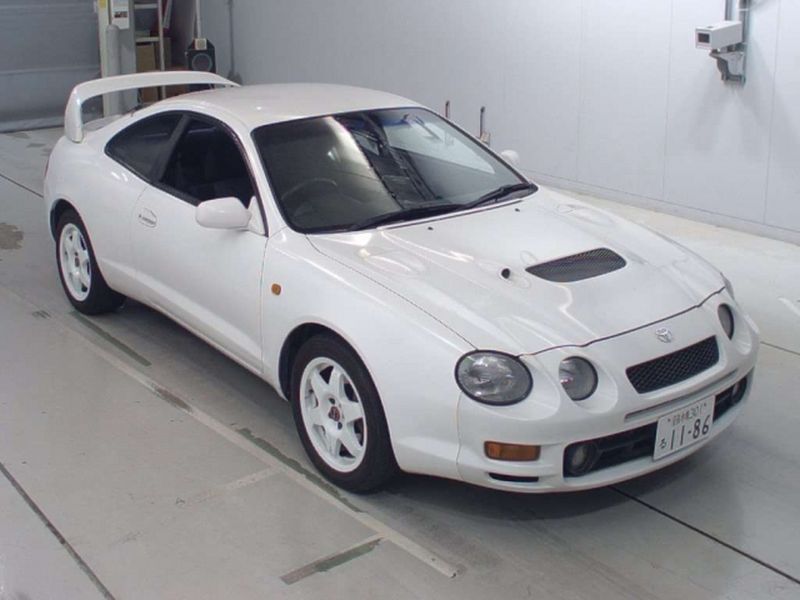
The GTI-R's styling was shaped entirely by function. A hood bulge, large enough to clear a substantial top-mounted intercooler, dominates the front end alongside a new front apron and heavily vented panels designed to feed the brakes, radiator, and intercooler. A large rear spoiler sits on the trailing edge of the roofline, completing a silhouette that made the car instantly recognizable as something other than a standard Pulsar hatchback.
Most body panels were steel, but the bumpers, side skirts, rubbing strips, intercooler scoop, hood vents, and rear spoiler were molded from GRP and polypropylene to save weight in high-stress aero areas. Nissan launched the car with four exterior colors — Black, Ivory White, Grey Metallic, and Red — though the palette shifted during the production run: Red was dropped entirely, Ivory White gave way to Super White, and Grey Metallic was eventually replaced by Green Metallic.
Japanese-market cars received a handful of cosmetic changes partway through production. A Nissan badge replaced the Pulsar logo on the nose, a plain windscreen replaced the earlier item's blue-tinted upper band, the doughnut-style headrests gave way to solid units, the upholstery pattern was subtly revised, the steering wheel swapped its GTi-R script for a Nissan badge, and a steering-wheel airbag joined the options list.
The car's aerodynamic package came with a packaging cost. Mounting the intercooler on top of the engine, fed by the functional hood scoop, pushed weight forward and produced a notably nose-heavy balance — a trait that contributed to handling complaints during the works rally program and one that still shapes driving impressions of surviving cars today. Nissan's own figures put the drag coefficient at 0.39 with 150mm of ground clearance, and the car's compact footprint measured 3,975mm long, 1,690mm wide, and 1,410mm tall on a 2,430mm wheelbase.
Nissan's in-house tuning division, NISMO, offered a substantial catalog of performance and aero parts for the GTI-R, including a strengthened bodyshell, a roll cage, welded and detachable underbody and differential protection panels, front and rear strut braces, a suspension kit, uprated brake pads, an oil cooler, an enhanced turbo and intercooler, a close-ratio gearbox, mechanical limited-slip differentials, BBS wheels, rally mudflaps, spot lights, a stripe kit, a NISMO steering wheel, alternate gauges, single-piece bucket seats with harnesses, and a motorsport tool kit — evidence of how directly the road car's design was tied to its competition intent.
機関SR20DET (54C variant), turbocharged DOHC inline-four · Powerplant
The GTI-R is built around a 2.0-liter turbocharged DOHC four-cylinder, badged as the 54C variant of Nissan's SR20DET, driving all four wheels through ATTESA and a 5-speed manual gearbox. In JDM Pulsar form, Nissan's own service manual figures list peak output at 169kW (227hp/230ps) at 6,400rpm and 284Nm (209lb-ft) of torque at 4,800rpm. Top speed was rated at 232km/h (144mph), though the road car was electronically limited to 180km/h (112mph).
The Euro-market Sunny GTI-R ran a different ECU map calibrated for lower-octane fuel, which reduced output to 162kW (217hp/220ps) at the same 6,400rpm and 267Nm (197lb-ft) at the same 4,800rpm.
Boost was tightly controlled: turbo pressure sat at 550mmHg (10.6psi/0.73bar), managed through a brass restrictor and solenoid valve, while a wastegate spring pressure of 360mmHg (7psi/0.5bar) triggered a "safe mode" whenever the ECU detected detonation.
Straight-line performance figures vary somewhat by source but land in a consistent range:
- 0-60mph: 5.4 seconds (period UK road test); some sources cite 5.6 seconds for 0-62mph
- Quarter mile: 13.5 seconds
- Top speed: roughly 143-144mph (232km/h)
- A boosted 260bhp example tested at closer to 4.9 seconds to 60mph
Best Motoring's road tests reported sub-five-second runs to 62mph and sub-14-second quarter miles, matching the independent figures above. One frequently repeated online figure claims 277hp for the SR20DET, but that number conflicts with Nissan's own documented 227hp output and appears to be a transcription error rather than a genuine spec variant.
At a claimed weight of around 2,400lbs (1,220kg for the RA trim), the GTI-R produced roughly 189bhp per tonne — a figure that beat contemporary rivals such as the Lancia Delta Integrale 16v (163bhp/tonne) and Toyota Celica GT-Four (134bhp/tonne), and one that also outpaces later hot hatches like the Ford Focus RS (169bhp/tonne) and Honda Civic Type R (166bhp/tonne).
The RB trim added a close-ratio gearbox and a front limited-slip differential in place of the RA's open front diff, part of the weight-and-hardware package that made it the more track-focused of the two Japanese variants. Works rally versions of the SR20 were tuned to roughly 300ps, well above the road car's output, though the WRC cars' cramped engine bay limited cooling and made overheating a recurring issue in competition.
車台Chassis, Suspension & Handling Dynamics
Underneath, the GTI-R shares its galvanized steel chassis with other N14-series Pulsar models, wrapped around a compact wheelbase of 2,430mm. Suspension is fully independent: MacPherson struts at the front, paired with coil springs and a torsion-bar stabilizer, and a multi-link setup at the rear using parallel links with struts. Steering is rack-and-pinion with power assist and a tilt column.
The four-wheel-drive system routes torque through a viscous center coupling with a viscous limited-slip differential at the rear — the same ATTESA hardware later used in the R32 Skyline GT-R. Braking comes from heavy-duty ventilated front discs and rear discs, with ABS offered depending on trim. Road cars rolled on relatively modest 195/55R14 tires on 14x6JJ aluminum wheels, a size dictated by the standard Pulsar platform rather than performance ambition.
That 14-inch wheel size became a genuine competitive disadvantage in period rallying. WRC homologation rules permitted only a two-inch increase over the road car's wheel diameter, which meant the works GTI-R competed on 16-inch wheels while most Group A rivals ran 17s. Combined with the nose-heavy weight distribution created by the top-mounted intercooler, this contributed to documented handling shortcomings for the works team — the car showed flashes of pace but could not consistently match the development level of its established Group A rivals. Owner and enthusiast accounts of road cars today echo the same nose-heavy character, describing a car that rewards a specific driving style built around trail-braking and managed turn-in rather than one that simply points and shoots.
名義Nomenclature & Lore
The article does not detail a specific nickname or naming lore beyond the badge distinctions themselves: the car was sold as the Pulsar GTI-R in Japan (in RA standard and RB homologation trims) and rebadged as the Sunny GTI-R for European markets, reflecting regional trim strategies rather than a separate nickname culture.
相場Auction Records & Modern Market Value
Because it was never federalized for the US market, the GTI-R spent most of its life as a grey-market curiosity to American enthusiasts, only becoming legally importable once individual cars crossed the 25-year threshold under US import law. The earliest 1990-model cars became eligible in 2015, and the final 1994 cars followed in 2019 — a rolling window that has steadily expanded the pool of GTI-Rs legally on US roads over the past decade.
New Zealand tells a different story. Sold new for around NZ$45,000, the GTI-R arrived there in enough volume during the 1990s and early 2000s that the used market was, in relative terms, flooded with examples, keeping prices soft for years compared with rarer JDM homologation cars of the same era. That abundance has thinned over time as cars have been exported, crashed, or converted for track use.
Rarity within the model range varies sharply by variant. The RB homologation special — stripped of air conditioning, power windows, and ABS to save weight — totaled only 701 units against 13,131 standard RA cars, making clean, unmodified RBs the more sought-after variant among specialists. European-market Sunny-badged cars are scarcer still, with just 771 built in left- and right-hand drive combined. Nissan's own Nismo-tuned run is even tighter: one surviving 1990 example is documented as number 13 of just 21 cars modified by Nissan's Motorsports Division, a detail that places it among the rarest GTI-R variants in existence.
With production spread across conflicting official counts — anywhere from roughly 11,500 to 14,613 depending on the source — and no factory example ever having won a WRC round outright, the GTI-R's market value has historically rested less on race pedigree than on scarcity of unmolested, low-mileage examples, particularly RB and Nismo-modified cars.
継承Keeping the Legend Alive (Restomod & Specialist Culture)
Nissan never built a direct successor to the GTI-R's formula of a small, boxy hatchback wrapped around a turbocharged four and full-time all-wheel drive for Group A rallying. After withdrawing its factory WRC effort in 1992, the company redirected its competition budget toward the Le Mans-focused R390 program, while Nissan Motorsport Europe shifted its rallying attention to the front-wheel-drive Sunny GTI in the F2/A7 category, where Alister McRae picked up results. The compact AWD rally-homologation niche the GTI-R occupied was largely left unfilled within Nissan's own lineup going forward.
What has continued is a dedicated restoration and preservation culture around the surviving cars, exemplified by Nissan's own project to restore one of its 1992 RAC rally entrants. Around 115 volunteer employees worked on the car during off-hours over roughly a year, deliberately choosing not to repair most of the exterior dents and scratches so the car would remain in the condition it was in after its last race — a decision project lead Toshiaki Kawai framed simply: because it's a rally car, it should look like one.
Outside the factory, the GTI-R's restoration scene has grown alongside its US import eligibility. As more 1990-through-1994 cars clear the 25-year threshold, dedicated registries and owners' groups — including the GTI-R Registry and Canadian GTI-R communities — have taken on the task of documenting chassis numbers, production phases, and the differences between JDM Pulsar and European Sunny variants, filling in gaps left by the production-count discrepancies that still surround the model.
問答Questions of record
問01How much horsepower does the Nissan Pulsar GTI-R (RNN14) have?
The JDM Pulsar GTI-R produces 227hp (230PS) at 6,400rpm and 209lb-ft (284Nm) of torque at 4,800rpm from its SR20DET turbo engine. The European Sunny GTI-R, tuned for lower-octane fuel, made 217hp (220PS) and 197lb-ft.
問02How many Nissan Pulsar GTI-R cars were made?
Production figures vary by source, ranging from roughly 11,500 to 14,613 units. The most commonly cited breakdown totals 14,613, including 13,131 GTI-RA, 701 GTI-RB, and 771 European Sunny GTI-R cars.
問03Was the Nissan Pulsar GTI-R ever sold in the United States?
No, it was never sold new in North America. It only became legally importable under the US 25-year import rule, with 1990 models eligible starting in 2015 and 1994 models following in 2019.
問04Did the Nissan Pulsar GTI-R ever win a WRC rally?
No, the GTI-R never won a Group A rally outright. Its best WRC result was a third-place finish by Stig Blomqvist at the 1992 Swedish Rally, and Nissan withdrew its factory program after that season.
問05What made the GTI-RB different from the standard GTI-RA?
The GTI-RB was a stripped-out homologation special weighing 1,190kg versus the RA's 1,220kg, deleting air conditioning, power windows, and ABS while adding a close-ratio gearbox and front limited-slip differential. Only 701 RB units were built compared to 13,131 RAs.
問06What all-wheel-drive system does the GTI-R use?
It uses Nissan's ATTESA (Advanced Total Traction Engineering System for All) system, routing torque through a viscous center coupling with a viscous limited-slip rear differential — the same hardware later used in the R32 Skyline GT-R.
結 · IN CLOSING
The Nissan Pulsar GTI-R (RNN14) was built between 1990 and 1994 as a Group A homologation special, combining a 227hp SR20DET turbo four with ATTESA all-wheel drive in a compact three-door body. Nissan campaigned it in the World Rally Championship for two seasons, debuting fifth at the 1991 Safari Rally and peaking with a third-place finish at the 1992 Swedish Rally before withdrawing factory support; it never won a WRC round outright, though Grégoire de Mévius took the 1992 Group N championship in one. Production totals are disputed between sources, ranging from roughly 11,500 to 14,613 units across JDM Pulsar and European Sunny badges, with the ultra-rare 701-unit RB homologation trim standing out for collectors. Never sold new in North America, it only became legally importable to the US under the 25-year rule starting in 2015. Nose-heavy handling, born from its top-mounted intercooler, shaped both its rally record and how it drives today. With no direct factory successor, its legacy now lives mainly through registries, restoration projects, and a slowly growing US grey-market following.
この項目についてAbout this entry
Specification figures are cross-checked against factory data and period source material. Editorial is researched and reviewed before publication; drafting and formatting may be assisted by tooling, but accuracy checks rest with the editorial desk. This entry was last reviewed in August 2026. Spotted an error? Send a correction →