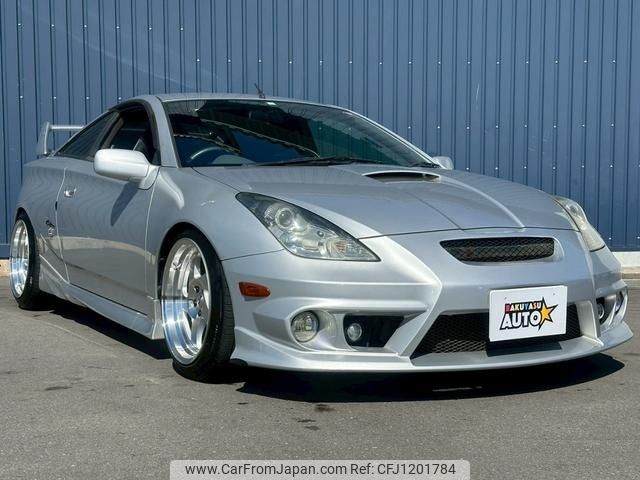
1998 Toyota Altezza RS200 (SXE10)
トヨタ・アルテッツァ
Editorial review
- 型式Chassis
- SXE10
- 製造者Maker
- Toyota
- 年式Years
- 1998-2005
- 用途Class
- Sports Sedan
参考動画Reference footage
The Toyota Altezza RS200 (SXE10) is a Japan-only rear-drive sports sedan built from 1998 to 2005 around a 210 PS, 2.0-liter 3S-GE four-cylinder engine. It shared its body and double-wishbone chassis with the Lexus IS 200 sold overseas, but no Lexus ever received its engine or its close-ratio six-speed manual. The Altezza won the 1998–1999 Car of the Year Japan, spawned the clear-lens "Altezza lights" craze, and gave Toyota's GAZOO Racing its first Nürburgring 24 Hours entry in 2007. Today the six-speed RS200 is the version importers and collectors chase, and 1998 to 2001 cars are now old enough for US import.
諸元Specification of record
- 原動機Engine unit
- 3S-GE BEAMS
- 総排気量Displacement
- 1,998 cc
- 最高出力Power
- 210 PS at 7,600 rpm (manual); 200 PS at 7,000 rpm (automatic)
- 最大トルクTorque
- 22.0 kgm at 6,400 rpm (manual); 22.0 kgm at 4,800 rpm (automatic)
- 駆動方式Drivetrain
- Rear-wheel drive
- 変速機Transmission
- Aisin J160 six-speed manual or A650E five-speed automatic
- 車両重量Kerb weight
- 1,340 kg (six-speed manual); 1,330 kg (automatic)
The Toyota Altezza RS200 (SXE10) represents a singular moment in Japanese automotive history: a factory-backed, Japan-market-only sports sedan that competed internationally through its Lexus badge while retaining exclusivity in its home market. Released on 30 October 1998 and developed under chief engineer Nobuaki Katayama from 1994 to 1998 as internal program code 038T, the Altezza arrived to revive a format—the rear-wheel-drive compact sports sedan—that had fallen quiet in Japan by the late 1990s. What Toyota created was half sports sedan and half premium compact, engineered to serve the domestic market through its Netz dealer network while its shared platform became the foundation for Lexus's assault on the BMW 3 Series and Mercedes-Benz C-Class in Europe and North America. The RS200 was the sporting heart of this dual mission: a naturally aspirated four-cylinder answer to a question Japanese buyers were not sure they were asking, yet one that would define a generation of enthusiast imports and spawn a styling trend that persists today.
来歴History & Motorsport Heritage
Toyota released the Altezza on 30 October 1998, and the company's own history frames it as a revival of the rear-wheel-drive sports sedan, a format that had gone quiet in Japan by the late 1990s. Engineering work ran from 1994 to 1998 under the internal program code 038T, led by chief engineer Nobuaki Katayama. Tomoyasu Nishi completed the exterior design in 1995; it was frozen in 1996 and filed with the Japan Patent Office on 5 December that year. The development car's chief test driver was Hiromu Naruse, a name that would return to the Altezza story a decade later.
The brief changed during development. The project began as a compact front-engine, rear-drive sedan, then absorbed another sports sedan program Toyota had running in parallel. It also picked up a second job: serving as Lexus's entry model against the BMW 3 Series and Mercedes-Benz C-Class in Europe and North America. That dual role, half sports sedan and half premium compact, explains much of what the finished car became.
In Japan the Altezza was sold only through Toyota's Netz Store dealer network, and the RS200 carried the sporting end of the range. It took the 1998–1999 Car of the Year Japan title, and in October 1999 the RS200 also received a Good Design Award. Sales never matched the critical reception. Best Car magazine points to Netz's fixed, no-discount pricing as one reason, noting that the turbocharged Subaru Legacy B4, which dealers discounted heavily, outsold it.
The buyer profile also shifted over the car's life. Younger buyers drove early demand for the RS200 manual. Later, once Toyota dropped the Chaser (another Netz model), the sales mix moved toward drivers in their 40s choosing the six-cylinder AS200 automatic.
Overseas, the same body became the Lexus IS 200 in Europe from 1999, with the 1G-FE inline-six, and the IS 300 in North America from 2000, with the 3.0-liter 2JZ-GE. The European IS 200 was rated at 153 hp with a 9.3-second 0–100 km/h time. In the US the IS line peaked at 22,486 sales in 2001 before falling below 10,000 units in 2004. None of those export cars used the RS200's four-cylinder.
The SXE10 never ran in JGTC's GT300 class; Toyota's GT300 effort in that period was built around the MR2, MR-S and Celica. The Altezza's competition record sits in production-based and one-make racing instead: Manabu Orido drove an RS200 Z Edition to second overall in a commemorative Altezza race at Fuji on 3 May 2000. The Netz Cup Altezza series ran from 2000 to 2006 as a one-make championship that drew established drivers and worked as a feeder for higher categories. In Super Taikyu from 2000 to 2005, the Altezza raced in the Group N+ class, open to naturally aspirated cars from 1,601 to 2,000 cc with broader modification rules and slick tires. It won the class title every year from 2000 to 2005, the last of those in a class renamed ST5. Orido also finished second in an Altezza at the Macau Guia Race in 2001. A Super Taikyu-spec Altezza started the 2003 Nürburgring 24 Hours and retired after contact.
The most consequential Altezza race came in 2007. Akio Toyoda, racing under the name "Morizo," and his mentor Hiromu Naruse entered two second-hand Altezza RS200s in the Nürburgring 24 Hours under the GAZOO Racing name, with Toyota employees as drivers and engineers. Both cars finished: No. 110 placed 104th overall and 14th in SP3 after 82 laps, and No. 109 placed 110th overall and 16th in SP3 after 80 laps. Toyota now describes that entry as the starting point of TOYOTA GAZOO Racing, and the No. 109 car was displayed at Tokyo Auto Salon 2025.
The RS200's engine also reached the British Touring Car Championship by a side door. For 2001, ABG Motorsport built a Lexus IS 200 to BTC-T rules but replaced the UK car's six-cylinder with the four-cylinder from the Japanese Altezza RS200, stripping out the variable valve timing for racing. The car used an Xtrac six-speed sequential gearbox, weighed 1,128 kg, debuted at Thruxton and was withdrawn when ABG left the series at the end of 2001.
In drifting, HKS moved Nobuteru Taniguchi out of his championship-leading Silvia S15 and into an SXE10 Altezza at round 6 of the 2004 D1 Grand Prix at Ebisu. The new car had teething problems, Taniguchi failed to qualify for the last two rounds, and he finished the year as runner-up. Later in its life the HKS car ran a GT3037 turbo and was quoted at 560 hp.
希少性Exclusivity & Production Run
Altezza production ran from October 1998 to 2005 at Kanto Auto Works' Iwate plant in Kanegasaki. English-language sources give August 2005 as the end date for the line. Japanese sources are more specific about the four-cylinder car: RS200 production stopped in March 2005, and Altezza sales ended in July 2005.
Total Altezza output across the sedan and the five-door Gita, all engines included, was 111,462 units according to De Agostini's Japanese car reference series. One US buyer's guide quotes an estimated 300,000 for the XE10, but that figure is labelled an estimate and appears to fold in Lexus IS export production. No breakdown isolating the RS200 has been published, so the share of SXE10s within the 111,462 total is unknown.
What is clear is the RS200's exclusivity. The SXE10 was a Japan-market car only. Every overseas Lexus IS used a six-cylinder, so any RS200 outside Japan arrived as a used import.
The two cars share a body, platform and suspension, which is why they are often confused on import listings. The chassis code is the quickest way to tell them apart: the RS200 (SXE10) uses the 2.0-liter 3S-GE inline-four with 210 PS, while the IS 200 (GXE10) uses the 2.0-liter 1G-FE inline-six, rated at 153 hp in European form. The IS 200 corresponds to the Japanese Altezza AS200, not the RS200. Both could be had with the J160 six-speed, but the RS200's automatic is a five-speed while the six-cylinder cars used a four-speed in Japan. The RS200 was sold only through Toyota Netz in Japan, while the IS 200 went on sale in Europe in 1999. Lexus quoted 216 km/h and 9.3 seconds from 0–100 km/h for the European IS 200, but Toyota published no equivalent figures for the RS200.
The RS200 changed in small steps rather than one large facelift. It launched in October 1998 with the RS200 (SXE10, 3S-GE) and AS200 (GXE10, 1G-FE). An L Edition luxury trim was added in May 1999. The six-speed manual became available on the AS200 in May 2000; the L Edition became a regular grade. A minor change came in May 2001, including a grille shared with the Lexus IS and a revised gauge layout for RS200 manuals. The Altezza Gita five-door was added in July 2001. HID headlamps were offered across the range starting August 2002; the RS200 LIMITED special edition and LIMITED Navi Package were introduced. HID was made standard in August 2003; Dark Grey Mica Metallic, Super Bright Yellow, Dark Green Mica and Dark Blue Mica were dropped in favor of Dark Blue Mica Metallic. RS200 production ended in March 2005.
The SXE10 was offered in several grades, most available with either the six-speed manual or the five-speed automatic. The RS200 was the base sporting grade; in the May 2000 to April 2001 catalog the six-speed listed at ¥2,400,000 before tax, and the automatic at ¥2,240,000. The RS200 Z Edition added a body kit (front lip, side skirts, rear lip and deck spoiler) and sport suspension, with 215/45R17 tires standard at ¥2,500,000 for the manual. The RS200 L Edition added luxury equipment including power seats in leather and Ecsaine, door courtesy lamps and automatic headlamps at ¥2,740,000 for the manual. The RS200 LIMITED (from August 2002) featured 17-inch wheels, a Torsen limited-slip differential, projector fog lamps, aluminum pedals and, on manual cars, an aero grille; the LIMITED Navi Package six-speed listed at ¥2,630,000 including tax. Prices crept up slightly after the May 2001 update, with the RS200 manual moving to ¥2,430,000 and the Z Edition to ¥2,530,000. Two dealer-channel variants sit outside the factory grade list: Toyota's design subsidiary Modellista sold a customized "Qualitat" version, and TOM'S sold the 280T, a bolt-on turbo car. One Japanese dealer listing describes the 280T as a 100-unit limited complete car; that count has not been confirmed by TOM'S or Toyota.
意匠Aerodynamics & Design Philosophy
The SXE10 measures 4,400 mm long, 1,720 mm wide and 1,410 mm tall on a 2,670 mm wheelbase. Width grew to 1,725 mm after the 2001 update. That width mattered in Japan: at 1,720 mm the Altezza was 20 mm wider than the 1,700 mm compact-car limit, so it missed the smaller-car dimension category despite its 2.0-liter engine. Toyota accepted the trade for a wider track.
The design leans on proportion rather than ornament. Overhangs are short at both ends, the wheelbase is long for the car's length, and the wheels are 17 inches across. Japanese Wikipedia credits this stance as a template for later Toyota and Lexus rear-drive sedans, beginning with the S180 Crown.
Toyota left its own badge off the car. The grille wore a stylized "A" emblem, and the steering wheel pad and wheel center caps read "ALTEZZA". The only Toyota branding was the marking etched into the window glass.
The rear lamps are the RS200's most copied feature. Each side used two circular units of different sizes under a clear acrylic cover, set in a chrome housing. The style became known as "Altezza lights," and also as Lexus lights, Euro lights, crystal lights or clear lights. The look spread in two directions. Aftermarket suppliers sold clear-lens conversions for a wide range of cars, while other manufacturers adopted the layout from the factory, including the first-generation Mazda6, third- and fourth-generation Nissan Altima and the 2007–2016 Mitsubishi Lancer. Some histories credit the A80 Supra's encased gunmetal tail lamps as an earlier influence, but the Altezza made the format widespread. Wikipedia also links the trend to later clear-covered LED lamps that only show their color when lit. The 2003 facelift, styled by Hiroyuki Tada, smoked the trim around the head and tail lamps and fitted xenon headlamps. Japanese cars gained the Lexus IS grille design in the 2001 update.
Inside, the RS200 used a chronograph-style instrument cluster. The speedometer housed three small dials for coolant temperature, oil pressure and battery voltage, where AS200 models had an instant fuel economy readout instead. After the 2001 update, RS200 manuals switched to a layout with the tachometer in the main position. The gear knob was originally a polished metal ball on every model. It became uncomfortably hot in direct sun, so Toyota later added a leather-wrapped option. The leather used in Japanese cars was a lower grade than the Lexus IS received, and the shift and handbrake boots were synthetic.
Toyota has not published a drag coefficient for the XE10 Altezza, and none appears in period catalogs consulted for this profile. The 0.28 Cd often quoted online belongs to the second-generation Lexus IS.
機関3S-GE BEAMS · Powerplant
The RS200 uses the fifth and final generation of Toyota's 3S-GE, commonly called the "Black Top" after its cam cover. It produces 210 PS at 7,600 rpm and 22.0 kgm (216 N·m) at 6,400 rpm in manual form. At launch, no other Japanese naturally aspirated 2.0-liter engine had a higher catalog rating.
The 3S-GE family dates to 1984, and Yamaha co-designed its cylinder head. The Altezza version, part of Toyota's BEAMS (Breakthrough Engine with Advanced Mechanism System) series, was extensively reworked: 1,998 cc displacement, square 86.0 × 86.0 mm bore and stroke, redesigned from transverse to longitudinal mounting for rear-wheel drive. Compression was set at 11.5:1, the highest of any 3S-GE. Dual VVT-i adjusted both intake and exhaust camshafts, where earlier BEAMS engines varied intake timing only. Lighter connecting rods and pistons allowed a higher redline. An electronically controlled throttle still used a cable (a semi drive-by-wire setup that removed the idle-speed controller), plus a returnless fuel rail. The Altezza engine is distinct from the gen-four "Red Top" 3S-GE fitted to the MR2 and ST202 Celica. Some buyer's guides describe the RS200 unit as a Red Top with individual throttle bodies; neither claim is supported by Toyota or by the engine's technical documentation.
Toyota built two versions of the engine, matched to the gearbox. The six-speed manual used titanium intake valves (35 mm) and titanium exhaust valves (29.5 mm), 33 mm buckets and stiffer valve springs, producing 210 PS at 7,600 rpm; 22.0 kgm at 6,400 rpm. The five-speed automatic used milder cam profiles, smaller steel valves and 31 mm buckets, producing 200 PS at 7,000 rpm; the same 22.0 kgm, but at 4,800 rpm. Peak torque is identical, so the difference is where it arrives. The automatic engine makes its torque 1,600 rpm earlier, which suits a torque-converter gearbox, while the manual engine is tuned to keep pulling toward its power peak. The two can be told apart under the hood by their wiring looms and the manual engine's acoustic blanket on the intake plenum.
One summary table on Wikipedia lists the engine at 212 PS at 7,500 rpm. Toyota's own specification sheet and Japanese catalogs give 210 PS at 7,600 rpm, and that is the figure used here.
The manual car uses the Aisin J160 six-speed with ratios of 3.874, 2.175, 1.484, 1.223, 1.000 and 0.869. Second through fifth are closely spaced, which keeps the engine near its narrow power band during hard driving. The J160 is sometimes described as exclusive to the RS200, but Toyota also fitted it to the AS200 from May 2000 and to the European Lexus IS 200. The J160 behind the 3S-GE uses a different bellhousing pattern from the six-cylinder version, which matters for anyone sourcing a replacement. The automatic is the A650E five-speed, with buttons on the steering wheel for manual shifts.
Official 10·15-mode fuel economy was 11.6 km/L for early manuals, 11.4 km/L for later manuals and 11.0 km/L for the automatic. The engine requires premium fuel and draws from a 60-liter tank. Toyota did not publish acceleration figures for the RS200. A third-party database lists 9.5 seconds from 0–100 km/h and a 215 km/h top speed for the automatic, but these are not factory-tested numbers. No reliable figure for the manual was found.
The 3S-GE in the RS200 is generally durable when serviced on schedule, and most documented problems trace to neglect or modification. The BEAMS engines do not share the non-interference design of earlier 3S units, so a snapped timing belt can damage valves; dealers quote replacement every 80,000 to 100,000 km. A worn lock pin in the cam gear, aggravated by poor oil maintenance, causes a VVT-i gear rattle on cold start. Ring wear on neglected engines, often after sustained high-rpm use, leads to oil consumption. Aging coils and intake leaks cause ignition misfires and unstable idle. A cold-start listen, a compression test and service records covering the belt are the main checks for anyone assessing the engine's health.
車台Chassis, Suspension & Handling Dynamics
The Altezza's platform came from the Toyota Progrès luxury sedan. Toyota cut the wheelbase by 110 mm and widened the front and rear tracks by 20 mm and 25 mm respectively. The underlying architecture traces to the "FR multi-platform" introduced on the second-generation Aristo, and the Altezza borrows a number of parts from that car. Toyota mounted the engine well behind the front axle line in what it called a "front midship" layout, and moved heavy items such as the battery and fuel tank toward the center of the car. The goal was quick, accurate steering response rather than outright straight-line speed.
Both ends use double-wishbone suspension, the same type Toyota fitted to the Supra and the Crown, mounted on subframes to separate road noise from the body. Key dimensions for the RS200 are: 1,495 mm front track, 1,485 mm rear track, 215/45R17 tires, 5.1 m minimum turning radius, 135 mm ground clearance. Brakes consist of ventilated front discs and solid rear discs.
On manual cars, the front calipers came from the Aristo and the rear calipers used a piston one size larger than the Aristo's. In Japan's brake assessment testing at the time, the Altezza recorded the shortest stopping distance. Manual RS200s and AS200s came with a Torsen limited-slip differential as standard. On the August 2002 LIMITED special edition the Torsen unit was listed as part of the package.
The RS200 six-speed weighed 1,340 kg and the automatic 1,330 kg. The Z Edition manual came in at 1,360 kg, rising to 1,370 kg in later years, and a late L Edition reached 1,390 kg. Japanese commentary at the time considered this heavy for a 2.0-liter compact, a result of a crash structure engineered to pass Japanese, American and European standards in a single body.
The May 2001 minor change brought the most significant chassis revisions. Toyota increased body rigidity around the rear of the car, which improved how well the rear suspension followed the road surface. The ABS was replaced by a "Sport ABS" system with a G sensor, and the steering gear was made more precise, with a quicker ratio for sharper response. For buyers, this makes post-2001 cars the better-developed version of the chassis.
The chassis earned praise, but the driveline did not. Early tuners found that the gearbox and differential had limited capacity, and modified cars broke them often enough that the Altezza developed a poor reputation in the Japanese aftermarket during its first years. Forum consensus places the J160's practical limit near 200 kW, though no manufacturer figure exists. Factory-affiliated suppliers addressed the rear end directly. TRD sold a limited run of revised rear suspension members designed to improve road-following, and TOM'S offered side-frame braces and reinforcement rods for the suspension members. For age-related wear, rear toe arm bushings and front lower ball joints are the common items on cars now past 20 years old.
名義Nomenclature & Lore
"Altezza" is an Italian word. Toyota translates it as "height" or "nobility," English references usually give "height" or "highness," and Japanese sources render it as 高貴, meaning noble. The later five-door took the name Gita, Italian for "short trip."
The car's informal tag in Japan was hachiroku no sairai, "the return of the AE86." The comparison came from the combination of rear-wheel drive, a twin-cam four-cylinder and a six-speed manual at a moderate price, which the Japanese press linked to the AE86 Corolla Levin and Sprinter Trueno of the 1980s. The comparison does not hold up on specifics, and Japanese references point this out. The AE86 was a light, inexpensive compact coupe. The Altezza was a heavier four-door positioned as a premium sedan and engineered to compete with the BMW 3 Series overseas. When the car arrived with more weight and more refinement than the AE86 label implied, part of the tuning community turned against it, which fed the mixed reputation described above. Japanese articles still debate whether the label helped or hurt the car.
The RS200 also has a place in Japanese street-racing fiction. In Initial D, Nobuhiko Akiyama, leader of the Northern Saitama Alliance, drives a silver RS200 Z Edition, and the car appears in several of the series' arcade games.
相場Auction Records & Modern Market Value
Prices for the RS200 depend heavily on three things: transmission, documentation and how much the car has been modified. Most Altezzas on the used market have been changed in some way, and the market now pays more for stock, documented manual cars than for undocumented builds.
Under the US 25-year rule, the first 1998 Altezzas became eligible in 2023, and 2001 models became eligible in 2026. Later production years follow through 2030. JDMBUYSELL places the overall Altezza market at $12,000 to $38,000, with a median around $22,000, and advises budgeting $20,000 to $30,000 for a clean, documented six-speed. Cars under $15,000 are typically projects, automatics or missing paperwork. Recent auction results show how wide the spread is: a 1999 RS200 Z Edition six-speed modified with 98,000 miles sold for $11,700 on Cars & Bids on 31 March 2026; a 1999 RS200 Z Edition six-speed modified with 104,000 miles sold for $10,700 on Cars & Bids on 10 April 2026; a 1998 RS200 Z Edition six-speed modified was bid to $13,600 without selling on Cars & Bids on 28 May 2026; a 1998 RS200 Z Edition automatic modified (Canada) sold for $3,500 on Cars & Bids on 20 August 2026. Dealer asking prices for low-mileage, largely original manual cars sit well above those auction results: a 1999 RS200 six-speed with 37,000 miles was listed at $27,499 in July 2026, a 1998 RS200 six-speed with 30,000 miles was listed at $22,499 in September 2026, and a 2000 RS200 Z Edition six-speed with 83,000 miles was listed at $20,000 in February 2026.
In Japan, Gulliver's trade-in appraisals for the RS200 Z Edition over the six months to mid-2026 ranged from ¥270,000 for a 2000 car with 80,000 km to ¥1,480,000 for a 2001 car with the same mileage. Retail prices for modified six-speed Z Editions reach about ¥2.6 million, and a modified RS200 Limited II was listed at ¥1,606,000. New Zealand, where the Altezza was a common used import, shows a lower band: dealer listings in September and October 2026 ranged from NZD 8,650 for a 1998 automatic with 310,000 km to NZD 20,550 for a 1999 manual.
Australia is a harder market to enter. In July 2005 the federal vehicle standards administrator ruled the XE10 Altezza not eligible for the Specialist and Enthusiast Vehicle Scheme, because the closely related Lexus IS was already sold locally in full volume. The Altezza RS200 later appeared on the government's December 2021 SEVS interim arrangements eligible list. A Lexus owners' forum quotes a departmental figure of 45 import applications and 38 approvals for the Altezza, though that number has not been independently confirmed. With early cars now past 25 years old, the older-vehicle import pathway is also open to 1998 to 2001 examples.
Across all three markets the same factors decide value. A six-speed transmission is worth significantly more than an automatic; a Canadian automatic Z Edition sold for $3,500 in 2026 while clean manuals list above $20,000. Documentation matters—auction sheets, timing belt records and verified mileage carry a premium. Modified cars with unknown tuning or wiring sell at a discount to stock cars. Rust in the sills, rear arches and subframe, plus accident repair, are the biggest value killers.
継承Keeping the Legend Alive (Restomod & Specialist Culture)
The Altezza name lasted one generation. Lexus showed the second-generation IS (XE20) at the Geneva Motor Show in March 2005, and when the Lexus brand launched in Japan that year, the new IS went on sale there in September 2005 through Lexus dealers. The Altezza nameplate, and the four-cylinder RS200, ended with it.
The IS line returned to Japanese racing in 2008, when Racing Project Bandoh entered an IS 350 in Super GT's GT300 class with Manabu Orido, the same driver who had finished second in the Altezza one-make race at Fuji in 2000. Orido and Tatsuya Kataoka won the GT300 drivers' and teams' titles in 2009.
The RS200's aftermarket developed despite its early reputation, and several well-known tuners built cars around it. TOM'S sold a dealer-sold bolt-on turbo version called the 280T; secondary sources describe an IHI turbo at 0.6 kg/cm² boost with 280 PS and 30.0 kgm, though TOM'S has not published those figures in sources consulted for this profile. HKS offered turbo kits, with a GT-SS kit rated at 317 PS and 327 N·m and a GT-RS kit rated at 372 PS and 360 N·m, according to figures relayed by a UK Lexus owners' club. Infini built a TD06SH-25G bolt-on turbo aimed at 500 PS for drag events, with a best quarter-mile of 11.8 seconds. Esprit created a supercharged car producing 280 PS, chosen partly because a supercharger loads the gearbox less abruptly than a turbo. HKS's Track Attack car from 2000 was a time-attack build reported to use a 3S-GTE-based engine with a GT3037S turbo, moved rearward toward 50/50 weight distribution, with custom pushrod suspension.
Engine swaps are common because the Altezza Gita, the Lexus IS 300 and the Progrès all used JZ-series six-cylinders, so mounts and other parts interchange. 1JZ-GTE and 2JZ-GTE swaps are the usual route in Japan, while V8 conversions exist overseas. Lexus itself showed a one-off V8-powered IS 430 at the 2003 SEMA Show.
For owners restoring rather than modifying, the RS200 benefits from its Lexus twin. Many body, interior and chassis parts interchange with the IS 200 and IS 300, which were sold in far larger numbers in Europe, North America and Australia. The four-cylinder engine and its J160 gearbox are the parts specific to the SXE10. The cars that buyer's guides now identify as most desirable are original six-speed RS200s with intact clear tail lamps, the factory limited-slip differential and full paperwork. The No. 109 GAZOO Racing Altezza on display in Tokyo in 2025 is a reminder of where Toyota's current motorsport brand started: a used RS200 bought for a 24-hour race in 2007.
問答Questions of record
問01How many Toyota Altezza RS200s were produced?
Total Altezza production across all versions (sedan and five-door Gita, all engines) was 111,462 units. No breakdown isolating only the RS200 has been published, so the exact number of SXE10 four-cylinder models is unknown.
問02When did the first Toyota Altezza RS200 become legal to import to the United States?
Under the US 25-year rule, the first 1998 Altezzas became eligible in 2023, and 2001 models became eligible in 2026. Cars from 2005, the final production year, can be imported after 2030.
問03What engine powers the Toyota Altezza RS200?
The RS200 uses the 3S-GE BEAMS, a 1,998 cc naturally aspirated inline-four with dual VVT-i. The six-speed manual version produces 210 PS at 7,600 rpm and 22.0 kgm at 6,400 rpm; the five-speed automatic produces 200 PS at 7,000 rpm with the same torque at 4,800 rpm.
問04Is the Altezza RS200 the same as the Lexus IS 200?
They share the same body, platform and suspension, but use different engines. The RS200 has the 2.0-liter 3S-GE four-cylinder (210 PS manual, 200 PS auto), while the European Lexus IS 200 uses the 2.0-liter 1G-FE inline-six (153 hp). The RS200 was Japan-only; every Lexus IS exported used a six-cylinder.
問05How much does a Toyota Altezza RS200 cost in the US market today?
Documented six-speed RS200s typically list between $20,000 and $30,000, depending on condition and mileage. Dealer asking prices for low-mileage original examples range from $20,000 to $27,500, while modified or automatic versions often sell at auction for $10,000 to $13,600.
問06What is the 'Altezza lights' trend the car started?
The RS200 featured clear-lens circular rear lamps under clear acrylic covers, a design that became known as 'Altezza lights.' The style spread globally through both aftermarket conversions and factory adoption by other manufacturers like Mazda6, Nissan Altima, and Mitsubishi Lancer, making it one of the car's most influential contributions to automotive design.
結 · IN CLOSING
The Toyota Altezza RS200 (SXE10) remains a paradox: a sales disappointment that became a cultural icon and an orphaned model whose exclusivity has only grown in value. Released on 30 October 1998 and developed under chief engineer Nobuaki Katayama, it used a 1,998 cc 3S-GE with dual VVT-i, 11.5:1 compression and titanium valves to make 210 PS at 7,600 rpm with the J160 six-speed manual, or 200 PS with the five-speed automatic. A shortened Progrès platform, double-wishbone suspension at both ends and a Torsen limited-slip differential on manual cars gave it a chassis built for steering response. It won the 1998–1999 Car of the Year Japan, introduced the clear-lens "Altezza lights" style that became a global aftermarket phenomenon, and earned the nickname "the return of the AE86" from a Japanese press that wanted it to be lighter and cheaper than it was. In racing it won the Super Taikyu N+ class every year from 2000 to 2005 and, most significantly, gave GAZOO Racing its first Nürburgring 24 Hours entry in 2007, when two RS200s finished the race. That entry, with Akio Toyoda and mentor Hiromu Naruse, is now recognized as Toyota's current motorsport brand's starting point. Unlike the six-cylinder AS200, the RS200 had no Lexus counterpart overseas, making every car outside Japan a used import. Altezza production totalled 111,462 units across all versions before the Lexus IS replaced it in Japan in September 2005. Today, documented six-speed RS200s list between $20,000 and $30,000 in the US, with 1998 to 2001 cars now eligible for permanent US import, and the No. 109 GAZOO car displayed at Tokyo Auto Salon 2025 is proof that Toyota remembers what this overlooked sedan started.
この項目についてAbout this entry
Edited by Kenneth Au. AI tools help gather the research and write a first draft; every entry is then edited by hand before it is published. This entry was last reviewed in October 2026. Spotted an error? Send a correction →